
'Brian and Maggie' Recap: Episode 2
Daniel Hautzinger
October 12, 2025
Brian and Maggie is available to stream. Recap the previous episode.
Keep up with your favorite dramas and mysteries by signing up for our newsletter, Dramalogue.
As Margaret Thatcher continues her remaking of the British economy and government in her second term, splits are starting to emerge amongst her advisors. Her Cabinet – including Chancellor of the Exchequer Nigel Lawson and Foreign Secretary Geoffrey Howe – want to continue the process of integrating the United Kingdom with mainland Europe by tying the pound to the German mark, in a single currency union. Thatcher, supported by the informal adviser Alan Walters, vehemently disagrees, and wonders if the Cabinet has been scheming to push this plan without her.
She doesn’t want to lose sovereignty.
And she’s still popular, winning a landmark third term in 1987 on the strength of a booming economy.
Brian Walden has retired from television with awards to show for it by then, as interest in and support for long-form interviews like those he conducts has waned. He’s now a millionaire – with residency in the tax haven of Guernsey – and writes newspaper columns.
He maintains a relationship with Thatcher, who invites him for an interview in 1988, hoping he’ll help her get her message out via his column. But she’s less open than she once was, and sees Walden as more of a tool than a friend. She refuses to answer him about the currency debates, and tells him off the record that she doesn’t see a successor.
He nevertheless shares that in his column, which also lightly criticizes her for the mismatch between her public and private personas: she’s more human and amenable to debate in private than the “Iron Lady” depicted in public.
By 1989, she’s envisioning a fourth or even fifth term while celebrating the “ruins of socialism.” But the divisions in her government are growing, even as she becomes more and more convinced due to her victories that she alone knows how to govern. Her Cabinet dislikes the influence of Walters on her and worries that she’s losing her instinct. They’re considering issuing an ultimatum over joining the European currency union. She purposefully snubs them.
Then she demotes Howe from the Foreign Office as he continues to push for further integration with Europe.
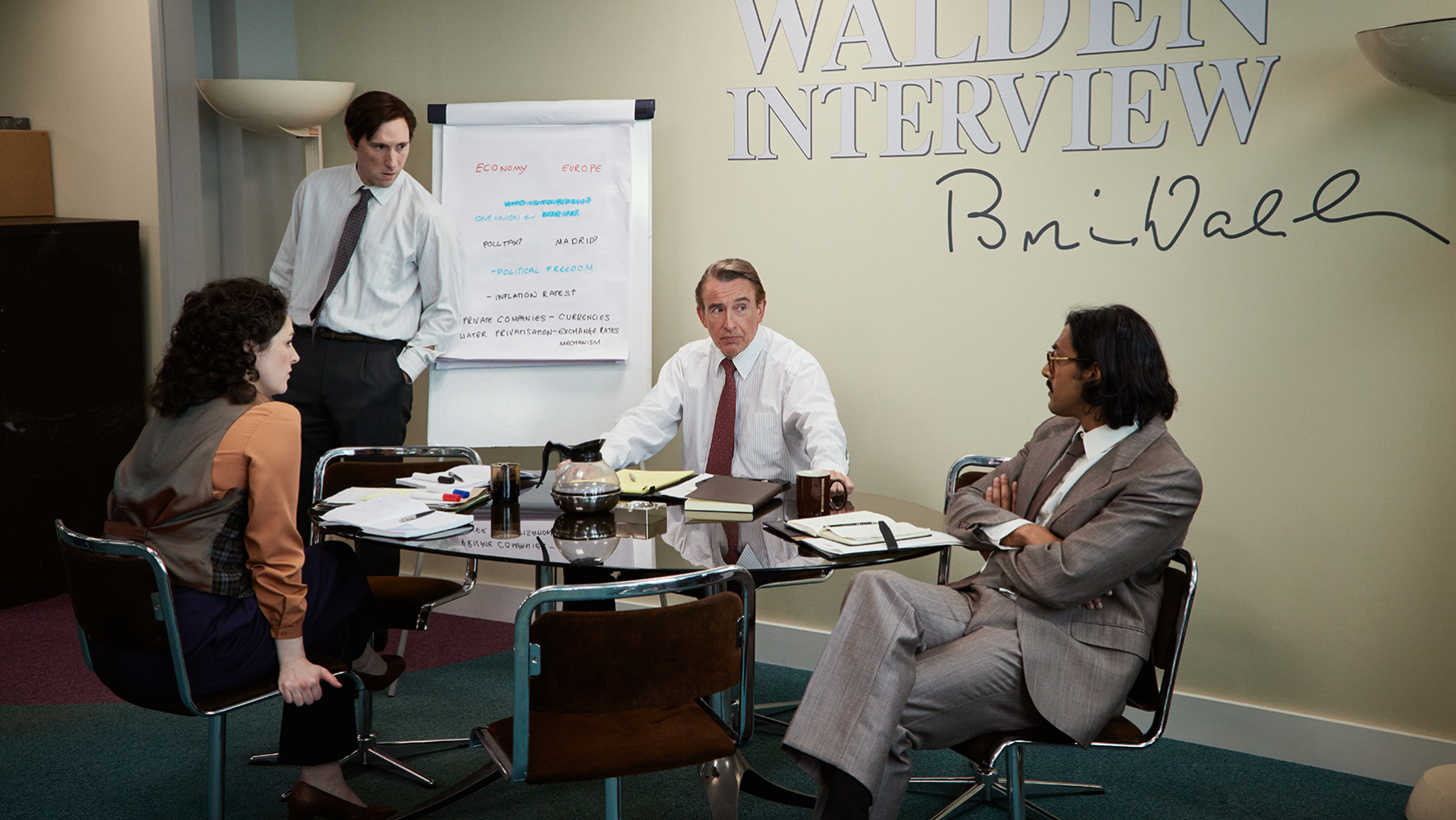
In the meantime, Walden’s former television producers are trying to lure him back; they will even rename the show “The Walden Interview.” The sweetener is that Thatcher has offered an interview – but only if Walden conducts it. He accepts.
Days before the interview, Chancellor of the Exchequer Lawson resigns from Thatcher’s government. Calls begin to emerge from backbench members of parliament for her to step down, as rumors circulate that she’s losing it, “off her trolley.” The rumors aren’t helped by her penchant for taking electric baths in an attempt to retain a youthful appearance.
The producers now want to make the interview focus on Thatcher as a person, her character. They try to coach Walden on the avoidance strategies of politicians, but he’s confident that he can get her to talk. When her aide calls and demands flowers on set, the producers realize that Thatcher is panicking and trying to soften her image. But Brian insists she won’t cancel. The producers know she trusts him.
At a club, Walden and a producer argue over Thatcherism, as her deregulatory economic agenda has become known. Walden defends it for the creation of general affluence – and that’s the same defense Thatcher takes, arguing that greater inequality is worth it if it means that not just the rich but also the poor are wealthier even as the gap between them grows.
Once the producer leaves the club, Thatcher’s aide approaches Walden and asks him for some tips on topics that will be included in the interview. Walden writes “Europe, economy, off her trolley!” on a coaster and leaves.
When the interview begins, Thatcher has her flowers on set. Walden has told his producer that the result of the interview is on her. He will press her on how a consequential partnership imploded; it’s up to her whether she listens and engages.
She doesn’t. She continually tries to move onto another topic as Walden keeps pressing her on why Lawson resigned. He casually throws in the bombshell that Lawson will appear on the show the following week. When asked directly if Lawson would have stayed if she fired Walters, she says, “I don’t know,” a shocking admission from an ever confident politician. He again contrasts her public and private personas.
At the ad break, she excuses herself and tells her aide that the interview is a “betrayal.”
When it resumes, she fights back, accusing Walden of dominating the interview. He continues to hammer her. The producers are shocked at his aggression.
After it’s over, she heads off to a small drink and snack table to politely hobnob with the crew while Walden sits for a minute and cools off. When he joins the gathering, Thatcher immediately leaves.
She and Walden never speak again.
She easily defeats a leadership challenge in the days after the interview, but eventually resigns after a resignation speech against her by Howe in the House of Commons – which now has cameras that allow the public to watch.