New Documentary Explores the Fight to Transform Old Railroad Corridors into Public Trails
Meredith Francis
October 17, 2025
From Rails to Trails airs Monday, October 20 at 9:00 pm on WTTW and streaming on the PBS app.
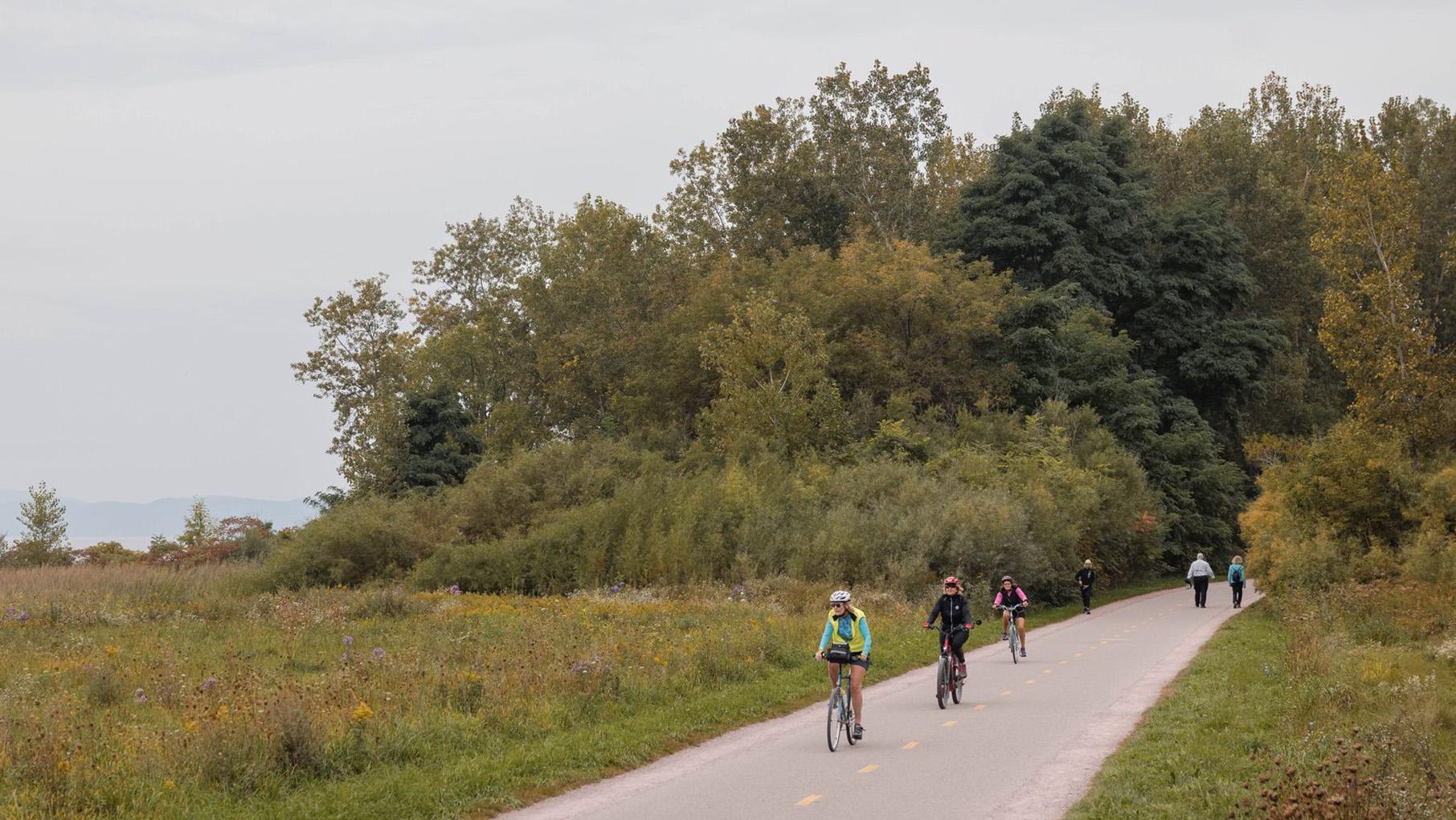
If you’ve ever walked on Chicago’s trail, The Bloomingdale Trail at the 606, you have tread where freight cars once rumbled through the city. The 2.7 miles of that urban trail are just a few of more than 26,000 miles of rail trails in the United States. A new documentary chronicles the at times controversial transformation of former railroad corridors into these multi-use public paths.
From Rails to Trails, narrated by actor Edward Norton and premiering Monday, October 20 at 9:00 pm on WTTW and streaming on the PBS app, explores how a passionate group of activists fought to turn former railways into places now loved by walkers, runners, and cyclists. From the High Line in New York City to the Illinois Prairie Path in the western Chicago suburbs, these trails have been the sites of small-town political battles and U.S. Supreme Court cases alike. WTTW spoke to the film’s director and producer, Dan Protess.
This interview has been edited and condensed for clarity.
Q: What is the rails to trails movement, and how did it begin?
Dan Protess: Rail trails are former railroads that were transformed into trails starting in the 1960s. The documentary traces this entire movement from the earliest days of rail hikers, who were people informally looking for a place to hike and realizing a good way to get away from cars and roads is to hike along these old rail beds. At some point, people realized, maybe we could actually pull up the rails and turn these into trails.
In many ways, the movement started here in Illinois with the Illinois Prairie Path, which was the vision of a naturalist named May Watts. In her time, she was an extremely well-known figure internationally and here in Chicago. She wrote an editorial to the Chicago Tribune saying, “The abandoned CA&E railroad is a proud resource. We need to preserve it, and the time to act is now.” She galvanized people from all over the western suburbs to turn this into a trail, and today it’s the Illinois Prairie Path. Because it crossed many municipalities and counties, there were many forces – as there always are – trying to stop it. In many instances these railroad corridors are valuable real estate and the private property holders along the route are eager to snatch it up before anyone can turn it into a trail.
Q: What made you want to make a documentary about this movement?
Protess: Peter Harnik, who was one of the founders of the Rails to Trails Conservancy and also wrote a book on the history of the movement, approached me with this idea. I had worked with him about 10 years ago. He was an advisor to me on [WTTW’s] 10 Parks that Changed America. I had a look at his book and realized, “Wow this is a super interesting political and social movement.” It had a fair amount of controversy over the decades. Not everyone was necessarily eager to turn these into trails. Pretty consistently, there were forces trying to stop them, and obviously conflict always makes for good television. On a personal level, I live in Bucktown and I’m an avid runner. For many years, I would run on the streets of Bucktown having to dodge traffic and stop every block for intersections. Then 10 years ago they built The 606 and it has been an enormous asset for this neighborhood and just personally has changed my life in a lot of ways. I’m there twice a day. I’m jogging there every day and often there with my family after dinner. So I am a believer in rail trails as a resource.
Q: The film discusses the large, mostly unplanned network of railroads around America emerging from the Industrial Revolution. Can you explain why there are so many abandoned railroads in our country?
Protess: The first part of that is why there were so many railroads to begin with, more than America needed. In many countries, the government came and said, “We need railroads here, here, and here.” In America, we usually believe more in private enterprise. We not only let the railroad barons compete with each other and do what they wanted to do, but the federal government in the U.S. actually gave them, in many instances, the land. There was an incentive to build, and it was more profitable to build railroads than to operate them.
So there were redundancies in the system to begin with. And with the rise of automobiles and trucks, many of them were no longer needed. Europe and Asia have pretty robust passenger and freight railroad systems. In the U.S., we’re pretty enamored with our cars, and so passenger rail service was just not as popular and these rails were often abandoned. It’s important to note that the rail trail advocates, the people who have been working to build rail trails over the decades, they’re almost to a person pro-rail. They’re not forcing railroads out of business so they can build their trails. They’re just using these railroad corridors that have already been abandoned anyway.
Q: What are some of the arguments for and against these trails?
Protess: Rail trail advocates and users just love these long, uninterrupted stretches where they can commute to work or where they exercise without having to deal with automobiles, because railroads were built such that they would not be interrupted by intersections. They’re often above grade or they go under roads. So today, you have these trails that go miles and miles totally uninterrupted by cars.
The argument against it is largely on private property grounds. People who live along these railroad corridors assumed that when the railroad went out of business, the land would be theirs. This has all been litigated in the courts all the way up to the U.S. Supreme Court, which deemed that railbanking – which is the preservation of railroad corridors for future use – is in fact constitutional. I thought it was important to interview the anti-rail trail activists to hear what their concerns are. We live in a pretty polarized country. As journalists and filmmakers, especially on public television, it’s important to hear every side of an issue. So I talked to these rural Missouri farmers, and also this man, Dick Welsh, who’s way out in the country outside Seattle, to hear their perspective. I hope they’re as happy with the documentary as the pro-rail trail advocates because it’s their story as well.
Q: How do these trails change the nature of the communities they go through?
Protess: Interestingly enough, one of the major concerns about these trails coming in is that it's going to be bad for people’s property values and that there's going to be undesirables coming through on the trail. In New York, along the High Line, the real estate interests wanted to demolish what became the High Line because they were concerned that that was going to be bad for real estate values. And, of course, what has turned out to be true, particularly in cities like New York, Chicago, and Atlanta, is that it is a boon to real estate values, and these are incredible assets that people want in their communities, and that real estate developers want in their communities because people gravitate toward the trails and that then it’s good for restaurants and housing values.
The flip side of that, of course, is gentrification and displacement. That has become true in many cities in particular that have built rail trails, particularly starting with the High Line: the people who are already living in the neighborhood are not necessarily the people benefiting from the assets. They just see their taxes go up and real estate values go up and are displaced. Now, there’s been a movement to try to capture that new value to make sure that the people living in the community benefit from the trail. So we showed in Atlanta, as the tax base grows as a result of the trail, they’re putting some of that new growth into building affordable housing.
Q: What do you hope people take away from this film?
Protess: I think there’s a real lesson in community organizing here. We see examples of people who want to build trails. We show in Brownsville, Texas, how the community wants to build a trail and they come to the city council with a wheelbarrow full of petitions. So I think it’s something of a roadmap for social movements. It has inspired me and also given me something of a toolkit that I might be able to use to galvanize my own community.