Kedzie Avenue in Albany Park Becomes a Hub for Middle Eastern-Style Cafes, as Four Open Within a Mile in a Year
Daniel Hautzinger
January 16, 2026
Get more recipes, food news, and stories at wttw.com/food or by signing up for our Deep Dish newsletter.
Have a food story or recommendation? Email us at [email protected].
As coffee behemoth Starbucks closes hundreds of stores, a different type of coffee shop is rapidly expanding: Middle Eastern-style cafes. Along one mile-long stretch of Kedzie Avenue in Albany Park and North Park, near a Starbucks that closed in September, four separate Middle Eastern coffee shops have opened in the past year, offering light-roasted coffees brewed with spices, desserts featuring nuts and honey, strong teas, and, of course, colorful, social media-ready lattes and refreshers.
Two of the new cafes are the first Chicago outposts of quickly growing Yemeni coffee chains with their roots in the Middle Eastern enclave of Dearborn, Michigan, outside Detroit. Qamaria first came to the Chicago area with a shop in the southwest suburb of Chicago Ridge, near Bridgeview, a locus of the Arabic community in Chicago. Qamaria now has locations in Bridgeview, Aurora, Lombard, and most recently, in a strip mall at 4728 N. Kedzie Ave. in Albany Park, amidst a number of Middle Eastern businesses. Shibam’s beachhead in the Chicago area was Glendale Heights; it has now also entered the city in a strip mall at 5241 N. Kedzie Ave.
It’s likely that coffee beans were roasted, brewed, and drunk for the first time in Yemen in the 15th century; the word “coffee” derives from the Arabic “qahwa,” while “mocha” comes from the Yemeni port of Mokha. The country still grows coffee beans high in the mountains, letting the fruit dry in the sun. Yemenis keep the skin of the bean after drying, mixing it with spices like ginger, cinnamon, and cardamom for the beverage qishr or cascara, which falls between coffee and tea, and is available at both Shibam and Qamaria.
Both shops also incorporate spices into some of the more familiar coffee brewed from the interior of the bean, as well as some of their tea blends. Yemeni coffee tends to be light roasted for bright, fruity notes, instead of the more bitter, robust flavors of the dark roast many Americans are used to. “We don’t dark roast. Back home, that’s almost like saying, ‘I want my meat super well-done,’” Hatem Al-Eidaroos, the co-founder of Qamaria, told WTTW in 2023.
They also offer a few Yemeni pastries, such as a bready honeycomb drizzled with honey, syrup-soaked cakes, and treats featuring pistachios, in addition to cheesecakes and other more Western desserts. At Shibam, ranks of pre-packaged, trendy Dubai chocolate are available to purchase.
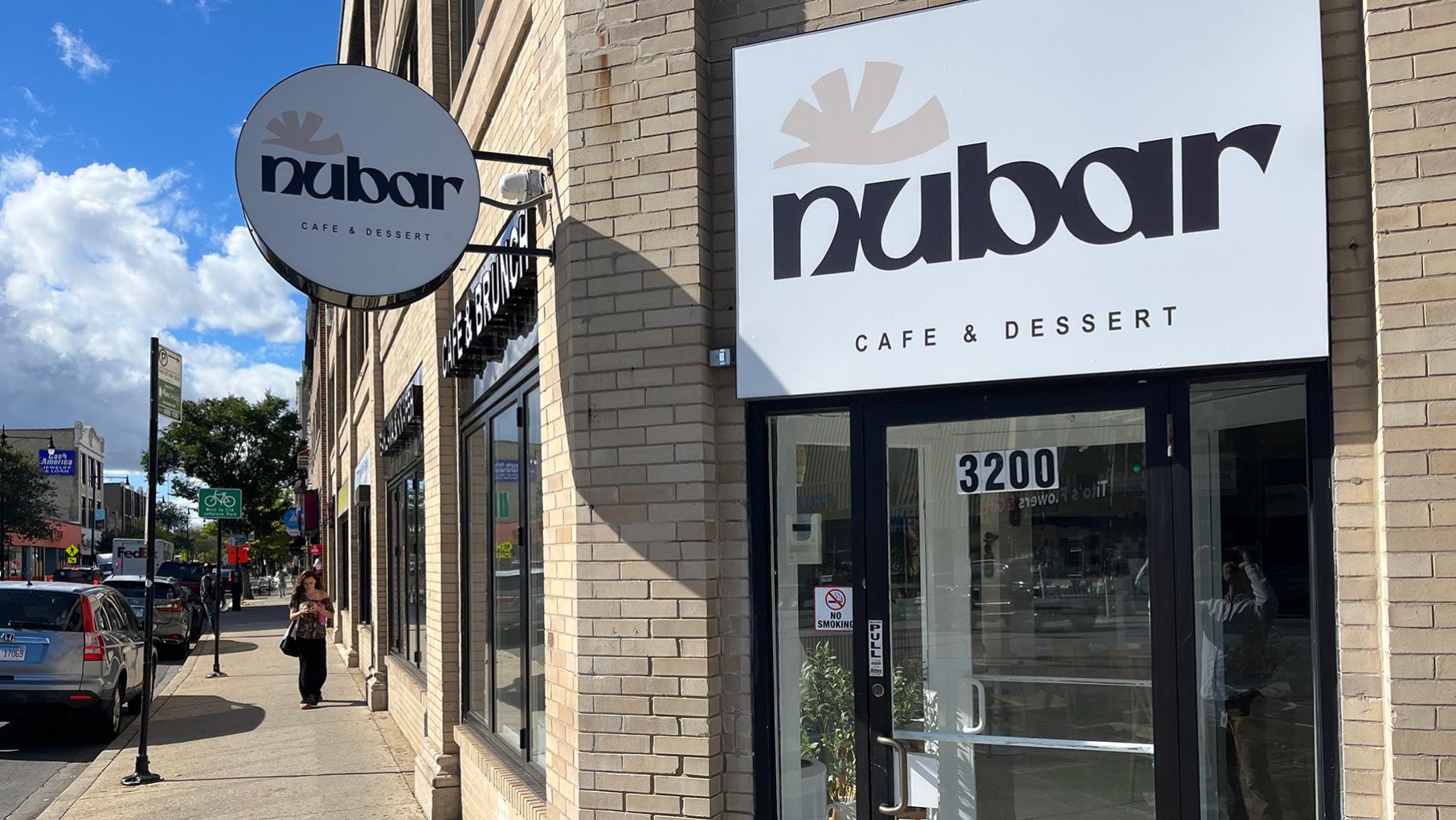
At Nubar (on the corner of Kedzie at 3200 W. Lawrence Ave.), there’s even a Dubai chocolate latte. Opened last year, the Kurdish cafe has a number of such zeitgeisty coffee drinks, while also offering rich and thick Kurdish and Turkish coffee. It has a full food menu in addition to pastries and drinks, with Middle Eastern mezze such as hummus, muhammara, and falafel, plus sandwiches, wraps and shakshuka.
Nubar shares a breezy, Mediterranean look with the Yemeni coffee shops, with basket lights, light woods, ersatz marble counters, and antique touches like amphorae or walls painted to look like peeling plaster common elements.
Uri Cafe, opened last year in a strip mall at 4640 N. Kedzie Ave., adds some blue pops to this aesthetic – and cases full of baklava. It, too, has photogenic lattes primed for influencers, in addition to more traditionally minded Turkish coffee.
One notable element of these shops, with the exception of Nubar, is their hours: Uri and Shibam close at 10:00 pm every night, while Qamaria is open until midnight. The cafes offer a post-dinner social gathering space that is not associated with alcohol, an important aspect for many of the Muslim communities they serve. They take the place of bars; expect to find them especially packed after the sun goes down and the fast is broken during the holy month of Ramadan, which begins in February this year.