A Fine-Dining Chef with a Bygone Pandemic Pop-Up Returns to the Game with Exclusive Japanese-Inspired Yakitori Meals
Daniel Hautzinger
February 25, 2025
Get more recipes, food news, and stories at wttw.com/food or by signing up for our Deep Dish newsletter.
Have a food story or recommendation? Email us at [email protected].
It might be the most exclusive menu in Chicago right now: 16 diners a night, only two nights a week. But the new yakitori offering called CATSU isn’t rarefied or snobby; one diner recounted on Reddit that their server ran to the liquor store in the middle of the meal to buy the guest beer. (CATSU is currently BYOB.)
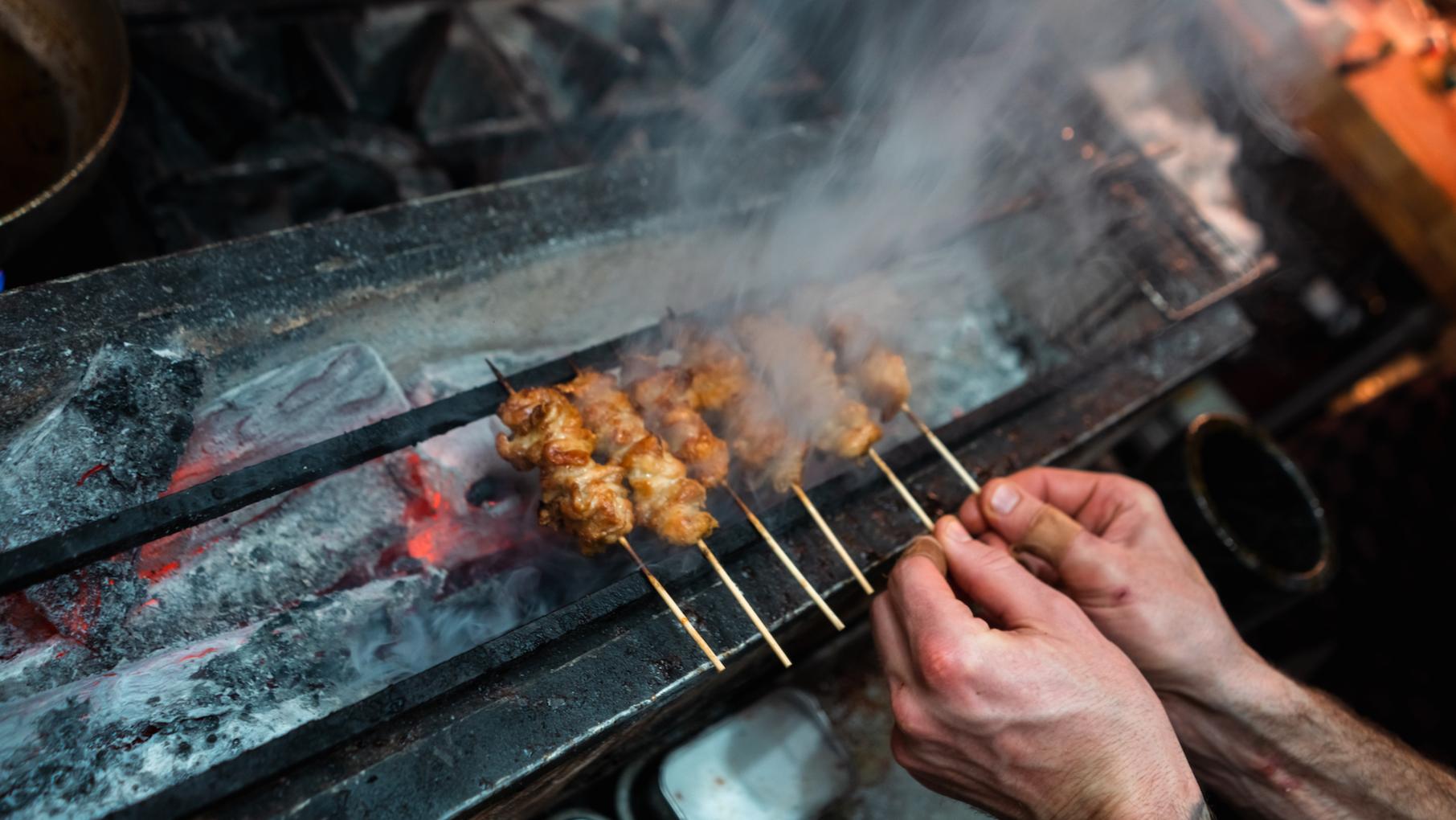
CATSU is about “appreciating simplicity,” says Shawn Clendening, the chef behind the venture, which serves a set menu of around 16 grilled skewers out of Flour Power at 1642 W. Chicago Ave. in West Town on Saturday and Sunday nights. (Reservations currently go live each week on Monday.) Yakitori is a style of Japanese cooking in which chicken – everything from common cuts to organs – is dipped in a tare sauce and grilled on a skewer over blistering hot charcoal. At its most refined, that’s it.
In Japan, tiny establishments called yakitoriya only serve yakitori, and chefs devote a lifetime to mastering it. Each has their own unique tare, which generally consists of soy sauce or shoyu, sugar or another sweetener, and sake or mirin. (Clendening doesn’t use sake in his.) Different cuts – tenderloin, skin, neck, heart, oyster, thigh plus scallion – are dipped in the tare before, during, and after the grilling process, depending on a chef’s discretion. The grilling itself occurs on skewers over a fire of dense, high-grade binchotan oak charcoal that burns extraordinarily hot.
Clendening can't use the highest quality binchotan that is used in Japan – it's illegal to export it. He notes that he is inspired by Japanese food, but "I can't really call it Japanese;" rather, CATSU is "heavily congruent to it."
CATSU is a yakitori omakase, meaning a chef’s choice set menu, with a few alternative options available. Think of it like the sushi omakase spots that have recently proliferated in Chicago, where a chef behind a counter meticulously prepares raw fish and rice and passes it to a small number of customers an individual piece at a time. Instead of nigiri, you get grilled skewers.
Clendening is leaving some room for exploration by doing kappo-style yakitori with CATSU, in which not every skewer has chicken – for instance tightly rolled blanched and marinated mustard greens blackened by the charcoal. He also garnishes most of the skewers, for example with cured egg yolk, a coconut-fish sauce caramel, or a spice blend. “It’s super in flux. It started as yakitori; it’s probably always going to have chicken,” he says. “But the more I do this, the more I want to incorporate all those odd vegetable ideas that we had.”
“We” refers to Clendening and Will Schlaeger, who together launched Cat-Su Sando during the height of the pandemic in 2020 to serve playful Japanese-inspired sandwiches and other treats, including grilled skewers. It operated as a ghost kitchen before a stint in a brick and mortar location in Humboldt Park. Some time after closing Cat-Su Sando, Clendening left the restaurant business to work as a recording engineer with musicians, work that he still does.
But he eventually decided to return to the food world to have another flexible source of income and creative output; hence operating out of an existing daytime restaurant while it’s closed, only two nights a week. “After being away from this for a while, I realized that this is the only kind of cooking I really still enjoy, and feel like I can have a philosophy and a stance on,” he says.
Part of that philosophy is limiting waste, which yakitori does well, given that it traditionally uses almost all parts of the chicken. Since CATSU only launched a month ago, Clendening is still in early stages, but he wants to offer more organs and off-cuts, using up every bit of an animal and buying parts from farmers that they typically have a hard time selling. (Meat processors typically separate out organs and other off-cuts, even for farmers who sell them.) “A restaurant just creates problems and waste at the end of the day,” Clendening says. “Looking to reduce both is something I’m a big fan of.”
He’s trying to source as much as possible locally, and wants to eventually make his own misos and shoyus, including from the byproducts of other ingredients – both miso and shoyu harness fermentation and so can transform products that might not otherwise show up on a menu. But that will require expanding his team, which currently consists only of himself and one other person.
That doesn’t mean hospitality is lacking in a CATSU meal, however: recall that beer run for the Reddit diner. Clendening has worked in the upper echelons of fine dining, at Blackbird, Oriole, and Smyth, and he wants to bring the experience of dining at such places to a more casual, simplified format. “I’m trying to replicate more of the experience as opposed to the food,” he says. “I want you to feel that comfortable and that taken care of.”