Grant Achatz Pays Tribute to Another Legendary Chef, and Reflects on the Future and His Own Legacy
Maggie Hennessy
July 11, 2025
Get more recipes, food news, and stories at wttw.com/food or by signing up for our Deep Dish newsletter.
Have a food story or recommendation? Email us at [email protected].
One of the most famous dishes Italian modernist chef Massimo Bottura ever created at his three-Michelin-starred restaurant Osteria Francescana in Modena, Italy, is called “Five Ages of Parmigiano in Different Textures and Temperatures.” The dish not only put the Emilia-Romagna region and its gregarious culinary ambassador on the map, it was pivotal to evolving how we think about fine-dining ingredients and dish composition in the modern era.
So, naturally, when chef Grant Achatz began envisioning a Massimo Bottura tribute menu as the summer theme at Next, his shapeshifting, Michelin-starred tasting menu restaurant, Five Ages of Parm counted among the 10 iconic courses he planned to replicate exactly as patrons would have experienced it at Osteria Francescana, which opened in 1995.
But Bottura, who is also Achatz’s friend of 20 years, had other ideas when the two got on Zoom.
“He was like, ‘I want you to take that philosophy we have with Parmigiano and recreate it in your own way, retranslate it into the American Midwest,’” Achatz says. In other words, in order to best honor Bottura’s evolving legacy, the Next team should instead take up his steadfast ethos of locality and breathe Midwestern life into it.
“I want two fingerprints on every dish,” Bottura told his friend. “Mine and yours.”
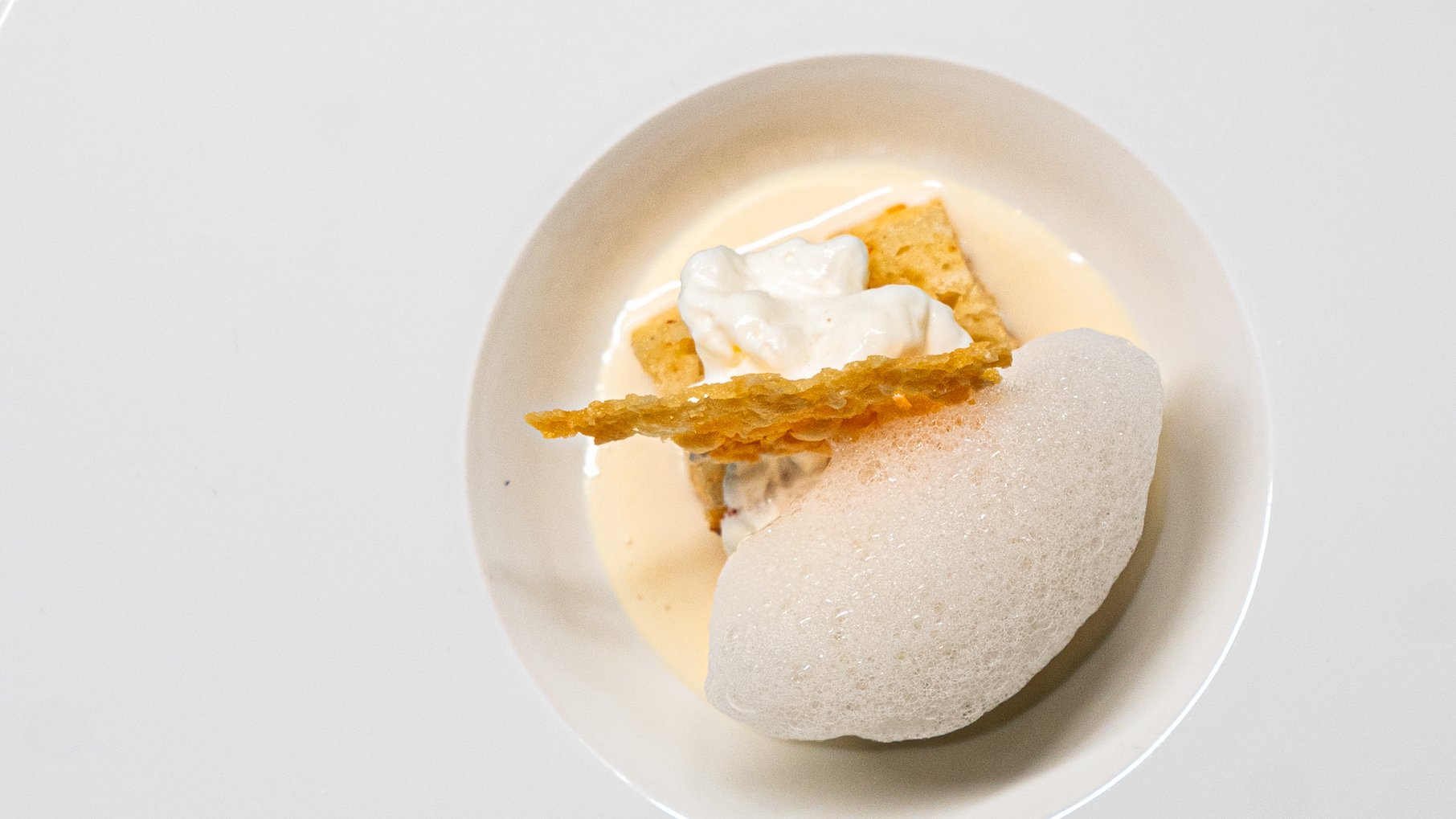
Suddenly, Achatz found himself back in his own proverbial backyard – well, close, in Wisconsin, reaching for the ageable Parmesan of the Midwest: farmhouse Cheddar. As Bottura had playfully highlighted the various stages of Parm’s slow aging process through manipulation (30-month as demi-soufflé, 40-month as crispy biscuit), Achatz, too, would let Cheddar’s characteristics at different stages – from creamy 2-year edged in sharpness to crumbly 7-year with its tangy bite and crunchy salt crystals – tell him which form they should take, be it a chip (3 years), cheese sauce (6 years) or foam (7 years).
This exercise proved a blueprint for the rest of the menu, which reimagines some of Osteria Francescana’s most famous dishes through a local lens, smudged with a whimsical Next fingerprint or two. It’s available through the end of August and starts at $225 per person.
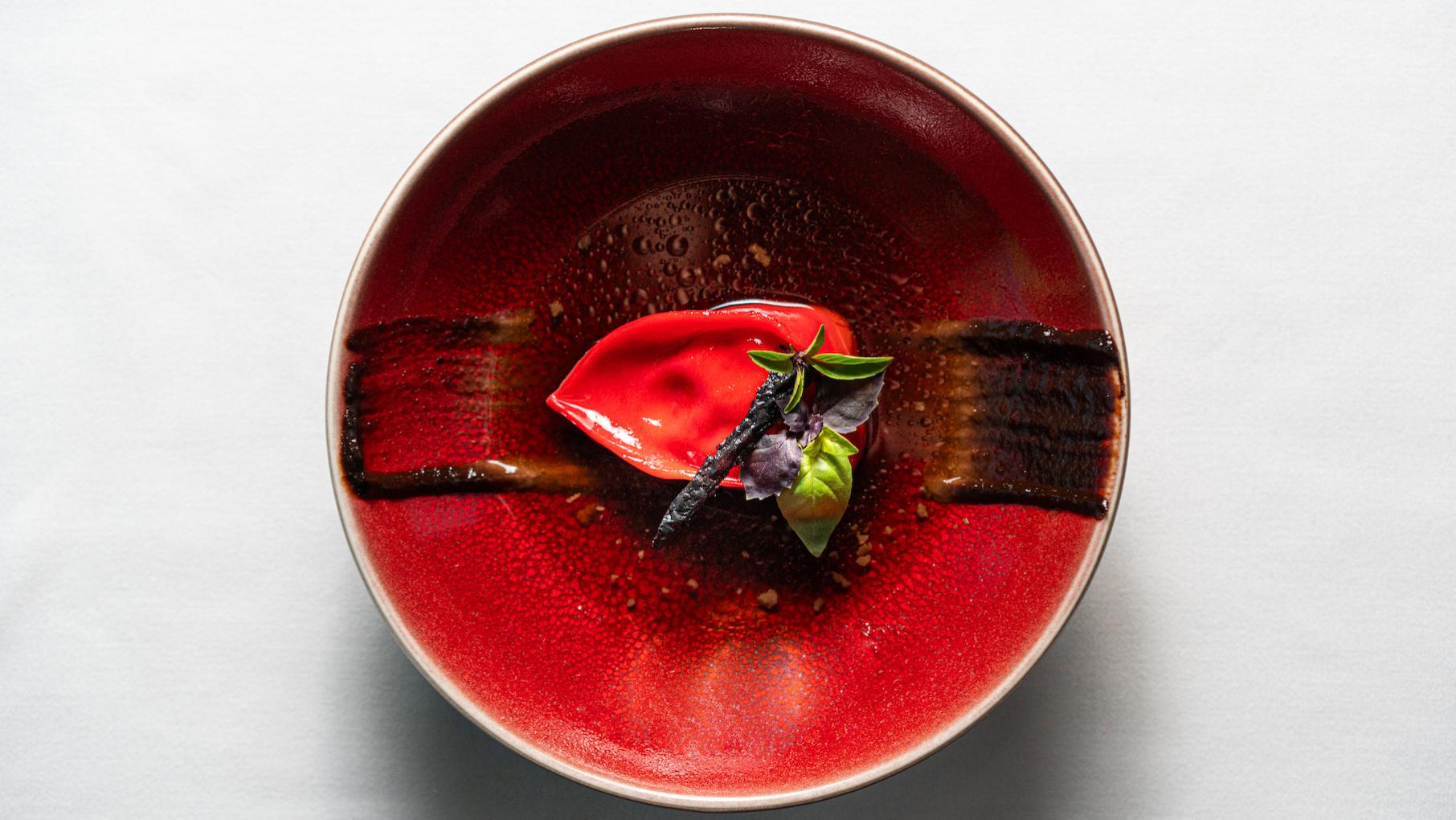
Green Goddess Unveiled appears as a humble bouquet of petite lettuces until one starts to giddily excavate dressing, white asparagus, capers, and wispy egg yolk bottarga shavings, “like a child unwrapping a present’,” Achatz says. A Chicago-style oyster, comprising dry-aged beef tartare, oyster bavarois (custard), celery leaf, and giardiniera, puts a Windy City spin on Bottura’s Normandy Oyster, a memory brought to life as raw cured salt-marsh lamb tartare seasoned with oyster water and cider. Tortelloni Drowning in Broth, which turns Bottura’s Tortellini Walking on Broth on its head in a manner as if conceived by Bottura himself, might be Achatz’s favorite. Rather than suspending delicate tortellini atop gelatin-infused broth, Next’s version submerges a fat tortelloni stuffed with prosciutto, chicken, and pine nuts in onion and allspice consommé. Instead of packing the pasta with crimson filling as Bottura did, Achatz stains the dough itself brilliant red.
“It’s a lot of opposites,” Achatz says. “When that story is told at the table, and the guest really understands what happened, and the trust afforded to us by Massimo to make it our own and have fun with it, it makes them laugh when they hear that. That to me, his smile, is that dish. It evokes that joy that’s literally laugh out loud.”
Achatz and the Next team are no strangers to the tribute menu, having homaged the work of stratospheric chefs like Thomas Keller, Ferran Adrià, Heston Blumenthal, and, most recently, Charlie Trotter. In those instances, Next worked more like a restorer of iconic artworks, painstakingly reconstructing samples of each chef’s personal IP in order to transport diners in Chicago to the early days of spherification at Adrià’s bygone elBulli in Catalonia, Spain or to quaint Bray, U.K., for Blumenthal’s mind-bending culinary theater. It’s a tall order that demands a lot of trust.
“You have to take that trust seriously,” Achatz says. “If we are going to do another chef’s food, we have to nail it.”
It’s hard not to think of Next’s current menu, almost the 50th since the restaurant opened in 2011, within the hallowed context of legacies – and not just because Osteria Francescana turns 30 this year. Achatz’s own flagship restaurant, Alinea, is also turning 20. He’s preparing to take it on tour with a series of pop-ups in Beverly Hills, California; Miami; and Brooklyn, N.Y. This year also saw his newest project, the live-fire restaurant Fire, fizzle after less than a year, owing to soaring rents and not enough tables.
“[Planning this tour], coupled with reflecting on the 20th and all the people who’ve been part of it, it’s heavy,” Achatz says. “You can’t slow time down.”
There’s also the weight of this moment of immense change in the hospitality and culinary arts industries, amid the rise of new technologies like artificial intelligence and restaurant workers’ changing relationships to their careers. In a recent New York Times story by journalist and longtime restaurant critic Pete Wells, Achatz disclosed that one of Next’s 2026 menus will be almost entirely built by generative AI. Then again, from a chef who has long called Google his favorite cooking tool, it’s perhaps unsurprising that he’s embraced AI as an implement for creative inspiration.
What’s more, he told Wells that the tool’s innate eagerness to answer every prompt, or bat around geeky ideas into the wee hours may go so far as to occasionally fill a void left by today’s young sous chef cohort. “That dialogue is something that simply does not exist anymore and is the lifeblood of progress,” Achatz said.
Gone (mostly) are the 16-hour shifts so common when Alinea first opened, when cooks would linger long after finishing cleanup and prep lists to exchange the sorts of fantastical ideas that churn the gears of creative progress. Most would rather go home to their significant others, pets, families, and hobbies – to their full lives outside the four walls of the restaurant that 20 or 25 years ago didn’t (or couldn’t?) matter.
“I recognize that the world has changed,” Achatz tells me. “I think it’s a positive thing. I don't wanna be a dinosaur. I feel different now, frankly.”
So who should a fine-dining chef faced with the pressure of constant evolution bounce ideas off of instead? Why not a thirtysomething, time-traveling AI-generated chef named “Jill” who’s worked for the long-dead father of modern cuisine, Auguste Escoffier, the exacting sushi master Jiro Ono and the modernist Adrià – and who will create one of the dishes for the Next AI menu?
Of course, researchers have given us plenty of reasons to abstain from AI, chief among them the staggering, collective environmental impact as usage grows, the platform’s tendency to confidently deliver error-riddled replies, and ChatGPT’s potential harm to critical thinking skills, particularly in developing brains.
“On one side of the coin, I agree with everybody who’s concerned,” Achatz says. “And I think there really should be certain areas that are regulated. On social media now, you can barely tell what’s real.”
But as a creative tool? That’s another story, similar to many we’ve read before, he says.
“Thirty years ago, what would you have done instead? Gone to Barnes and Noble and picked up a cookbook, and looked at those photos and recipes and read that chef’s philosophies and you would have been influenced,” he says. “I understand the fear. There was fear of automobiles, television, the internet, Amazon, Instacart, Uber; there’s fear about the unknown and the new. Do we have to keep an eye on it? Yeah. If used correctly, it can be a powerful, positive tool.”
For a few months more at least, Achatz will bask in channeling the kinetic energy and infectious joy of his flesh-and-blood friend, whose locavore challenge breathed life into the tribute menu as none yet has at Next. All that remains is for Bottura to come and try it.