
'Brian and Maggie' Recap: Episode 1
Daniel Hautzinger
October 5, 2025
Brian and Maggie airs Sundays at 7:00 pm and is available to stream. Recap the following episode.
Keep up with your favorite dramas and mysteries by signing up for our newsletter, Dramalogue.
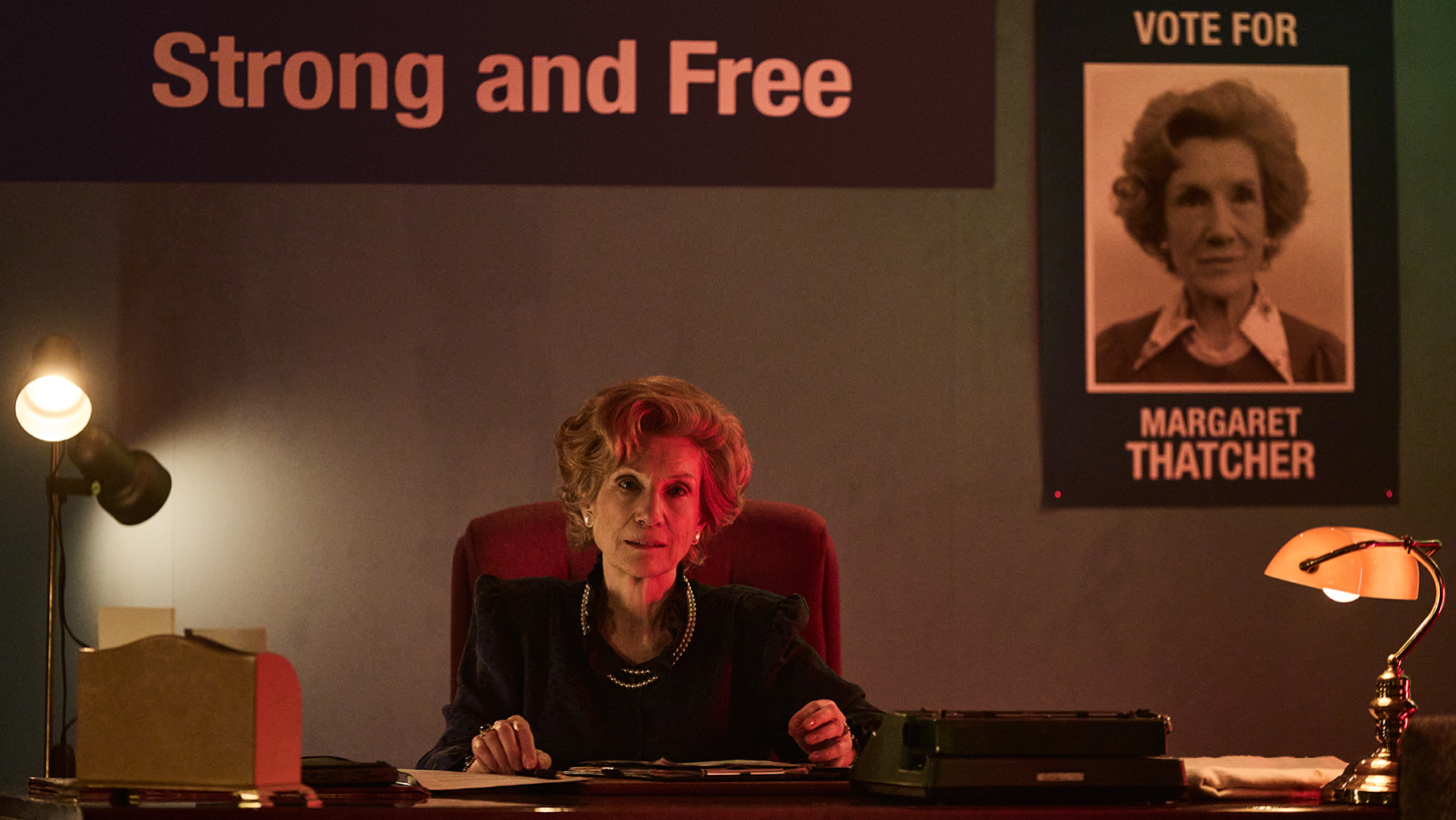
Thirty-one years after the first British political interview aired on television, Margaret Thatcher prepares for a live interview with Brian Walden. She has often been interviewed by Walden, whom she considers a friend and her favorite interviewer. But in 1989, the government she heads as Prime Minister is wobbling after the resignation of her Chancellor of the Exchequer Nigel Lawson. She hopes Walden won’t dwell much on such drama. But, when the interview gets underway, she takes his grilling as a betrayal.
Walden’s first interview as a TV journalist was with Thatcher. He was a member of Parliament for the governing Labour Party and at one point was considered a future party leader, but became unhappy with its leftward drift, while she was leader of the opposition Conservatives. Producers from London Weekend Television’s interview program had scouted Walden and convinced him to give up his political seat and become a journalist, since he is a commoner with an accent that will resonate with their popular audiences.
For his first interview, Walden suggests Thatcher. Some people think she’s a bit empty, but he wants to use his “long-form forensic interview to help facilitate mass comprehension,” as a producer calls the program, to get at her substance, despite the skepticism of some of the more liberal producers. They’re not happy when he lets Thatcher pontificate on individualism without significant challenges, but Walden is conciliatory by nature and has recognized a kindred life story in Thatcher, who is also a Midlander who went to Oxford on a scholarship.
Thatcher likes the interview.
Two years later, in 1979, she becomes Prime Minister – the first democratically elected woman leader of a Western country.
She invites Walden to interview her at the Prime Minister’s residence of 10 Downing Street in 1980, and is now a media pro, familiar with the lingo and conscious of her appearance. He is slightly more confrontational, and likes that she answers questions directly – but his producers still urge him to prosecute her more. So he asks them to teach him how. They begin mapping out the possible directions an interview could go, and he memorizes the plans: if someone answers this, ask that.
In 1981, he again interviews her and is pleased with identifying “Victorian values” in her ethos. His producers think she will start using the phrase herself, positively. She asks him for a drink afterward, and he accepts without telling his producers. The pair once again bond over meritocracy – they both worked hard to be where they are, unlike some of those elites with connections. She especially has had to overcome the constant hurdles impeding her as a woman.
After their convivial night, Walden pens a newspaper column praising Thatcher.
Two years later, she’s riding high from a demonstration of her popularity at a rally of young conservatives during a general election and fires her old speechwriter, wanting to give a more fiery oration the next day. She suggests Walden as a replacement, to the shock of her aide, and summons him in the middle of the night – when he can’t bother his producers to ask if he’s violating journalistic ethics.
She tells him that she polls as strong and capable but not likable; he tells her that he likes her. She thanks him for taking her seriously before anyone else did.
As they write her speech, he urges her not to compromise. In the morning, after he has returned home, she calls to share a joke that she was trying to remember earlier.
She wins the election in a landslide. Walden’s producers decide that they must push back even harder against her, now that she is in a stronger position.
Thatcher embarks on an agenda of privatization, having brought the United Kingdom out of a recession, and appoints Nigel Lawson as her Chancellor of the Exchequer – although he needs to cut his “unkempt” hair first.
She now worries that she has shown too much of herself to Walden. When he calls, she foists answering off onto an aide.