“Someone is Deliberately Killing Your Hometown Paper”: New Documentary Examines the Decline of Local Newspapers, Including the Chicago Tribune
Meredith Francis
October 9, 2025
Stripped for Parts: Journalism on the Brink premieres on Sunday, October 12 at 4:00 pm on WTTW and is available to stream.
For the past couple of decades, local newspapers have been fighting to survive in a changing media landscape. There is, of course, the rise of the internet and social media, which have drained ad revenue and diverted the attention of audiences everywhere. But as a new documentary highlights, there is another force at work: powerful hedge funds that profit by purchasing struggling papers, selling off their assets, and gutting their newsrooms.
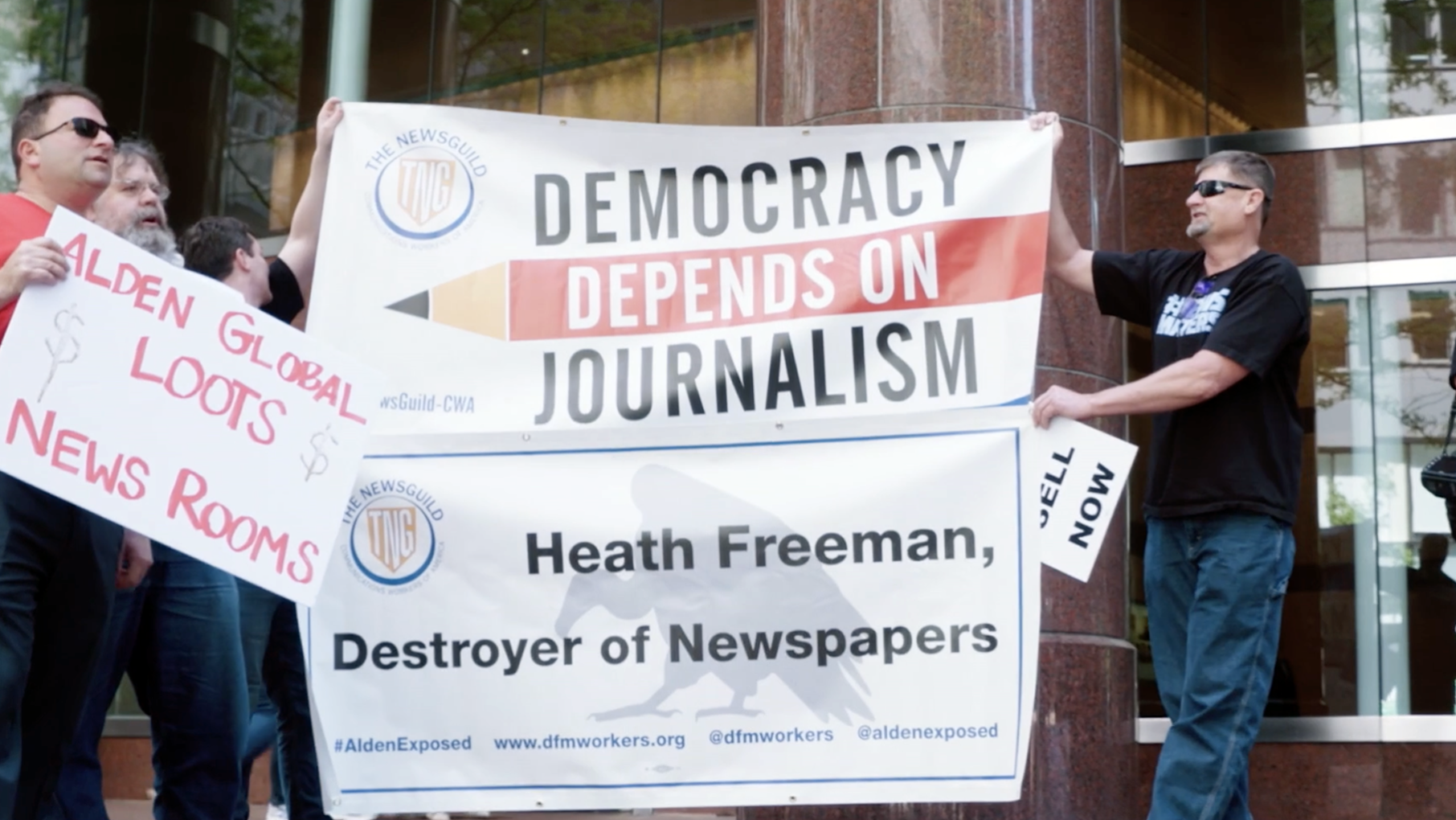
Stripped for Parts: American Journalism on the Brink explores the human and civic toll of this trend through the stories of the journalists fighting back. As one journalist laments, “Someone is deliberately killing your hometown paper.” The documentary includes interviews with some of the journalists who have investigated – and fought back against – one particular hedge fund called Alden Global Capital after it bought their own local papers. One of the affected papers that the film highlights is the Chicago Tribune, whose parent company, Tribune Publishing, was bought by Alden Global Capital in 2021. According to February 2024 figures from The News Guild, the Tribune staff was down "from 111 to 76 since June 2021." Again in July 2025, another 8 newsroom employees were laid off, per the Chicago Sun-Times. WTTW spoke to Rick Goldsmith, director and producer of the film.
This interview has been edited and condensed for clarity.
Q: How did this documentary come about, and why did you want to tell this story now?
Goldsmith: Back in 2018 when I first started making the film, I still subscribed to two newspapers, the New York Times and my local San Francisco Chronicle. I had noticed the Chronicle was getting thinner and thinner every month or every year. I was aware that journalism was at the crossroads and not doing too well. But what I didn’t know was this phenomenon of private equity hedge funds and how much hedge fund owners were taking advantage of a dying industry just to make money. The twin goals of your traditional newspaper publisher – which was make money and serve the community – those were reduced to one goal, which was make a lot of money.
How I became aware of the story was actually a discussion with [the late journalist] Bill Moyers. In the spring of 2018, I get an email from Bill, and he says, “I’m reading this article with the headline with something like, ‘Alden Global Capital is making so much money wrecking local journalism. It may not stop any time soon.’” So it became known that these hedge funds were destroying the industry in a way that other challenges, like the internet and all those other things – they were damaging, but this was at a different level.
Q: When people talk about the decline of local papers, they talk about how they couldn’t keep up with the internet or social media and couldn’t figure out how to monetize their work on those platforms. But this documentary challenges that notion with its discussion of Alden Global Capital. What is Alden Global Capital, and what do they do?
Goldsmith: Alden Global Capital is a hedge fund that was started by a man named Randall Smith. And he was known as the kind of father of “vulture capitalism” – that’s a Wall Street term. Smith gravitated towards the world of bankruptcies and failing businesses. And his genius was something called distressed asset investing. And what that meant was you go into a company or an industry, and you look for the weak spot.
It’s a three-step process. In the case of newspapers, number one, you buy up the distressed company (maybe they’ve filed for bankruptcy). Number two, you go for the assets that you can sell off. For newspapers, the main asset is the newsroom. If you look at the Chicago Tribune, think of Tribune Tower. That’s a landmark in Chicago. In its heyday, it probably had hundreds of people working in its newsroom. Another asset could be the printing press. So you sell off those big assets. Number three: You increase revenue, and decrease expenses. So they’ve already increased their revenue by selling off the newsroom. And then they cut the staff.
Heath Freeman – who is Randall Smith’s partner at Alden Global Capital – he famously walked into a newsroom and he said, “What do all these people do?” He was saying, “Why do we need so many people to do these things? Let’s cut a bunch of them.”
Q: What are some of the implications for communities – big and small – when their local newspaper is diminished?
Goldsmith: What happens to papers that are taken over is that they’re just not as good. They get rid of staff and they offer buyouts rather than laying off people. So who takes the buyouts? Senior staff. You’re starting to lose the institutional knowledge of your newsroom. You have young people just coming out of journalism school who are really raring to go, but didn’t know where the bodies were buried, so to speak. Morale goes down. The reporters are just dragging themselves to work, and a lot of them are constantly asking themselves, do I stay or do I go?
They just can’t cover as much because of the reduced numbers. You can’t cover the city or country as well. One [Bay Area News Group reporter] you see in the film, he was covering Contra Costa County courts all by himself. Two years later, he was covering Contra Costa County and Alameda County all by himself. It’s ridiculous at a certain point. You have too few reporters covering too big an area.
So what happens when you don’t have a newspaper? As [journalist] Penny Abernathy says in the film, corruption goes up, and voter participation goes down because it’s easier, for example, for corporations to pollute streams. Bad things happen to the community without watchdog journalism.
Q: Some of the journalists you interview discuss the importance of newspapers to democracy, pointing to the founding fathers’ emphasis on freedom of the press. Why do journalists feel that their work is necessary for democracy?
Goldsmith: Well, they’re not just bragging. When it comes to local journalism, if you have an off-year election, those turnout numbers are very depressed. And if you don’t have coverage in your daily newspaper – to say, who’s running, there are three state initiatives on the ballot, what does one side say or the other – people stay home.
Let’s go back to the founding fathers. They were experimenting with this new thing: a democratic republic. Nobody knew what the hell that meant. They built in, in the Postal Act of 1792, the biggest outlay of federal money, and what was it about? It was to build post roads so horses and buggies could go from town to town. And why do they have to go from town to town? To deliver the papers. The postal rate remained close to zero for the newspapers. It was so important among these people – like Jefferson, Madison, and Franklin – to say we need an informed populace. We need to have the breadth of not only facts and information, but opinions.
Now let’s flash forward in 2025. We finished this film in 2023. So we didn’t foresee the current administration. But now, on top of all the kind of business model challenges that news organizations have, you have an active attack on the press in front of our eyes. It has to be all hands on deck now, not only among the journalists themselves who are doing their best to sound the alarm, but among all of us to stand up. Journalism is a really, really important public service. Especially watchdog journalism.
Q: Do you have hope for the future of local journalism? How do you envision future journalists handling these changes in the industry?
Goldsmith: I do have hope. I've toured with the film and I’ve probably been in 60 or 70 different screenings all over the country. I speak to audiences both older and younger. A lot of journalism schools and a lot of young people in journalism. And my hope is this: Why would I be invited to go to this many screenings of the film? Because they’re concerned about their local journalism.
They’re trying to figure it out. And in every city, town that I go to, there’s some new twist – usually some sort of digital startup. There’s a news organization that's specifically geared towards the state legislature, or ones strictly covering education or climate change. They are trying to figure out the business model that works in their community, which is different from one city to another.
What I find is that young people know how their peers get the news about the world. They are already starting to figure it out. They will figure out how to make this a public service in a way that people in my generation can’t even begin to imagine as that baton starts to get handed off.