Czech It Out: Bohemian Food in Chicago
David Hammond
November 21, 2025
Get more recipes, food news, and stories at wttw.com/food or by signing up for our Deep Dish newsletter.
Have a food story or recommendation? Email us at [email protected].
Anna’s biceps were roughly the circumference of my eight-year-old waist, and when she hoisted massive plates of hearty Czech food onto the family Christmas table, those biceps flexed to the size of regulation Chicago softballs. Anna lived in Berwyn, and it was at her bungalow that a much younger me had my first taste of what was then called “Bohemian” food.
In those days, Berwyn was Prague-on-the-Plains, full of Bohemian restaurants that smelled like history and rendered pork fat. Berwyn’s Bohemian restaurants included Old Prague, which featured a wall-sized, backlit cityscape of the Czech capital with windows illuminated by tiny twinkling lights, and Klas, a multi-story restaurant with seating for hundreds. When I first moved to the area, I became a regular at both restaurants, because even in the 1990s, you could have a dinner of salad, soup, entrée, and dessert for around ten dollars. Bohemians were once stereotyped as being passionately thrifty;at Old Prague and Klas, many of us were there to squeeze a dollar from a dime, and eat until bursting.
The Chicago area has been home to one of the largest diasporas of Czech citizens outside of central Europe, who granted names like “Pilsen” to areas in which they lived and incubated powerful politicians. Wherever immigrants settle, restaurants spring up to serve those newcomers the food of their homeland. At Anna’s house and nearby restaurants like Old Prague and Klas, I got to know Czech specialties – and the dumplings that often accompany them.
For most Czech dishes, dumplings aren’t just a side – they’re the foundation. “It’s for the memory,” says Milada Chlubnová, owner of Café Prague (6710 W. Belmont). Born in Náchod, Czech Republic, Chlubnová insists dumplings are more than just a starch. “They remind you,” she said, “of your traditions back home.

Bread dumplings (houskové knedlíky) are genius additions to gravy-laden Czech dishes. These soft dumplings – made of just flour, yeast, milk, eggs, and stale bread – are shaped into a roll, then boiled or steamed and cut into highly absorbent slices. The moist, spongy dumplings are just about ideal for sopping up gravy, which may be why, as Chlubnová said, “bread dumplings are the most popular.”
Karlovarský, or Carlsbad, dumplings look like edible mosaics, their interiors speckled with cubes of bread; potato dumplings (bramborové knedlíky) bring a different heft and somewhat denser texture. The dumpling, it turns out, isn’t a sidekick – it’s the backbone of the meal.
For years, whenever we’d eat at Old Prague or Klas, I’d usually order svíčková, the national dish of the Czech Republic, and the one Chlubnová believes is “most representative of the Czech culinary tradition.” Having recently traveled in Central Europe, I can confirm that Czechs eat a LOT of meat; svíčková is marinated sirloin slices in a smooth cream sauce of root vegetables like carrot and celery. Svíčková is sometimes served with cranberry sauce, a slice of lemon and, unexpectedly, whipped cream. A sour-sweet element isn’t unusual in savory Czech dishes.
Koprová is a cousin of svíčková consisting of sliced beef roast with a savory sauce of diced dill pickles, served with bread dumplings or even rice, a grain that doesn’t often appear on Czech menus. The dill flavoring in the sauce may seem strange, but dill pickles on a hamburger are a delicious combo. Same way with koprová.
It may be that in the Czech Republic, beef is considered “fancier,” restaurant-type food, but for everyday eating, pork seems to be the more common meat.
In the old section of Prague, near the astronomical clock, I caught the sweet, smoky scent of the most wonderful hams sizzling over an open fire. Alas, it was raining hard, and I opted not to chow down on wet ham sandwiches. Still, the siren smell of ham cooked over a wood fire stays with me; I have dreamt about that ham more than once since we left Prague.
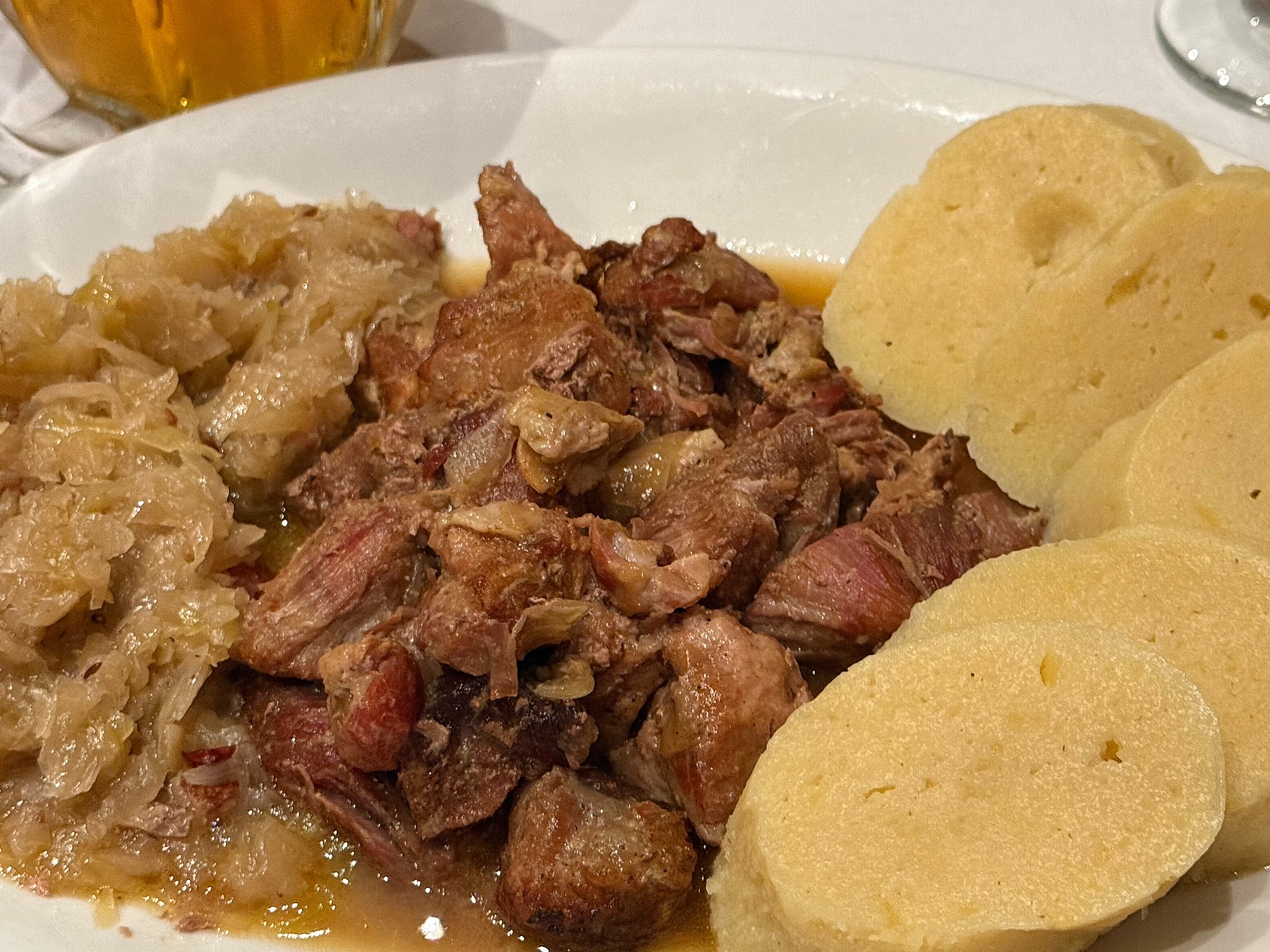
Pork shows up in some unexpected places; in Brno, for instance, I had funky Olomouc cheese, wrapped in bacon. Another dish called Moravian Sparrow isn’t bird but rather roast pork with brown gravy, dumplings, and sauerkraut. In Prague, roast pork with bread dumplings and sauerkraut appears on many menus.
Czech sauerkraut (zelí) strikes a delicate balance between sweet and sour, less aggressive than the sharp stuff piled on New York-style hot dogs. Caramelized onions and a pinch of sugar tame the acidity, turning what could be a side dish into a complementary companion for rich, fatty meats.
The Czech kolacky (also spelled kolaczki or kolache) is usually a relatively small cookie with rich, buttery dough, filled with prune, apricot, raspberry, and other fruit preserves. You’ll see the kolacky on dessert platters in the Czech Republic, Slovakia, Poland, and…Central Texas. That’s right, Texans have a thing for these cookies, which were brought to the Lone Star State by nineteenth century immigrants. As in Central Europe, the kolacky can be filled with fruit preserves, though sometimes in Central Texas what’s called a kolacky may also be more like a sausage roll. And, of course, the kolacky in Texas is bigger than most.
Czech food is substantial, and in this era of more conscious eating, there is a movement toward lighter-weight options. At Café Prague, Chlubnová is gradually lightening her menu with grilled Scottish salmon, Amish chicken, and other gravy-free dishes that aren’t “too heavy, like the traditional food.”
Anna and grand Bohemian restaurants like Old Prague and Klas are all gone, but I’m always glad to sit down to the food of the Czech Republic at the rare remaining places because the cooking is comforting, practical, generous, and a little indulgent. In times like ours, when comfort seems a rare commodity, there’s something grounding about a plate of dumplings in gravy. Czech food satisfies the stomach and feeds the soul.