The Kringle: A Wisconsin Specialty by Way of Denmark, with Help from Vienna and Medieval Monks
David Hammond
December 12, 2025
Get more recipes, food news, and stories at wttw.com/food or by signing up for our Deep Dish newsletter.
Have a food story or recommendation? Email us at [email protected].
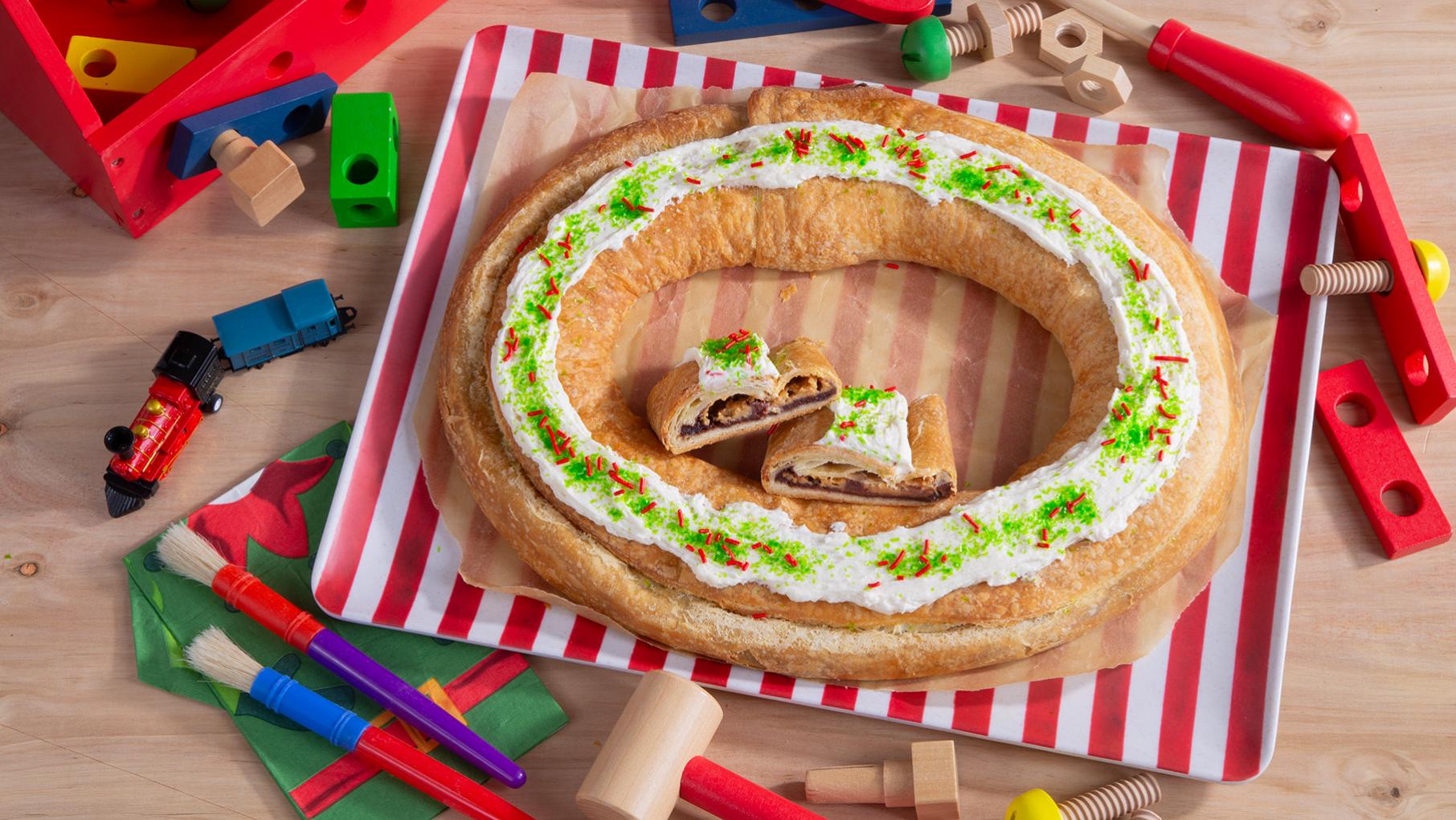
Chances are that at some point in your life, you’ve encountered a kringle: a delicate oval of buttery, laminated dough wrapped around nuts, fruits, and sometimes cheese, all finished with a ribbon of white icing. At the very least, you probably know its smaller cousin, the danish. Whereas in America the latter pastry is named for its Scandinavian origins, in Scandinavia itself the term for it and other laminated pastries such as the kringle reflects an earlier root: wienerbrød translates to “Viennese bread.” Amidst all this geographic hopping, throw in one more step to Racine in southeast Wisconsin, a city not far from Chicago and the Illinois border that has become the unofficial center of the North American kringle-verse.
During the winter, the kringle reaches hungry customers far and wide thanks to its availability in Trader Joe’s and ALDI stores, but the origin of all those pastries is Racine, where bakeries like O&H Danish Bakery and Racine Danish Kringles turn them out for grocery stores nationwide, in addition to supplying devoted local customers. (A few minutes in a warm oven will definitely bring out the flavors of this classic indulgence, no matter where you buy it.) It was in Racine – the most Danish city outside Denmark a century ago – where bakers adopted the oval shape that now defines the North American kringle, unwinding the loops of the classic pretzel shape in order to allow softer fruit fillings to be evenly distributed, according to Peter Oleson, the fourth generation Oleson to run O&H Danish Bakery.
That twisted shape originated with medieval monks who rewarded pretzels to children who had mastered their prayers. Derived from the Latin pretiola (“little reward”), the pretzel was designed to resemble arms crossed in devotion. Over time, this pretzel-shaped loop became the emblem of bakers’ guilds across Germany and Scandinavia.
The dough that defines the modern kringle, however, did not originate with Danish bakers. In the mid-nineteenth century, laminated yeast dough made its way to Denmark from Austria, home to the Sacher torte and a rich pastry tradition. Austrian baking also brought fillings such as almond paste, custard, and fruit jams to Denmark. The pretzel-shaped kringle quickly incorporated these innovations, becoming both richer and more refined. To this day, many Danish bakeries still display a gilded, crown-topped pretzel as the symbol of the bakers’ guild.
Denmark proved a perfect place for butter-rich pastry to thrive. Kay Zander Mellish, who grew up in Wisconsin, notes in “Denmark and Butter: A Love Story,” that butter is woven deeply into Danish identity. Denmark is one of the world’s top butter exporters, and the Danish language overflows with expressions beginning with smør (“butter”), including smørhul, literally “butter hole” – a term for the melted butter pool atop oatmeal and, metaphorically, any especially cozy place.
This cultural fondness for butter crossed the Atlantic during the surge of Danish immigration to the U.S in the mid-nineteenth century, a large portion of which ended up on the shores of Lake Michigan in Racine. There Danes found a familiar climate and welcoming farmland perfect for dairy cows – and thus butter.
By the mid-twentieth century, Racine had firmly established itself as America’s kringle capital. In 2013, the Wisconsin state legislature declared the kringle the state’s official pastry, making it one of the only states to even have a state pastry, which shows how important the kringle is to Wisconsin. Today, Racine bakeries offer flavors that nod not only to Danish heritage but also to Wisconsin food culture.
The Brandy Old Fashioned Kringle honors the signature sip of the iconic Wisconsin supper club. The Wisconsin Kringle incorporates Dairy State ingredients, including Montmorency cherries from Door County, cranberries (60% of the nation’s cranberries come from Wisconsin), and cheese (Wisconsin cheesemakers have won more awards than any other state for many consecutive years at the American Cheese Society competition). The Turtle Kringle is flavored with the chocolate, caramel, and pecan of the turtle sundae, drawing on the supposed origin of ice cream sundaes in Two Rivers, Wisconsin.
Creating a kringle is a three-day process: it all starts with a thick dough, into which is folded a thin sheet of cold butter. Then the dough is folded and refolded to create layers – a kringle contains approximately 36 layers of flaky dough – before it all goes into the refrigerator to rest overnight. In the final phase of kringle creation, the dough is rolled into long strips, filled with fruit, nuts, and other ingredients, shaped into an oval, and baked, before being finished with icings or specialty toppings.
During Christmas, when the rest of the country also keys into the kringle, many seasonally appropriate fillings are offered, including a Tipsy Elf version with cocoa, cream, and “a touch of Irish whisky” and a Reindeer Tracks kringle with chocolate curls, toffee bits, and vanilla frosting. Having such holiday specials is one way to keep people coming back, and when I recently visited an O&H Danish Bakery in Racine, it was not unusual to see people walking out with their arms full of three, four, six, or more kringles.
The kringle, Oleson believes, “brings people together.” Such sentiments were echoed by Becky Jackson, who has been working at O&H Danish Bakery since she was a teenager. Jackson explained that, “Here, we’re all about tradition, and it’s amazing to see customers standing in front of the kringle rack and running into someone they haven’t seen in years, and suddenly, it’s a reunion of people who’ve loved the kringle since childhood. We see that all the time, and it’s just a beautiful thing.”