Decades Before The 78, Dearborn Park Rose from An Old Railyard
Meredith Francis
January 15, 2026
Chicago could soon have a new neighborhood rising on a long-vacant stretch of land along the Chicago River just north of Chinatown. Known as The 78, the massive, multi-phase development promises housing, businesses, greenspace, a possible new stadium, and a reimagined riverfront on the site of a former railyard. Just across Clark Street, the Dearborn Park neighborhood followed a similar path decades earlier, rising from another expanse of abandoned railroad property amid high hopes – and deep unease – about whom downtown redevelopment was really for.
By the early 1970s, parts of downtown Chicago faced an all-too-familiar urban dilemma: many white families were fleeing to the suburbs, the tax base was eroding, and large swaths of land near downtown sat vacant and in disrepair. In 1971, rail service halted at Dearborn Station, a casualty of the broader decline of passenger rail in the second half of the 20th century. The train shed was demolished five years later, in 1976. Various civic and business groups had long had their eyes on the railyard for potential development, including Chicago Bears owner George “Papa Bear” Halas, who had his eyes on the property for a potential new football stadium.
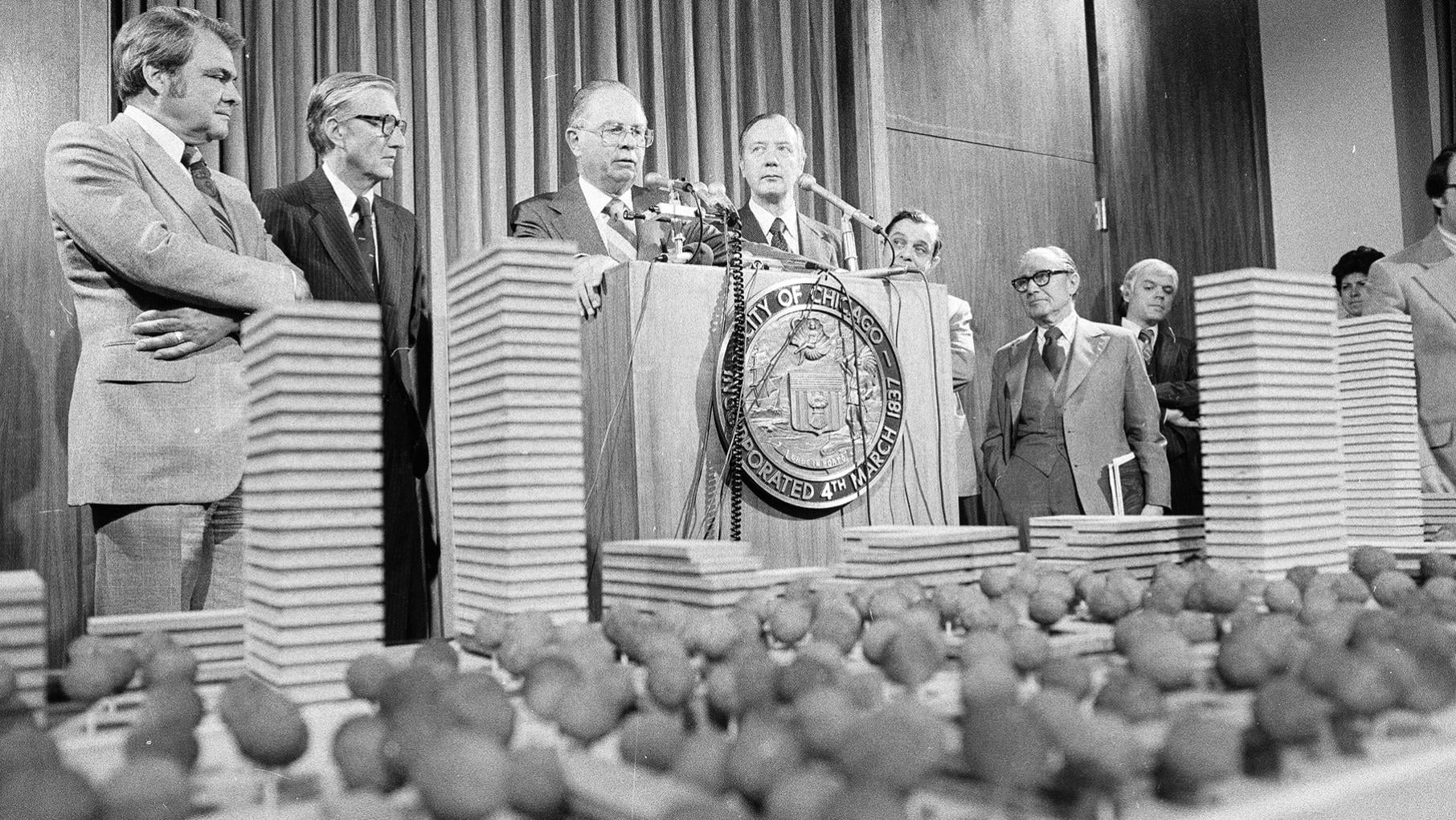
Ultimately, it was a group of businessmen that got the ball rolling on the development. They were: ComEd president Thomas Ayers; Sears CEO Gordon Metcalf, who was busy overseeing his company’s construction of Sears Tower; and head of Continental Illinois bank Donald Graham. According to Chicago reporter Lois Wille in her 1997 book, At Home in the Loop: How Clout and Community Built Chicago’s Dearborn Park, the idea first came to the trio while looking south out of a Loop high rise and seeing “a sorry string of sleazy bars, vacant storefronts, and 600 acres of mostly unused railyards.”
The group, along with the Chicago Central Area Committee, created the Chicago 21 plan, which sought to develop several neighborhoods near downtown, including the “South Loop New Town” that would become Dearborn Park. (The group later named itself the Dearborn Park Corporation). The idea was to attract middle-class families with an “open space system” of brick townhouses, terrace apartments, and green space meant to echo suburban living – all within walking distance to shopping, schools, and downtown. One brochure for the development doubled down on the suburban comparison, writing, “At last there’s a real neighborhood for people who want to live in the city and still enjoy the open spaces and tree-lined atmosphere of the suburbs.”
It took a lot of political wrangling, but the Dearborn Park Corporation acquired 51 acres of the former railyard from Halas, who had controlled the property but ultimately gave up on his stadium plan in the absence of support from the powerful Mayor Richard J. Daley. The new neighborhood, funded mostly by private investors, was constructed in two phases, beginning in 1977 with about 1,400 units and completed in the early ’90s with an additional 480 units. “The resulting apartments and townhouses along tree-lined walkways were hailed as models of urban renewal,” writes Erik Gellman in the Encyclopedia of Chicago.
But as with any urban renewal project, the construction of the Dearborn Park neighborhood was not without controversy. From the beginning, some activists opposed the development, fearing it would only exacerbate segregation in the city and exclude Black Chicagoans. As Wille writes, critics of the neighborhood said that its design was “keeping the real city at bay with brick walls and wrought-iron fences and a street pattern like a maze. It mixes skin colors and ages and occupations, but income levels start at the middle and go up from there.” To critics, those priorities were visible not just in whom the neighborhood was built for, but in how it was built. “Dearborn Park faces inward, its homes opening onto green culs de sac and sheltered patios while the uninterrupted exterior wall offers protection from the street – and confounds anyone trying to drive from State to Clark,” wrote Martha Bayne in a 2008 Chicago Reader article.
Today, as The 78 sits just to the west awaiting its next steps of development, Dearborn Park is home to about 3,300 residents, according to 2020 Census data, on a site that shifted from rail hub to planned residential neighborhood over the course of half a century.