A Funky All-Day Cafe in Logan Square Is an Outgrowth of an Artistic Supper Club Started by Veterans of Lula Cafe
Daniel Hautzinger
February 27, 2026
Get more recipes, food news, and stories at wttw.com/food or by signing up for our Deep Dish newsletter.
Have a food story or recommendation? Email us at [email protected].
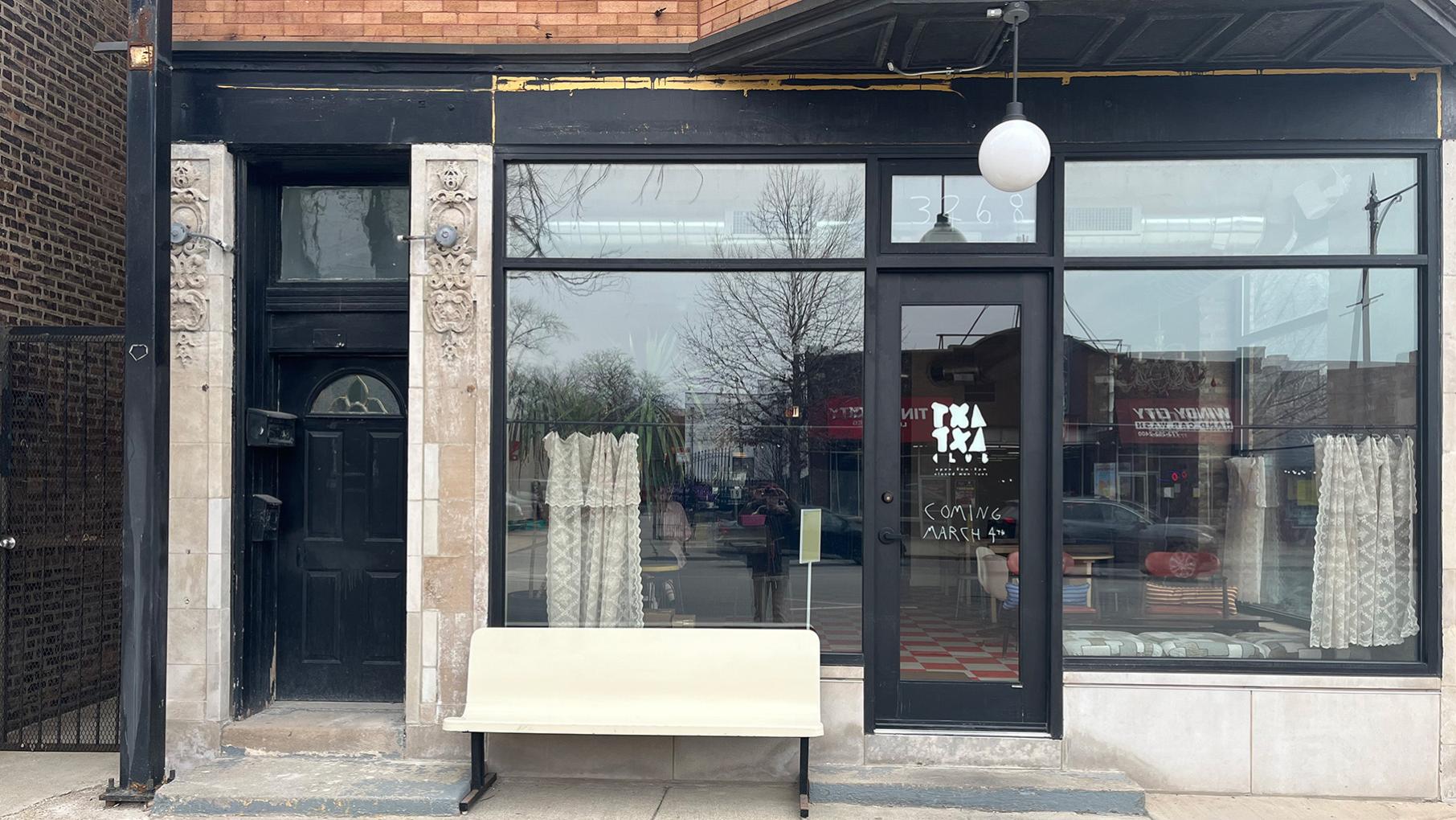
Here are all the things I had to look up on the opening menu of Txa Txa Club’s cafe, which opens at 3268 W. Fullerton Ave. in Logan Square on March 6: the Sicilian condiment salmoriglio, consisting of lemon, olive oil, herbs, and garlic; Vietnamese-style yogurt (it’s made with condensed milk in addition to fresh); the extent of the brassicas family of vegetables (broccoli, cauliflower, cabbage, sure, but turnip and radish?); ebaki (the Basque version of a cortado); Atxa Pacharán (a Basque digestif).
“I want it to feel artful, but not inaccessible,” says Daniel Parker of this brick-and-mortar manifestation of the funky supper club and event outfit he and his wife Liz Bendure have been running for several years. “I want someone to be like, ‘I never would have thought of that!’”
But Parker wants that surprise to give way to recognition. Take the staple brassicas dish, riffed on at various Txa Txa events. Broccoli salad with raisins, bacon, and a mayo-based sauce is familiar. Parker’s iteration, at least in winter 2026, substitutes broccoli-adjacent gai lan and rapini for the base, blackberry for the tart sweetness of the raisin, cured egg yolk for a bacon-y depth, turnip butter for creaminess, and fermented radish for the chew of the raisin.
“Maybe you see an ingredient or a combination of ingredients that you normally wouldn’t pair together, but when you eat it, something about it taps into this resonant, nostalgic something, or there’s an antecedent for it, even if it’s not obvious on the surface,” Parker explains.
The same might be said for Txa Txa Club as a whole. Caterers are common; one that incorporates Nerds candy, persimmon, saltines, chrysanthemum jelly, and shrimp on a kale tree maybe not so much. There’s nothing new about food pop-ups, even ambitious ones with seated meals, but it’s less usual for them to take place in kitchen-less spaces like art galleries. And while all-day cafes are becoming increasingly popular in this country – they’re the 24-hour diner or 6:00 am bar of white-collar digital America – most don’t serve a menu like this, let alone offer the same dishes for the twelve hours they’re open (8:00 am - 8:00 pm, Wednesday through Sunday at Txa Txa): a breakfast sandwich at night with a latte, sardines in the morning with sake, wine with the simple rice porridge congee at midday.
“We often exist either in vibe or in function in these more liminal or interstitial gaps,” says Parker of the draw of an all-day spot. “All of our food isn’t just one category. It fits in these in-between spots of the various Venn diagrams.”
Perhaps most surprising of all is that a restaurant was “never the goal,” Parker says. Whereas many people in the restaurant industry dream of owning their own place someday, “We always said, ‘Not a restaurant, not a restaurant, never a restaurant.’”
Parker and Bendure wanted to focus on their monthly supper clubs, artistic collaborations, and personalized event work – and the cafe will remain an outgrowth of that. After all, the building still says “Txa Txa Club,” not “cafe” or “restaurant” on the door. But having a physical space – they bought the building – provides them a professional kitchen out of which to prepare for events, in addition to consistent work for their employees and a cheaper, less intense way to experience their hospitality.
“The ante is a cup of coffee, and you still get to get washed in the music or the vibe of what Txa Txa is without having to commit to a fancy dinner,” Parker says of the cafe.
He and Bendure started those dinners after meeting while working at Lula Cafe, not far from the new Txa Txa Club location, Parker as a bartender and Bendure as a server. They began hosting supper clubs in their backyard during the pandemic, eventually graduating to larger venues. By the summer of 2023, they had built up enough business to commit to Txa Txa full time.
Despite a lack of formal training or even much time in professional kitchens, Parker handles the food. Bendure is responsible for design, visuals, hospitality. The cafe was fully designed and even somewhat crafted by the pair. “I like to say that we have a resident Venetian plasterer, and that’s Liz,” Parker says, pointing to some textured walls as Bendure’s handiwork.
The space has a mix of styles that somehow cohere into a singular aesthetic. The building’s exposed brick and tin ceiling remain, complimented by lacy curtains and a chintzy chandelier outfitted with blood-red fake gems that will catch the morning light through an east-facing window added to let the sun in. Neon plastic cubbies hold menus and vinyl curtains hang at the end of a long bar that transitions into an open kitchen. Stark tables and hardy stools sit on the red-and-white tiled floor under utilitarian wall-mounted lamps whose dangling power cords are visible.
“The food and the vibe are one and the same,” says Parker. “I don’t want anything to feel fussy.”
Imagine an intimate European spot with lots of Southeast Asian influence: the bread salad panzanella with a tomato-based Vietnamese dipping sauce; cold sesame noodles; espresso with lemongrass and galangal; a gin cocktail with lychee, coconut vinegar, and clam juice. Given Txa Txa’s all-encompassing focus on sustainability, many dishes feature adaptive transformations of “detritus” such as citrus peels, in Parker’s words, often through fermentation. Items will rotate – “Mother Nature has seasons for a reason” – but the aim will always be to comfort and welcome and trigger memory.
“Taking care of people through food is an ancient practice,” says Parker. “I think your intention with the food comes through, whether you’re trying to get write-ups and accolades versus make something that rings a really true bell with someone. I just hope that our food does [the latter.]”
This piece has been edited to correct Liz Bendure's role at Lula: she was a server, not a hostess, for most of her tenure there.