More Than a Century on, Ferrara and Scafuri Bakeries Carry on Italian Tradition with Sweets Like Zeppole
David Hammond
March 17, 2026

Get more recipes, food news, and stories at wttw.com/food or by signing up for our Deep Dish newsletter.
Have a food story or recommendation? Email us at [email protected].
“One of the things I like about Taylor Street is that you know your neighbors,” says Keira Gurovich, who is usually found behind the counter at Scafuri Bakery, 1337 W. Taylor St. “We have a tight-knit community. We know our neighbors, the people who live here, and the people who do business here. Brian, for example, owns the Taylor Street Tap, and when he comes in, I know exactly how he likes his coffee, and he knows exactly how I like my beer.”
That sense of familiarity and continuity is part of what makes Scafuri Bakery a neighborhood treasure. Everything there is made by hand. Many of Scafuri’s baked goods are based on recipes preserved in an old family recipe book. Its yellowing pages, now laminated, remain in daily use, a living link to an older way of baking: traditional and deeply personal.
Scafuri Bakery opened in 1904, when Luigi Scafuri, an Italian immigrant from Calabria, began selling traditional baked goods on Taylor Street. After Luigi died in 1955, the business passed to his daughter, Annette Mategrano, who later also opened Annette’s Kitchen and Mategrano’s Italian Restaurant. My family and I visited Mategrano’s in the early 1990s, and we still remember its homey and satisfying red-sauce Italian food. The matchbooks at the counter promised “Strictly home cooking from scratch,” and that was no exaggeration – especially if the home in question had an Italian mother doing the cooking.
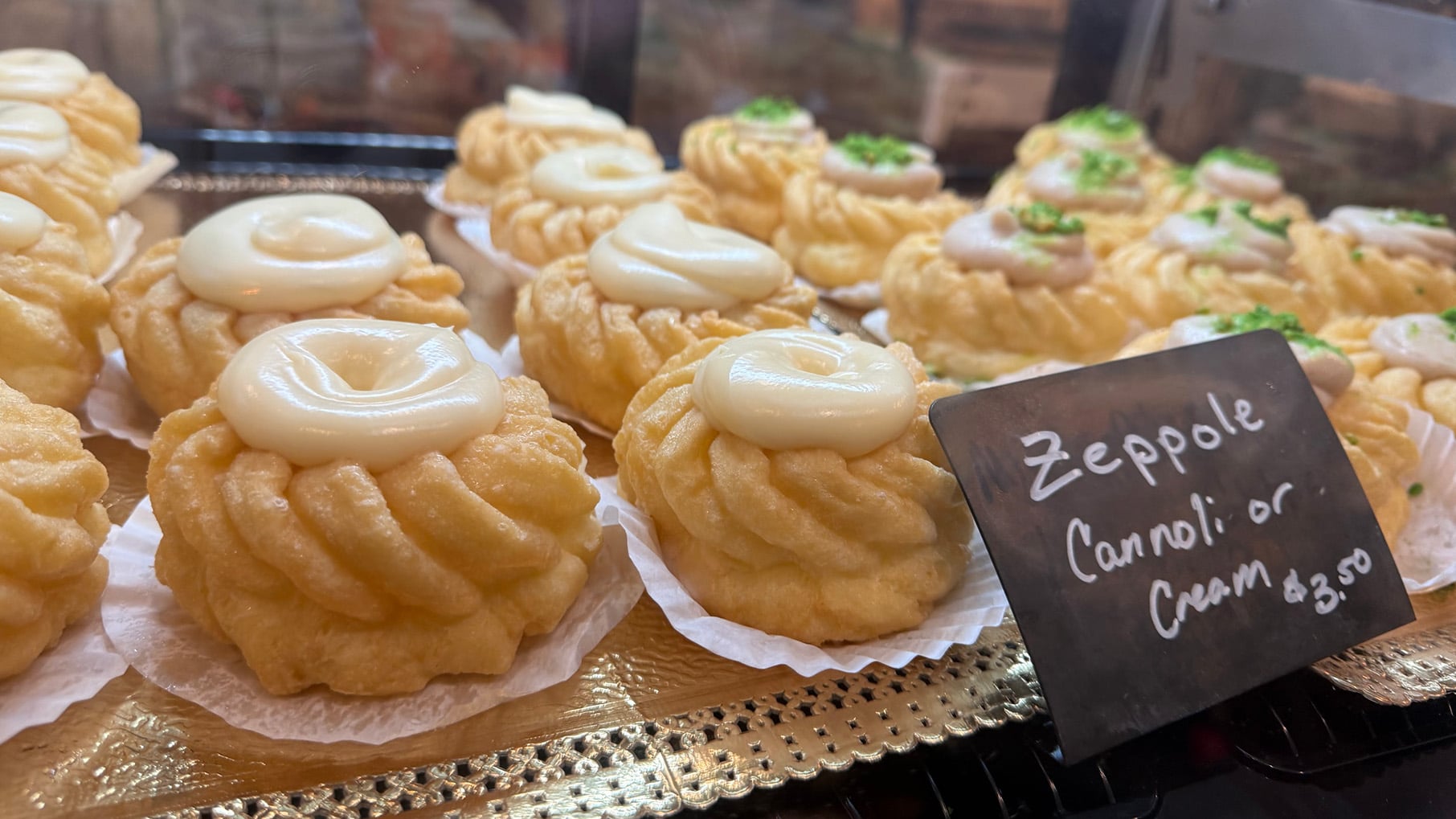
When Annette retired in 2008, the bakery closed, but it reopened in 2013. Today, Scafuri offers a wide range of baked goods, including cuccidati (ornate Sicilian fig cookies), pignoli (almond cookies topped with pine nuts), bomboloni (deep-fried doughnuts dusted with sugar), and, as March 19 approaches, zeppole.
March 19 is St. Joseph’s Day. According to legend, a famine in medieval Sicily led people to pray to Saint Joseph for rain. The rains came, and in gratitude Sicilians prepared simple wheaten fritters and placed them on St. Joseph’s Day altars.
Because the saint’s day falls during the Christian fasting period of Lent, its foods carry special significance. The humble ingredients of early zeppole – flour, water, and oil – made them especially suitable for a Lenten feast day.
Naples later refined the form, using choux pastry – the same dough used for éclairs – piped into rings and often topped with cream and a cherry. Chicago, like New York, long welcomed immigrants from southern Italy, and to this day local bakeries like Scafuri sell zeppole in the weeks leading up to St. Joseph’s Day.
Among them is Ferrara Bakery, at 2210 W. Taylor St. It was founded by Salvatore Ferrara, who came to Chicago from Nola, a town outside Naples, in the early 20th century. He brought with him a knowledge of Italian pastry and confections, and he put that knowledge to use in his new neighborhood. Along the way, he acquired a partner, Salvatore Lezza, who made spumoni, a Neapolitan specialty. The two men worked together for a time, and the Lezza name lives on in Elmhurst, where the company still offers Italian desserts.
After marrying Serafina Pagano, Ferrara increasingly turned his attention to candy-making, eventually launching Ferrara Pan Candy Company, responsible for such treats as Atomic Fireballs and Lemonheads. Serafina remained at the bakery and became a legendary figure in the neighborhood. Known by many as “The Angel of Taylor Street,” she was far more than a baker or businesswoman. She was a philanthropist, a civic presence, and a woman whose generosity made her beloved throughout the community.
Learn more about Ferrara Pan Candy Company and Chicago’s history as a center of candy manufacturing and innovation in Chicago Stories: Candy Capital.
Serafina was said to be godmother to more than 200 children. She was close to powerful political figures, including Richard J. Daley, but what mattered most was her devotion to the neighborhood. Her granddaughter, Nella Ferrara Davy, remembers that Serafina attended the funerals of countless members of the community. At the neighborhood funeral home, there was even a designated “Serafina’s chair,” where she would sit during services, pay her respects, and offer sympathy to grieving families – who all seemed to belong, in some way, to her very large family.
With misty eyes and a crack in her voice, Nella recalls that when Serafina died, “the governor, the mayor, the senator, congressmen, the aldermen – they were all at her funeral. Mayor Daley came to the church with his wife Pat and his whole family. He loved my grandmother. And at the Columbus Day Parade, there’d be all the men in the front line, and my grandmother was right there. You couldn’t believe it. She used to have parties for the different politicians, priests, and orphanages. She raised money for many charities. She was a wonderful woman.”
And she was also a wonderful baker.
Nella Ferrara Davy continues that tradition today, though the baking business has adapted to changing times. “When the economy went down, people stopped buying wedding cakes, and businesses stopped having Christmas parties for us to cater,” she remembers about the 2008 financial crisis. “We lost a lot of business, as did many other bakeries. And people are just not eating sweets like they used to. At lunch time, I could have 200 people go through the line, and out of 200 people, honestly, maybe four or five buy dessert. Offering lunch is what kept us alive.”
Italian bakeries endure not simply as businesses, but as vibrant centers of neighborhood life. “We’re a community place,” says Gurovich. “If you come in here often enough, I’ll recognize you. My employees will recognize you. We’ll catch up, we’ll talk. This place is special for them. It’s a place of community, a place of the heart.”