Rick Steves Revisits the "Making of a Travel Writer" in a Book on a Formative Trip
Daniel Hautzinger
April 16, 2026
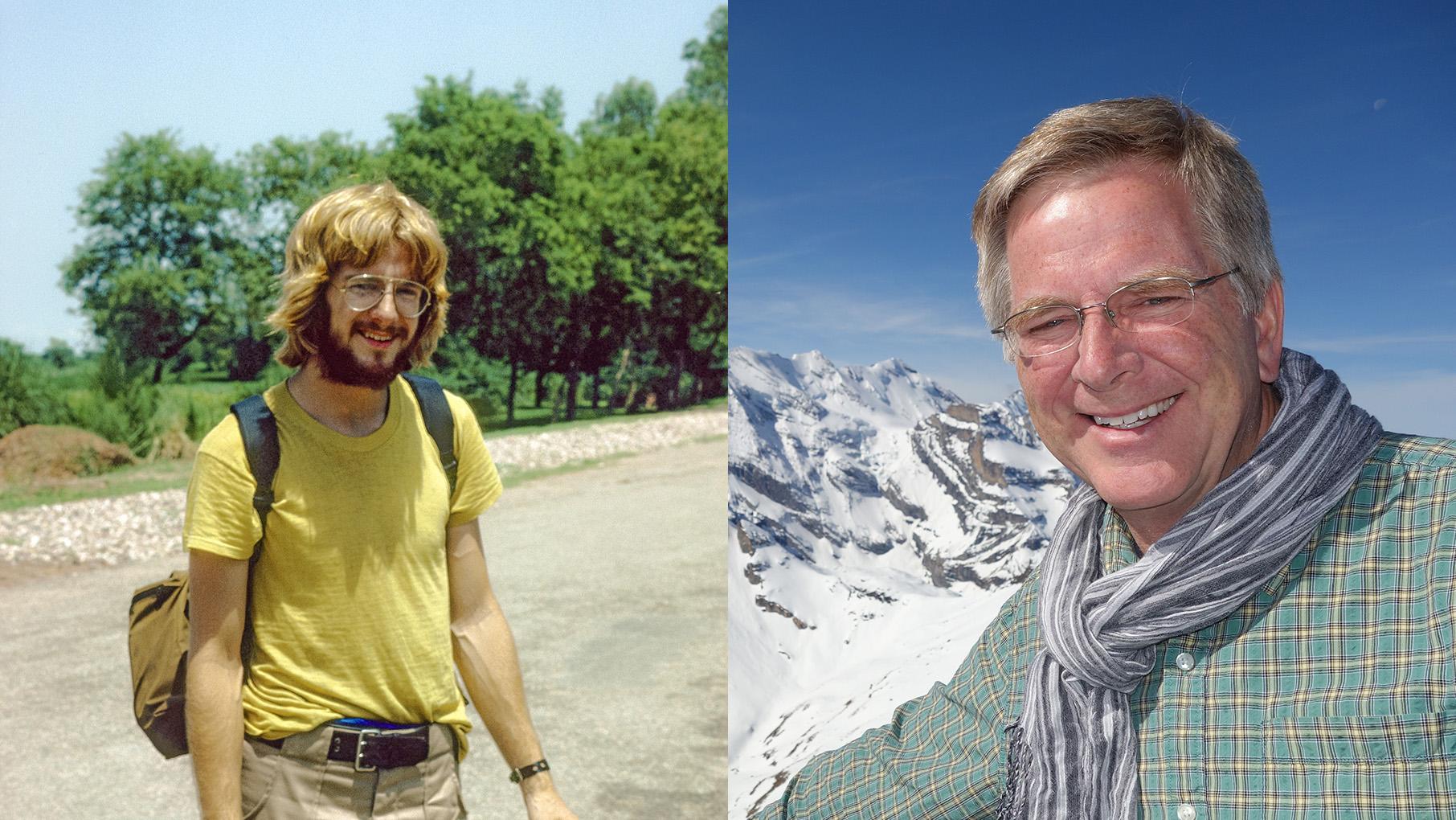
Rick Steves has devoted his career to charting Europe for travelers, but he had to go to a different continent to discover that career. In 1978, as an ardent 23-year-old eager to experience the world, he set off with a friend on an eight-week journey from Istanbul to Kathmandu, documenting the experience in a 60,000-word journal.
Almost 50 years later, he has published that journal along with some of the photos he took on the trip as On the Hippie Trail: Istanbul to Kathmandu and the Making of a Travel Writer.
“It’s my newest book and it’s my oldest book. I wrote it back before I was a travel writer,” Steves says, amusedly noting that it’s the only one of his publications to become a New York Times bestseller. It’s now being released in paperback, and Steves is traveling to Chicago for a sold-out talk on the book at the Chicago Humanities Festival. (Always eager to share without barriers, he points out that you can watch a similar talk for free at his website.)
At the time that he embarked on the so-called “Hippie Trail,” which was inspired by a psychedelic era of interest in India, he was a piano teacher who spent his free summers traveling cheaply throughout Europe. That’s how he expected to spend the rest of his life.
But his trip through Asia, with its world-expanding encounters with other cultures, helped crystallize the beginnings of a travel philosophy that he has now touted for decades: that travel can broaden your perspective if done right. A class he took on the Hippie Trail before his trip was “so lousy, it actually drove me to teach a travel class of my own the next year,” he writes in the introduction to On the Hippie Trail, thus beginning his career as a travel guru. The notebook of his journey is “like a compost pile from where everything I’ve enjoyed since I found my niche as a travel writer has sprouted,” Steves says.
In the book, you can discern the seeds of the Steves we know today from his PBS shows and guidebooks. Watching a sunset with a cleaner at a hotel in Afghanistan, he writes, “I guess people all over the world enjoy the same things” – an early version of his belief that people “carbonate” travel, or provide the excitement and worth of an experience. “We’re all equally lovable children of God, and by traveling, we get to know the family,” as he writes in the conclusion of On the Hippie Trail. He tries to dispel his ignorance of the places he’s traveling through by asking questions of people he meets and turning to books – he and his friend rip a memoir by Nikita Khrushchev in half so that they can both read it during a long, hot bus ride. Culture shock offers an opportunity to reflect on what he takes for granted or as a norm. He seeks out everyday life instead of just visiting the tourist areas.
On the Hippie Trail is “an anthropological dig into a 23-year-old version of myself,” Steves says.
He hadn’t read his notebook from the trip for decades, until he decided to take a look during the COVID-19 pandemic and was surprised by the vividness and candor. He bravely decided it was worth sharing his unguarded, youthful self with others by publishing it, mostly unedited.
“I think there’s a statute of limitations,” he says with a smile. “So if I did something politically incorrect, excuse me.”
It’s not just a coming-of-age story for Steves, however; it also offers a glimpse of a world that has passed. There was obviously no internet or social media as Steves and his friend navigated a world foreign to them, taking buses that broke down and a plane whose toilet was a hole straight to the sky. They rationed themselves to nine photos a day so that they didn’t run out of film. Soldiers and propaganda posters were an ubiquitous presence in Kabul, where there were rumors of a revolution supported by the Soviet Union. The USSR would invade the following year, ending the possibility of the Hippie Trail.
Iran also closed off in 1979 due to the overthrow of the Shah and the establishment of the Islamic Republic. When Steves traveled through Tehran, however, the country still had an American TV channel with shows like Bob Newhart and a radio station that broadcast in English.
“Not that I was aware at the time, but when we talk about regime change, it reminds me how imperial that is, and how greedy that is, and how ethnocentric that is,” Steves says. He likes to quote Muhammad, who said, “Don’t tell me how educated you are, tell me how much you’ve traveled.”
“If you have not traveled, or all you’ve ever done is gone to casinos and golf courses, what business do you have thinking you know what makes the world work?” Steves says.
Even though the Hippie Trail itself is no longer a possibility, Steves believes everyone needs to have an experience like it, even if it isn’t always comfortable – his friend was sick throughout much of their own trip, and Steves frequently considered turning back to simply relax in Europe before he reached India.
“The saddest thing to me among all the political pickle we’re in right now is that people are becoming more fearful and embracing the concept of building walls because we’re surrounded by enemies, when the world is a beautiful place filled with love and joy. It’s complicated and there’s some bad apples we gotta be realistic about,” he says of the world. “But if we really want to be safe and stable and affluent, the irony is we need the opposite of walls. We need bridges.”