An Albany Park Cafe Will Train, Employ, and Provide a Space for People with Developmental Disabilities
Daniel Hautzinger
May 12, 2026
Get more recipes, food news, and stories at wttw.com/food or by signing up for our Deep Dish newsletter.
Have a food story or recommendation? Email us at [email protected].
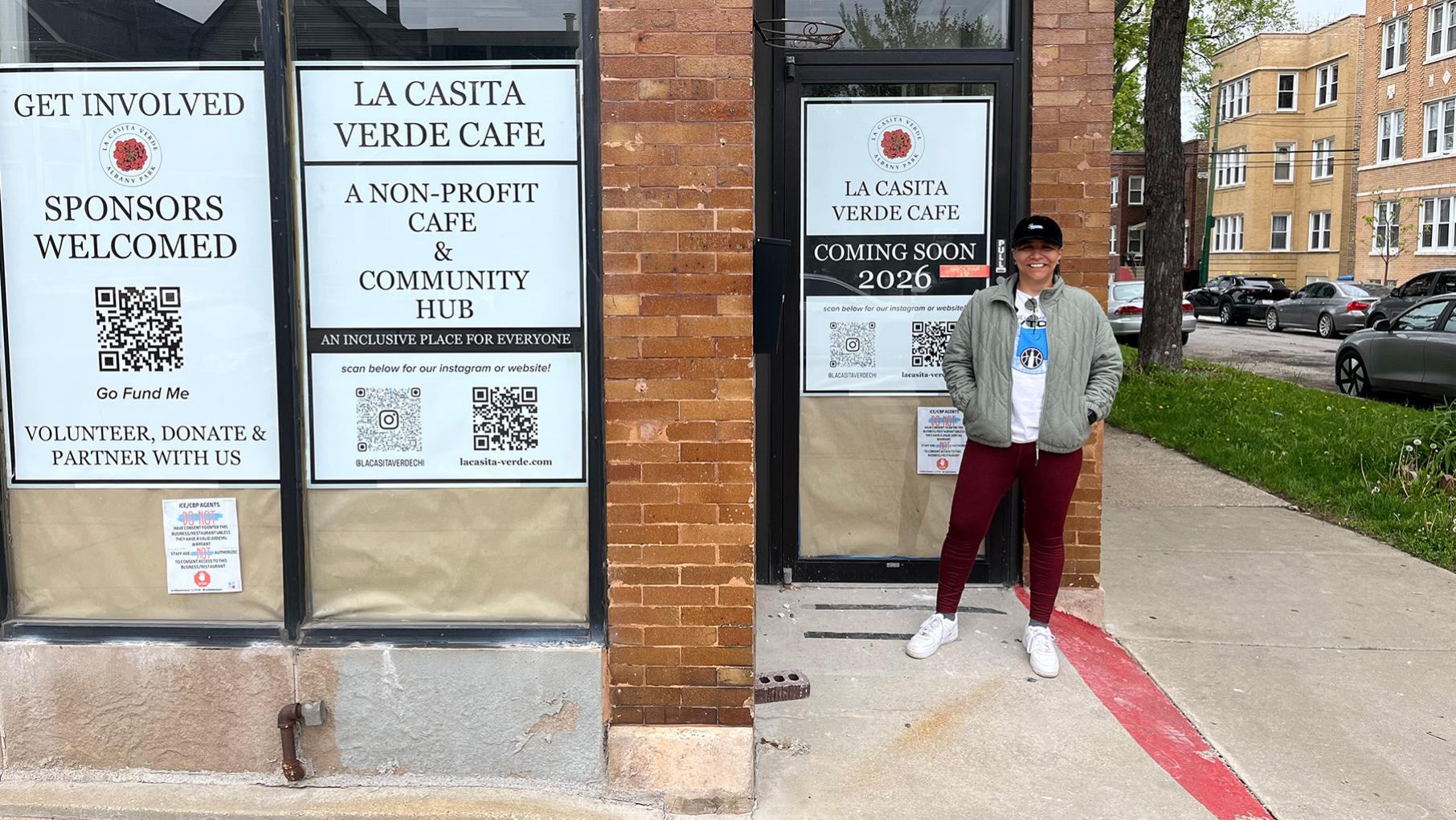
When Martha Del Rio was a child, she would walk a block south from Haugan Elementary School in Albany Park to the salon at the corner of Hamlin and Montrose Avenues where her mom and aunt worked and listen to their customers gossip in Spanish. Decades later, Del Rio is making that same storefront at 3800 W. Montrose into a safe place to gather, chat, and work again as she transforms it into La Casita Verde, a cafe that will provide an accessible space for people with intellectual and developmental disabilities as well as employment opportunities.
“The most important thing is going to be providing workspace and job training for people with disabilities, so that we can change the way cafes are,” Del Rio says.
There are some similar institutions providing food-service employment to people with disabilities, from Misericordia and its bake shop in Chicago’s West Ridge neighborhood to the sandwich shop Will’s Place in Skokie and Gerry’s Café in Arlington Heights. But Del Rio wants to provide employment not just at La Casita Verde but also train workers there to work in other coffee shops around the city. Casita Verde’s small production facility, where Mexican baked goods, sandwiches, and focaccia pizzas will be made, will be fully visible.
“We just want to create it where people are actually able to see it,” she says.
Dorothy’s Sweet Shoppe in Lincoln Square, a program of the nonprofit Gateway to Learning, provides another model of success, having trained at least one employee to go on to work at Vanille Pâtisserie, as WTTW News reported several years ago.
While there are programs for people with disabilities through school, once they graduate they are often left without support or places to socialize and be active outside their home. That’s why places like Casita Verde are not just about employment and making money, Del Rio says. They also provide a place where people with disabilities feel comfortable.
La Casita Verde will have low countertops and a large bathroom to accommodate wheelchairs and other needs. It will have sensory hours in the afternoon so that people who become overwhelmed or distracted by noise have somewhere outside of their own house they can go – as Del Rio points out, many students with disabilities have an awkward period of time between the end of school and when their parents finish work. And staff will be attendant and sympathetic to the needs of customers, thanks to firsthand understanding.
Firsthand experience is what inspired Del Rio to conceive of Casita Verde along with her wife Jenny Kessler and baker and co-founder Giovanni Sánchez. One of her nieces and her sister Elizabeth have intellectual disabilities, while a nephew is autistic and her late sister Sonia had Down syndrome. It was in part the death of Sonia last year that led Del Rio to work on Casita Verde.
“She was just the light of everything,” Del Rio says, taking off her glasses to wipe away tears. “Having her gone, it’s just making me more hungry to do this. If my sisters [couldn’t enjoy a place like Casita Verde], there have to be other families that can.”
She has witnessed the indignities and frustrations of moving through an unaccommodating world, an experience that leads many – including her mother and her sisters – to simply spend most of their time at home. She has never forgotten a moment when she was leaving the house and was asked, “‘Sister, but why not me?’ When she said that, that killed me. Because I looked at her and said, ‘I wish.’”
Casita Verde is Del Rio’s attempt to make that wish a reality.
“All their lives, they’ve only gone to two or three places, and it’s the same restaurants,” Del Rio says of her sisters. Elizabeth, who lives nearby with her mother, will work at Casita Verde part-time once it’s open, and has already been visiting the back patio while construction takes place. “She has her hopes up of coming here and being like, ‘I’m going to have friends,’ because she doesn’t have friends, because it is hard to get her around and everything like that,” Del Rio says, especially after she lost her sister. And the same goes for her mother, who has devoted her life to caring for her children and thus has little time for her own relationships outside the family.
Just as Del Rio hopes Casita Verde can prove beneficial to her mother, she also wants to support seniors in addition to people with disabilities, with programming to help them use technology. It’s just one of her many ambitious plans for the space: She wants to provide therapy and educational opportunities, plant a garden and construct a greenhouse in back to grow food, and collaborate with local vendors. Amidst recent increased immigration enforcement efforts, Casita Verde hosted a food drive and sold the tamales of vendors who were afraid to be on the streets.
All of this requires funding, however, which Casita Verde is still securing, in part through a GoFundMe campaign. But that doesn’t daunt Del Rio. “I’m so confident that this is going to work,” she says. “It has to work, and it will work. It’s just a matter of time.”