Kimski Celebrates Ten Years with a Blow-Out Block Party That's Everything Won Kim Loves About Chicago
Daniel Hautzinger
May 14, 2026
Get more recipes, food news, and stories at wttw.com/food or by signing up for our Deep Dish newsletter.
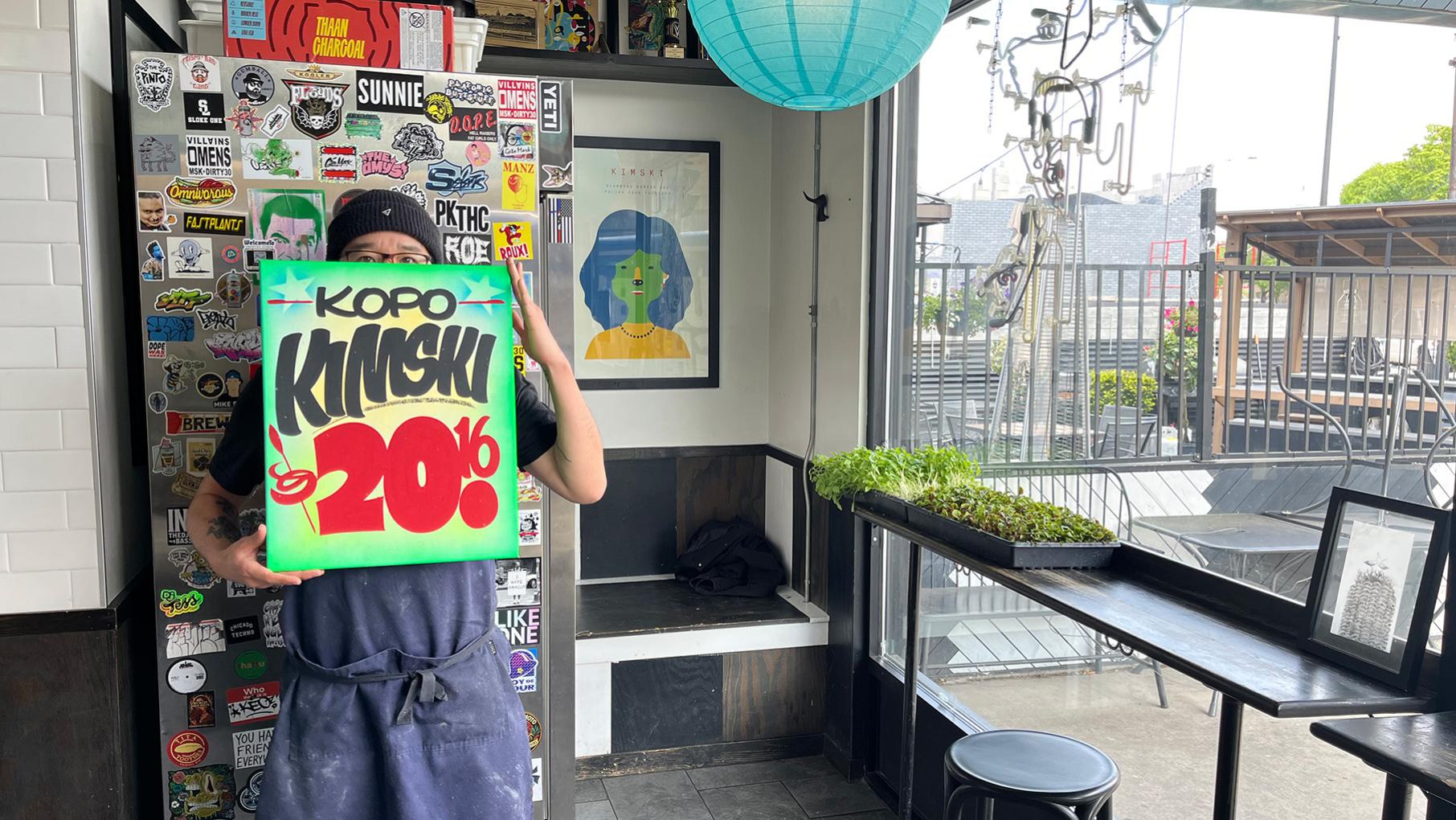
Won Kim goes all in. “No one likes fair weather, wishy-washy people. It’s either yes or no, and I’m always yes, for the most part,” says the chef, artist, DJ, event organizer, and locus of Chicago’s hospitality industry. If he finds a new enthusiasm, he dives deep and wants to share it, whether it’s through a pop-up, a fundraiser, a food-focused video series, or a chat over a meal. When he opened his counter-service restaurant Kimski inside Maria’s Packaged Goods & Community Bar in Bridgeport a decade ago, he threw himself into the project, designing a menu of off-the-wall Korean-Polish dishes, working the line late into the night, and trying to figure out how to build a restaurant on the fly.
“We got through the first year – no idea how, I should have closed – but I just hunkered down,” he says. “I just literally dedicated myself to this place.”
So it’s no surprise that he’s celebrating ten years of Kimski with a blow-out block party on May 16. For 12 hours, Kim’s friends from Chicago, Indianapolis, St. Louis, and New Orleans will serve food, spin music, add art to a graffiti wall, and hawk a specialty hot sauce and T-shirt.
“It’s just everything I love about the city,” he says.
Gathering such restaurateurs as the in-demand Oliver Poilevey of the Le Bouchon empire, the ebullient Omar Cadena of Omarcito’s Latin Café, and the ambitious team behind Lilac Tiger in one place for a block party is a feat, but it’s not unusual for Kim. For eight years, he and Ed Marszewski – whose family owns Kimski’s host bar, Maria’s – have organized a fundraiser for a different local school called Community Soup. At first, everyday people brought a big pot of soup to Marszewski’s Co-Prosperity cultural center down the street from Kimski for ticket-buyers to enjoy. These days, professional chefs make the soup; so many wanted to participate this year that Kim had to split the event into two nights.
That philanthropic spirit also led to a Community Kitchen and Canteen project spearheaded by Marszewski and Kim during the COVID-19 pandemic that both fed people in need and kept workers employed while restaurants were shut down.
“It wasn’t because I was trying to be some f-----g philanthropist,” says Kim with his characteristic take-it-with-a-grain-of-salt acidity. “It was just, I want to eat their food again. I also want to share that joy that I get eating awesome food with the neighbors and strangers.”
He and the Marszewski family have tried to share that joy in numerous ways. They’re tireless promoters of both the restaurant industry and Bridgeport, bringing North Siders to the under-visited South Side and spotlighting South Side restaurants. (Kim currently lives in Beverly.)
“We just want the best out of everyone,” Kim says of their partnership. “We want people to be happy and genuinely have a good time, despite how I sound to people.”
There’s Maria’s Patio Jam, a pop-up series that brings restaurants to the bar’s patio every Tuesday in summer; last year it was all South Side restaurants. A Saturday morning breakfast sandwich club and a monthly Polish sausage special are currently showing off other chefs at Kimski. Kim has been handing his kitchen over to pop-ups for since before COVID, allowing the people behind concepts like Thattu, Meze Table, what is now Jeong, and Cariño to find their footing before opening their own space. He was an early supporter of the now unavoidable tavern-style pizza trend: impressed by the thin crust pizza that Brad Shorten and Cecily and Billy Federighi were putting out from a home, he helped them open Pizza Fried Chicken Ice Cream next to Maria’s; they have since gone on to the ever-popular Kim’s Uncle Pizza and Pizz’Amici.
“I didn’t have time to go out to eat at other people’s places, so I would let them come here so I could eat their food. It was self-serving,” Kim says. His current menu at Kimski features products from friends around the city: Cariño tortillas to wrap duck breast in a ssam plate, Akahoshi Ramen noodles for black bean sauced jja jjang ramyun. The menu skews a bit more Korean than Polish these days, while still maintaining a fondness for disparate juxtapositions such as Asian-style dumplings topped with giardiniera and cheese sauce. The restaurant’s cultural fusion presaged Chicago spots based on other unexpected combos: Indian-Mexican, Cuban-Filipino, Colombian-Polish.
Some of Kim’s kitchen training was also self-serving, at least in his telling. Although he went to culinary school, he hated it. He spent much of his 20s doing odd jobs: art framing, working as a server in the suburbs, DJing, getting art commissions from his graffiti. (You can see his work at Thattu, EL Ideas, Bayan Ko, and Schwa, among other restaurants.)
“I met a lot of great chefs through art, because they would hire me to do art [for their restaurant]. And I’d be like, ‘Do you need help in the kitchen?’” he says. He was hungry for experience: “‘You don’t even have to pay me. I just want to see your kitchen. I want to eat your staff meal.’”
Food had always been a big part of his life. His mom ran a street food stand for a short time in Korea, and when the family immigrated to West Rogers Park – Kim was around one year old – she cooked dinner every day after a full shift of work, enforcing a rule that everyone sit down together to enjoy it. There was always a batch of homemade kimchi fermenting in the house.
“Growing up eating food in the city – it hit different,” he says. “It was literally a treat. It felt like an event every time, even if it was fast food.”
Despite his love of food and Saturday appointment viewing of cooking shows on WTTW, he didn’t think cooking was a profession. But he was always eager to be creative: He thought about going into theater or comedy, then found his way to DJing and graffiti. His pursuits balanced and fed each other. He parlayed work doing signs for Whole Foods into leading their demonstration kitchen and cooking monthly beer dinners there, and picked up restaurant shifts to cover expenses when art gigs were in short supply.
“I told [my mom] I wanted to be a cook one day and she was so happy about it, and then I was like, ‘No, I’m gonna be an artist’” – a prospect that worried her more, he says.
Kim frequented Maria’s on Mondays, when it was full of restaurant industry workers enjoying their night off. The Marszewski family had a tradition of putting kimchi on their Polish sausage in place of sauerkraut – the matriarch, Maria, who opened the slashie, is Korean, while her husband was Polish. They would grill sausages at their house down the street and offer them complimentary with a beer on Monday nights at the bar. When Kim stepped in to plate the food and handle would-be freeloaders, they were impressed.
They asked Kim to lead the small kitchen they were including in an expansion of Maria’s. He refused. But, “in a moment of desperation where I had a lull in work, I was just like, ‘I think I could do this,’” he recalls, and Kimski was born.
Ten years later, he still finds himself wondering why he did it and contemplating leaving it behind in his grumpier moods. Since COVID, he has turned the kitchen over to someone else over the winter so that he can focus more on his art, DJing, and other projects. “It could be just that I’m an old curmudgeon,” he says.
“But for all that negativity, I do have great regulars,” he continues. “I do have people that come here and support all the time. It’s easy to focus on all the bad s--t, right? But you don’t survive ten years without a community behind you.”