New Documentary Follows Local Reparations Debate in Evanston
Meredith Francis
January 13, 2023
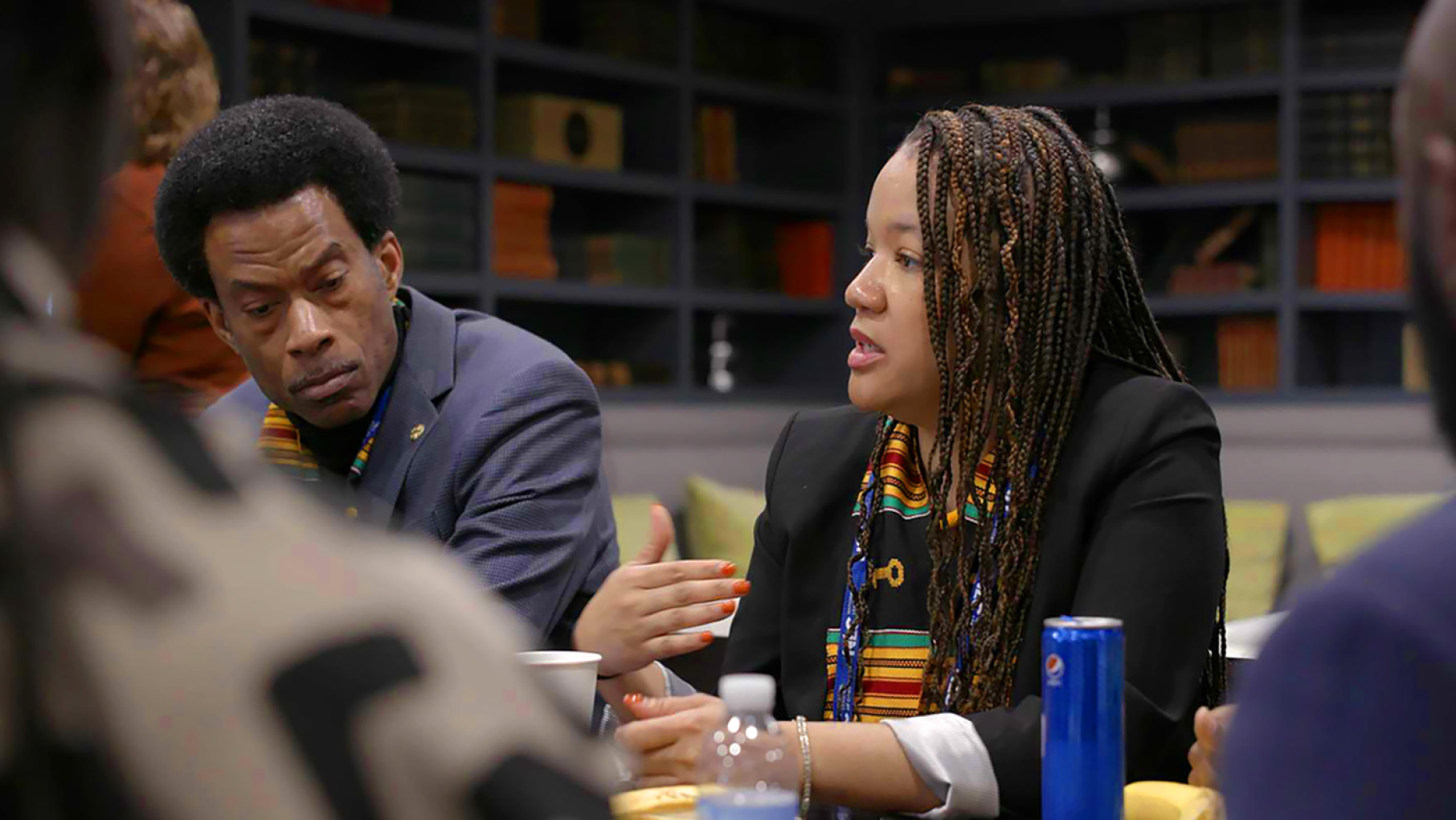
The Big Payback premieres on WTTW on Monday, January 16 at 10:00 p.m.
In 2021, Evanston became the first town in the country to pass an official government reparations program for Black residents. A documentary premiering on Independent Lens on January 16, called The Big Payback, follows an Evanston alderwoman, as well as other activists and residents, on the road to the plan’s passage.
“This is a reparations documentary, and it’s a conversation that should be had between two of the main parties, which is Black and white,” says Erika Alexander, one of the documentary’s co-directors.
Whitney Dow, the film’s other director, said they took both a “macro and micro” approach to telling the story. The documentary zooms out to the national level at times, tracking the status of HR-40, a bill that seeks to establish a commission to “examine slavery and discrimination in the colonies and the United States from 1619 to the present and recommend appropriate remedies.” That bill is led by Representative Sheila Jackson Lee from Texas.
But the majority of the documentary takes a local look, following now-former, then-rookie Alderwoman Robin Rue Simmons of Evanston’s 5th Ward, who designed and introduced the plan to the city council.
“Every community in America has some embodiment of institutionalized racism and mechanisms that excluded Black Americans from participating fully in American society,” Dow says. “We’re looking at this microcosm; this small community is looking at its own relationship to its Black residents and saying, ‘These are the policies and structures that injured them.’”
In Evanston’s case, some of those policies and structures were related to housing. A report from the Evanston Reparations Committee found that Black residents were, as Dow says, “systematically excluded from earning wealth through real estate.” They were denied loans, had their land devalued by banks, and paid higher rents.
To distribute any kind of financial reparations, Dow says, Evanston’s plan needed to stand on firm legal ground. The most solid way to approach that was through housing assistance. Over the span of 10 years, Evanston’s program will distribute $10 million using tax revenue from marijuana sales. The first phase of Evanston’s reparations program, which passed the city council in an 8-1 vote in March 2021, made $400,000 available in grants of up to $25,000. The grants were given specifically for home improvements and mortgage assistance to Black residents who could prove that they were descendents of people who lived in the town from 1919 to 1969.
When Alexander and Dow first set out to make a documentary about reparations, they weren’t planning on telling a story set in Evanston. But when they discovered Robin Rue Simmons’ initiative, they thought Chicago’s closest northern suburb was an ideal place to show how reparations debates are unfolding in cities across the country.
“I think what's so great about the story is that people expect a reparations story to take place in the Deep South,” Dow says. “They expect it to be something [where] there's a direct line that they can draw from the legacy of slavery to the conditions now. And it's really interesting to see something that is … a much more complex manifestation of that legacy.”
Also complex is the variety of viewpoints in the reparations debate. As Alexander and Dow point out, this isn’t a simple two-sided debate. The film shows Simmons’ perspective as the lawmaker, Black residents who wanted more or less to be done, white residents who support reparations, and white residents who do not support it.
Alexander says that one of the most challenging parts of portraying the complexity of the debate was finding a white resident who would be open to publicly sharing their reasons for opposing reparations. A common train of thought among those residents was, “I wasn’t around back then, so why is it my responsibility?”
“I think if you have the courage of convictions, then you should be able to defend your views in public in the same way you oppose it in private,” Alexander said. “To find [those people] within a community where they'd also have to live and have people know what they thought was difficult. We were very excited to have differing opinions, but it wasn't very easy on them. We appreciated their participation.”
Speaking of challenges, filming during 2020 and 2021 was no picnic for Dow and Alexander. When they first found out about Simmons' reparations plan in late 2019, they thought they were about to document “the rise of a national figure,” Dow says, as Simmons and Rep. Lee had planned to work together to host town halls on reparations across the country.
But as COVID-19 hit in March 2020, the filmmakers found themselves with a much more intimate portrait of local government work being conducted from Simmons’ laptop in her own home. As the Black Lives Matter protests filled the streets and discussions about race filled headlines in the summer of 2020, Alexander and Dow found that they had a lot to cover.
“All hell broke loose. It was crazy,” Alexander said. “But it said, each time, why reparations mattered.”
Despite the cynicism that recent years have unleashed in American political discourse, Alexander and Dow said they were glad to tell a story that showed a community finding a solution.
“Every story we see about race, every story we see about the environment, every story we see about the healthcare system, it's an unsolvable problem,” Dow says. “We thought, here's a story where we're actually showing a solution, and that was really exciting for us.”
In Simmons, they also show a woman from “a small ward in a small town who decided that she wanted to run for office to make her own community better,” Dow says.
Alexander says that, though many Americans think that government is broken, Americans are still a can-do people.
“This is their chance to prove that it’s not [broken], and to get involved and feel that they can own that issue and make a real change in the history of America,” Alexander says. “That’s a big deal.”