Marcella Hazan Changed How Americans Cook, Even Though She Had Never Cooked When She Moved Here
Daniel Hautzinger
July 15, 2025
American Masters: Marcella premieres on WTTW Tuesday, July 22 at 9:00 pm and is available to stream.
Get more recipes, food news, and stories at wttw.com/food or by signing up for our Deep Dish newsletter.
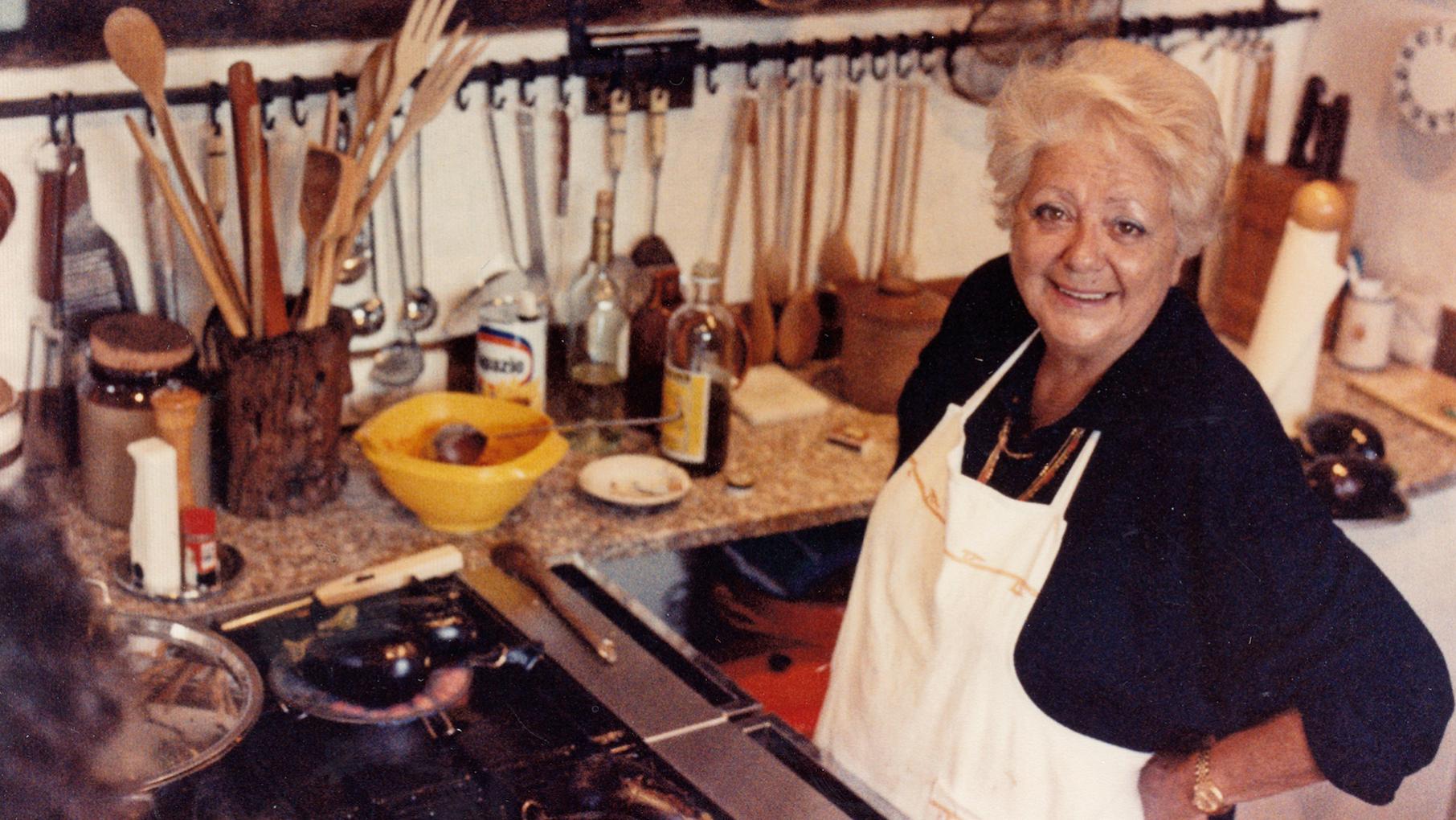
Even if you don’t know the name Marcella Hazan, you’ve probably benefited from her culinary influence. The cookbook author helped popularize in her adopted country of America such products of her native Italy as balsamic vinegar, sun-dried tomatoes, and extra virgin olive oil. An exalted conception of Italian cuisine, rooted in quality and simplicity, comes in large part from her, as does the idea that Italian food is a collection of regional styles distinct from Italian American food. “Italian cooking is very simple,” she said. “But it is not easy.”
Many of her recipes have become canonical, from a three-ingredient tomato sauce to a lemon-stuffed roast chicken dubbed “engagement chicken” because it has supposedly induced many a boyfriend to propose after trying his partner’s version. If you’ve ever heard not to stop stirring risotto, that came from Hazan. Among her admirers are Julia Child, Jacques Pépin, Lidia Bastianich, and the chef April Bloomfield, the last of whom becomes emotional as she cooks Hazan’s tomato sauce in the documentary Marcella, which is airing on PBS through American Masters. (Pépin and Bastianich also appear in the documentary.)
“Marcella, hope you’re happy,” Bloomfield says as she finishes the sauce and raises her eyes heavenward. “I hope I did a good job.”
Bloomfield’s not the only one to address the late Hazan, who died in 2013, or hear her voice while cooking. “She’s still talking to me,” Hazan’s son Giuliano says in the documentary while making his mother’s risotto, the first dish he learned from her. Even people who only know her no-nonsense voice from her books can hear it.
“She has been this voice in our head for decades,” says Marcella’s filmmaker Peter Miller of himself and his wife, who cook together every night. “We’ll say, ‘What would Marcella do?’” It was while they were preparing labor-intensive ravioli from one of Hazan’s cookbooks that Miller’s wife wondered if anyone had made a documentary about Hazan.
The answer was no. There wasn’t even a full biography, only Hazan’s own memoir and a section of the book Taste Makers by Mayukh Sen. So Miller decided to contact Hazan’s son, Giuliano. Within two weeks Miller was hosting Hazan’s 90-year-old husband and collaborator Victor for a filmed interview in his own apartment.
“His interview was magnificent. So articulate, so dramatic, so wonderful,” Miller says. (Victor is partially responsible for the literary style of Hazan’s cookbooks, since he translated her Italian writing into English.) “I thought, ‘OK, I guess I’m making a movie.’”
Six years later, that movie has won a prestigious James Beard Award, an accolade Hazan herself won several times for her cookbooks that changed Americans’ perceptions of Italian cooking.
And yet Hazan didn’t know how to cook until she began drawing on her and Victor’s memories and an Italian-language cookbook to recreate dishes from their home country in New York City after they moved there for Victor’s career. “I never cooked in my life until I married,” she said in an interview late in her life. “I never boiled water if it was not in the beaker in the laboratories.”
Hazan had two doctorates in science but couldn’t find work as a woman who didn’t speak English in 1950s New York. “Her biography is the story of somebody who is unbelievably overqualified to be a home cook,” says Miller. And yet she discovered a talent for cooking that she eventually began to share with others, first through classes that she taught while chain-smoking and then through cookbooks that she wrote with the help of Victor, who had to measure out her intuitive ingredient amounts as she prepared a dish.
All of that was despite a shaky hold of English and a childhood injury that limited the use of her dominant hand for the rest of her life. “She’s a disabled immigrant woman who came to America without ever having cooked, and then changed how we cook,” says Miller.
She has clearly affected how Miller and his wife cook. They got to meet her once, at a cooking class outside New York City. As they shared their admiration for her, Miller’s wife worked up the courage to ask about a Hazan recipe that sometimes failed them; the sauce didn’t always emulsify. How do you prevent it from breaking, Miller’s wife asked.
“Marcella looked at her with contempt – and affection – and said, ‘It doesn’t break,’” Miller recalls with a laugh. “That’s quintessential Marcella. There’s no filters. She’ll tell you what she’s thinking.”
It’s that voice that lives on in the heads of home cooks and chefs in their kitchens, chiding them to pay attention and make the best possible Italian food they can.