Chuck's Southern Comforts Cafe Isn't Your Typical Suburban Barbecue Joint
Daniel Hautzinger
July 25, 2025
Get more recipes, food news, and stories at wttw.com/food or by signing up for our Deep Dish newsletter.
Have a food story or recommendation? Email us at [email protected].
Chuck Pine still remembers the sensation of eating a lamb dish he made three decades ago. “I’m getting old, and [it was] 30 years ago, but I remember when you tasted it, it kind of numbed your lips,” the owner of Chuck’s Southern Comforts Cafe recalls with a smile. The lamb had been wrapped in maguey leaves from the agave plant and then smoked in an approximation of the indigenous Mexican barbacoa technique of burying a whole animal in a smoldering hole in the ground. But Pine was cooking the meat in small drum smokers – and it was to be served to famous chefs as part of a dinner at Rick Bayless’ Topolobampo, where Pine worked at the time.
Bayless “had given me the main course to take home with me to cook in these little smokers,” Pine remembers. “And it didn’t even all fit. I’m literally rotating it into my oven in the house. Definitely did not sleep a wink.”
But the dish was a memorable success. Bayless called Pine into the dining room to give him credit, and Pine received a standing ovation from the attendees, in his recollection.
Almost 30 years later, Pine is again heading to one of Bayless’ restaurants to share some smoked meat, now with much more experience and much less stress. On July 31, Pine will offer a Jamaican jerk pork taco at Bar Sótano as part of a “Homecoming” series spotlighting restaurateur alumni of Bayless’ restaurants that takes place on the last Thursday of every month through October.
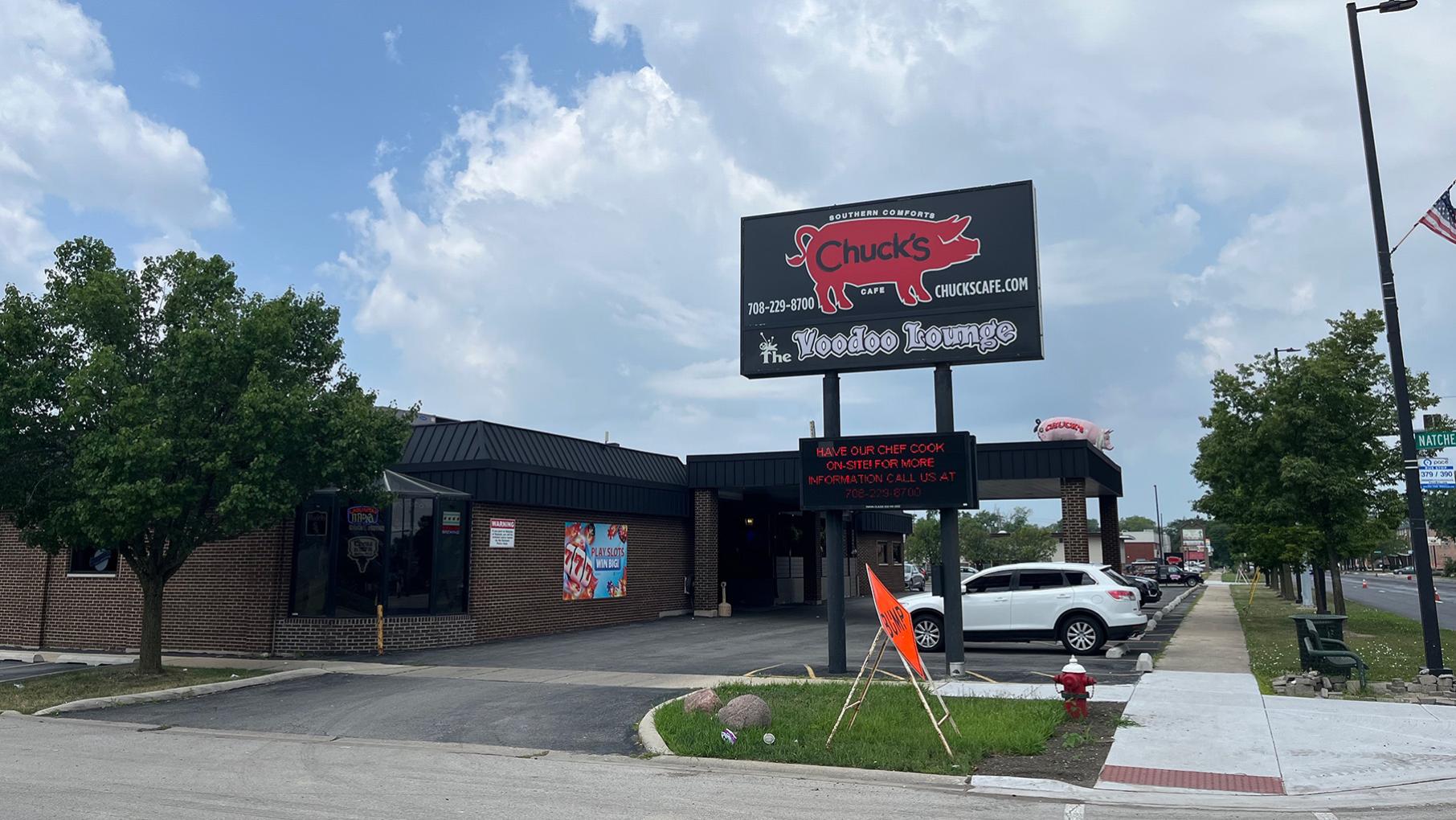
Pine might seem an outlier amongst the Homecoming alumni, most of whom now run Mexican restaurants, but on closer inspection Bayless’ influence is evident in many aspects of Pine’s food at his two Chuck’s locations in the southwest suburbs. The parking lot-surrounded, banquet hall-esque Chuck’s Southern Comforts Cafe isn’t the straightforward bar and barbecue joint with slot machines that it appears to be from the outside.
For one, “Southern” encompasses everything from Texan barbecue to Cajun dishes from New Orleans to regional Mexican specialties like chorizo verde. Pine’s signature barbecue sauce is deepened by dried chile notes more typical of Mexican cooking. He is constantly experimenting with new dishes and cuisines via ever-changing specials, like Irish-American-style corned beef (smoked, not boiled), a po’ boy with Korean fried chicken, and Californian tri tip on a sandwich with jus to dip – each appearing on the menu only for a day or two. And Chuck’s is literally farm to table: beyond the parking lot at the Darien location is a farm that supplies tomatoes, cucumbers, peppers, squashes, beets, peaches, cherries, apples, pears, rhubarb, herbs, and more.
The Mexican influence; the insatiable curiosity about new dishes; the reliance on local produce; and even the focus on barbecue all have roots in Pine’s time working for Bayless, whose parents ran a barbecue restaurant for 37 years in Oklahoma City. Pine would take home unused ribs cut from pork loins for Topolobampo and experiment with seasoning and smoking them, bringing them back to the restaurant for staff meals and critique from Bayless and his wife and business partner Deann. Their suggestions helped Pine adjust his recipes, “which was amazing,” he says. “I mean, who better to taste test?”
Topolobampo was Pine’s first job out of culinary school, which he attended after tiring of running an enormous video store with his brother. (He still has the old-school conviviality of a salesman, greeting regulars at the restaurant with a handshake and hello.) His mom was an “amazing cook,” preparing Thai and French dishes while other families in Burbank were “eating meatloaf and pot roast and crap.” His dad ran numerous laundromats throughout the city, and Pine loved eating barbecue from legendary Black-owned spots like Lem’s and Leon’s when he visited his dad’s stores; that appreciation lives on at Chuck’s, which offers Chicago-style rib tips, hot links, and wings.
He worked at Topolobampo for three years, receiving a crash-course in regional Mexican dishes by preparing appetizers for a tasting menu that changed every two weeks. Bayless “would come through every day basically for the first six months that I worked there and taste everything I was cooking,” Pine says.
He then briefly worked at another barbecue restaurant to get more experience before returning to his hometown of Burbank to open the first Chuck’s in 1998. At first the blue-collar suburban clientele was wary of venturing beyond his standard barbecue to try some of the Mexican and Cajun specials, but the original location had an open kitchen that allowed Pine to encourage people. “I”m a good sales guy,” he says. “It’s like, ‘Hey, we got the blackened scallops today! You want to taste a little?’”
“Once I got that crowd, we took off pretty quick,” he says. He’s constantly thinking about food, getting distracted by ideas for new soups or sandwiches when he tries to watch a movie or read a book. “They just started trusting me on whatever I wanted to throw together.”
He expanded into two neighboring storefronts in the strip mall before appearing on Check, Please! in 2008 and later Diners, Drive-Ins and Dives. He moved down the street to his current large space around 15 years ago and opened the Darien location some five years after that.
He kept in touch with Bayless, catering parties at his former boss’ Wicker Park home and offering some advice on how to grow microgreens hydroponically in the basement. “I just love growing stuff,” he says. While his childhood home didn’t have a backyard, he convinced his neighbors to allow him to plant a garden in theirs when he was only in sixth grade.
He started growing produce for his restaurant because he wanted access to hoja santa, an anise-y herb common in Mexican cooking but difficult to source here. “There’s quite a few cool recipes you can do with that one: there’s some soups we make, like a bouillabaisse-y kind of thing,” he says. (He loves soups, and his restaurant is known for gumbo and rotating specials like cream of poblano.)
Three decades in, he’s still obsessed with food even if he spends a little less time in the kitchen. He’ll enthuse about the butternut squash chips one of his cooks came up with, arguing in detail that the squash takes to frying better than sweet potatoes. A regional Mexican dish will pop into his head, leading him to describe the whole process of preparing it. And he’ll continually tweak a special like the jerk pork taco he’s serving at Bar Sótano, adding mango to the habanero salsa, deciding to char the meat on the grill after smoking it.
The taco is one the menu at Chuck’s for a limited time leading up to the Homecoming event, too. You wouldn’t expect to find a Jamaican jerk pork taco most places, much less at a barbecue restaurant – but then Chuck’s is definitely not most places.