Decorated Chicago Chef Curtis Duffy Runs a Quiet Kitchen. His Childhood Was Anything But, As He Recounts in a New Memoir.
Daniel Hautzinger
August 1, 2025
Get more recipes, food news, and stories at wttw.com/food or by signing up for our Deep Dish newsletter.
Have a food story or recommendation? Email us at [email protected].
Curtis Duffy prizes silence. The decorated chef may enjoy the rumble of a motorcycle engine and the roar of heavy metal, but he has banished all extraneous sound from his Chicago restaurant Ever. Custom soundproofing on the dining room ceiling keeps conversations hushed and private, while loud machines such as blenders are sequestered behind a door in the pristine kitchen. Silicone mats cover the quartz kitchen countertops during dinner service, both to mute the clatter of dishes and prevent them from losing heat. The only talking amongst the cooks and servers is the giving and receiving of orders and updates.
“For me, it’s a total discipline to be able to go through a night of service and just have 100% focus on what we’re doing and 100% focus on the guests’ needs. Everything is a distraction,” Duffy says. “And when we’re distracted, we make mistakes.”
“When it’s time for service and time to be in the kitchen, it’s total silence,” he says.
Duffy’s cultivation of the kitchen as a sanctum and devotion to silence as discipline stems, in his estimation, from a chaotic upbringing, which he narrates in his new memoir Fireproof, written with Jeremy Wagner. Unlike his controlled kitchen, his childhood was anything but calm.
Before Duffy was a year old, his 18-year-old father caught his mother with another man and stormed off to Colorado to join the Army, leaving Duffy behind with his mother. Months later, she tracked down Bear, as Duffy’s father was known, and handed over the infant Duffy to Bear’s new girlfriend Jan, whom Duffy came to call his mother. Bear eventually brought Jan and his children to Ohio, where the only room for Duffy in a small apartment was a closet. Parenting involved a leather strap, food was scarce or microwaved meals despised by Duffy, and guns and drugs were common when Bear’s biker friends partied.
Duffy found escape in a home economics class led by a woman who bought him materials to make a backpack because his parents couldn’t afford them. A wine- and food-loving history teacher encouraged his gastronomic interests while he attended vocational high school, while the culinary teacher there helped him get a job at a golf club kitchen with a permissive chef and well-provisioned kitchen.
“I never wanted to go home at the end of the night, because I felt like going home meant I had to deal with the s--t,” Duffy says of his teen years working in restaurants while also getting a culinary education in high school and college. So he stayed in kitchens honing his skills and experimenting with dishes late into the night, nurturing a burgeoning passion for cooking.
That passion provided him a lifeline when unthinkable tragedy struck.
Duffy was 19 when his father kidnapped his stepmother from a parking lot on her lunch break and barricaded them both in his house. Bear was spiraling in the midst of a divorce from Jan. After a ten-hour standoff with police, he shot and killed Jan and himself. Duffy had to identify the bodies.
This is where Fireproof begins.
“I felt like maybe if I get it on paper and I’m able to actually put it away, maybe that will help. And it seems to have,” Duffy says about deciding to write the memoir. He has told his story in interviews and conversations, and it is part of a documentary about him and his first restaurant called For Grace, but he still felt an urge to set down his experiences himself – in part for his children’s sake. (He has two daughters from a first marriage and two stepchildren from his current marriage.)
When For Grace started streaming on Netflix, he sat his daughters down and told them what had happened to his parents. That tender conversation was a far cry from the sort he had with his own father – like when Bear caused Duffy and his brother to cry by telling them at the ages of around five and six that Jan wasn’t their biological mother.
But Duffy knows that Bear was complicated, troubled by a harsh life and generational cycles: Bear’s own father also took a girlfriend hostage, and went to prison for it. Bear gave Duffy his first tattoo, as well as one that says “Love, Dad,” and engraved his knives for him when he started working in kitchens. When Bear left Jan for another woman and Duffy wrote in a Christmas wish assignment for junior high that he wished his parents would get back together, Bear received Duffy’s wish from the school, returned to Jan, and kept the note in his wallet the rest of his life.
While in a psychiatric hospital he had checked himself into, Bear wrote a letter to his son that Duffy found after Bear’s death. “Please don’t walk in my footsteps because you’ll be in a world of pain, hate, and sure won’t be loved and won’t be able to show love,” Bear wrote after assuring his son he would be a successful chef.
Fireproof is dedicated to Duffy’s parents. They are the people he would most like to cook for.
They didn’t get to witness his success after he moved to Chicago – “the greatest city in the world – and the greatest culinary destination as well,” he writes in Fireproof – to work at Charlie Trotter’s, one of the most important restaurants in America at the time. They couldn’t go to Evanston’s Trio, where Duffy jumped to work with Grant Achatz, or the influential Alinea, which Achatz opened twenty years ago with Duffy as his chef de cuisine. Duffy couldn’t host them at Avenues, which received two Michelin stars under Duffy in his first executive chef role, or Grace, the dream restaurant he built with his partner Michael Muser.
Grace was awarded three Michelin stars, a rarefied achievement matched only by Alinea in Chicago at the time, placing it in an elite echelon of restaurants. But Duffy and Muser had signed an investor’s contract without consulting with lawyers. They walked away from the restaurant despite its success after alleged shady dealings by the investor that resulted in numerous legal troubles.
“I look at Grace not as this huge failure. I look at it as such a success,” Duffy says. “Not only did we achieve a lot of great things; from the business side of it, the amount of growth that I’ve achieved from losing that restaurant – signing a sh--ty business deal, making sure that I have lawyers on my side at all times – those are huge life lessons.”
He applied them to opening Ever with Muser in 2020. The eight- to 10-course tasting menu there showcases Duffy’s seasonal and artistic approach to food: he wants a single ingredient to shine, complemented only by a few extra elements, transformed enough to surprise diners but not so much that they are confused. It’s an approach that transmutes the vegetable-forward cuisine of Trotter and the mad-scientist molecular gastronomy of Achatz through Duffy’s own vision.
Ever has two Michelin stars, and Duffy remains keen on winning a third. But he’s also interested in opening more restaurants in other cities, like Miami, where he now lives part time, letting some of the chefs he has mentored take the lead. According to him, it’s this focus on growth that led him and Muser to split up earlier this year after years of partnering on restaurants.
“It was time for him to find his own voice and find what he really wanted to do within the food and wine world,” Duffy says. “We had an incredible run.”
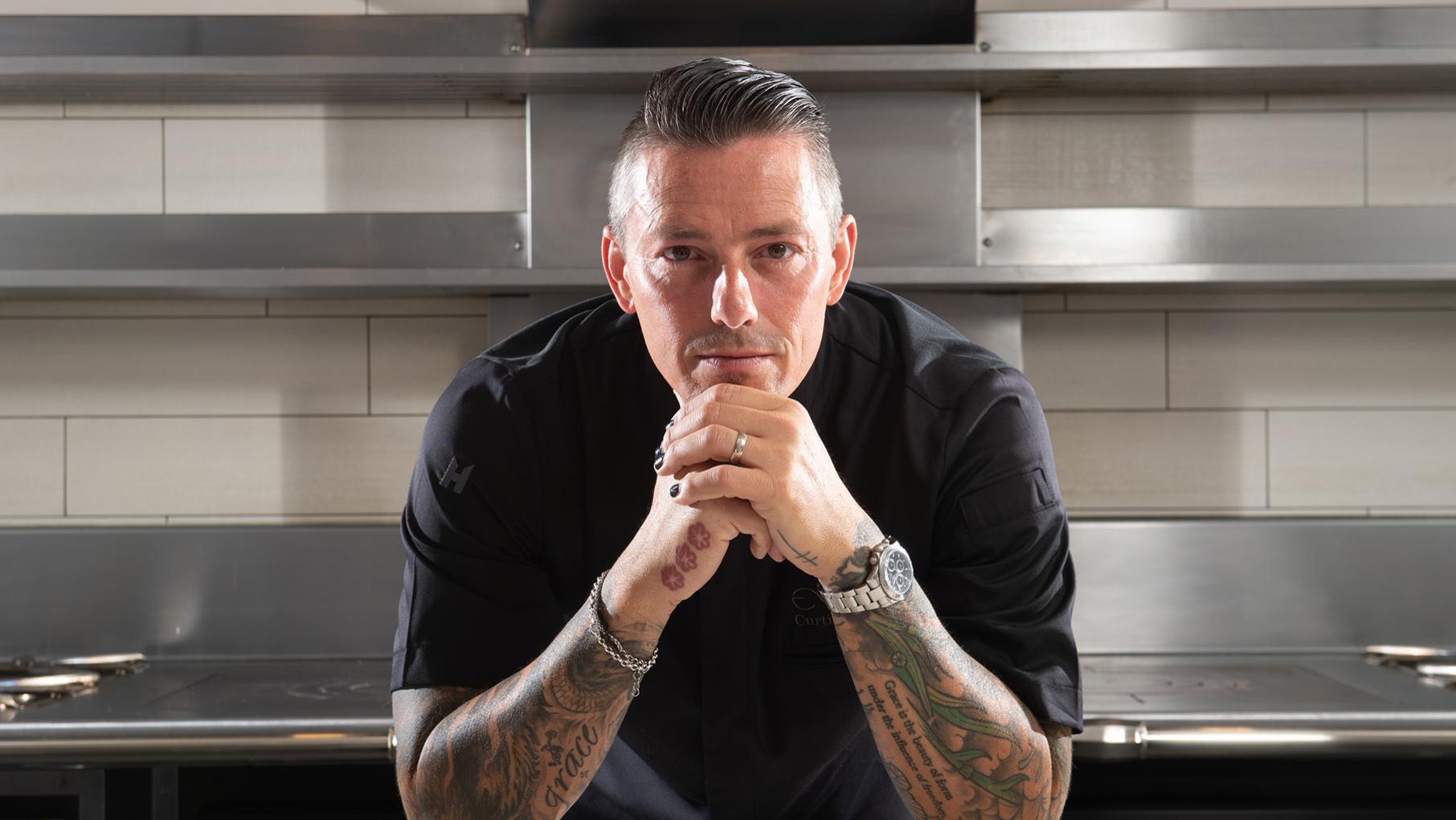
Ever gained widespread if unspoken fame by appearing as the world’s best restaurant in the popular TV series The Bear, while Duffy's neighboring cocktail lounge After appears as the set of another kitchen in the show. Despite Duffy’s quiet intensity and rock-star looks – chiseled facial features, sleek silver-streaked hair, black-painted fingernails – only his hands appear in the show, preparing dishes. But he sees certain parallels to his own experience in its exploration of the challenges of operating a restaurant in Chicago while dealing with the traumatic effects of a suicide in the family. (Despite the coincidence of his father’s nickname, The Bear is not based on Duffy.)
As the thirtieth anniversary of his parents’ death approached, Duffy considered hosting a dinner at Ever to honor them, inviting family members to celebrate them. He ended up working instead.
In addition to being something of an exorcism for himself, he hopes that Fireproof might help other people facing difficult pasts: “Seeing that somebody coming from such a dark childhood can bloom,” he says. “I channeled that darkness for a very long time and it helped me get to where I am today. It kept me not distracted by a bunch of noise.”
Fireproof is available August 5. A book tour includes several appearances in the Chicago area, including a live podcast recording of Supper with Sylvia on August 4 at After, Duffy’s cocktail lounge; an August 5 conversation with co-author Jeremy Wagner at the Barnes and Noble on Diversey Parkway; and a conversation with former Chicago Tribune restaurant critic Phil Vettel on August 18 at Anderson’s Bookshop in Naperville.