New Documentary Hosted by Brandis Friedman Explores the Legacy, Future of Historically Black Colleges and Universities
Meredith Francis
September 5, 2025
Opportunity, Access, and Uplift: The Evolving Legacy of HBCUs premieres Sunday, September 7 at 5:00 pm on WTTW and is available to stream.
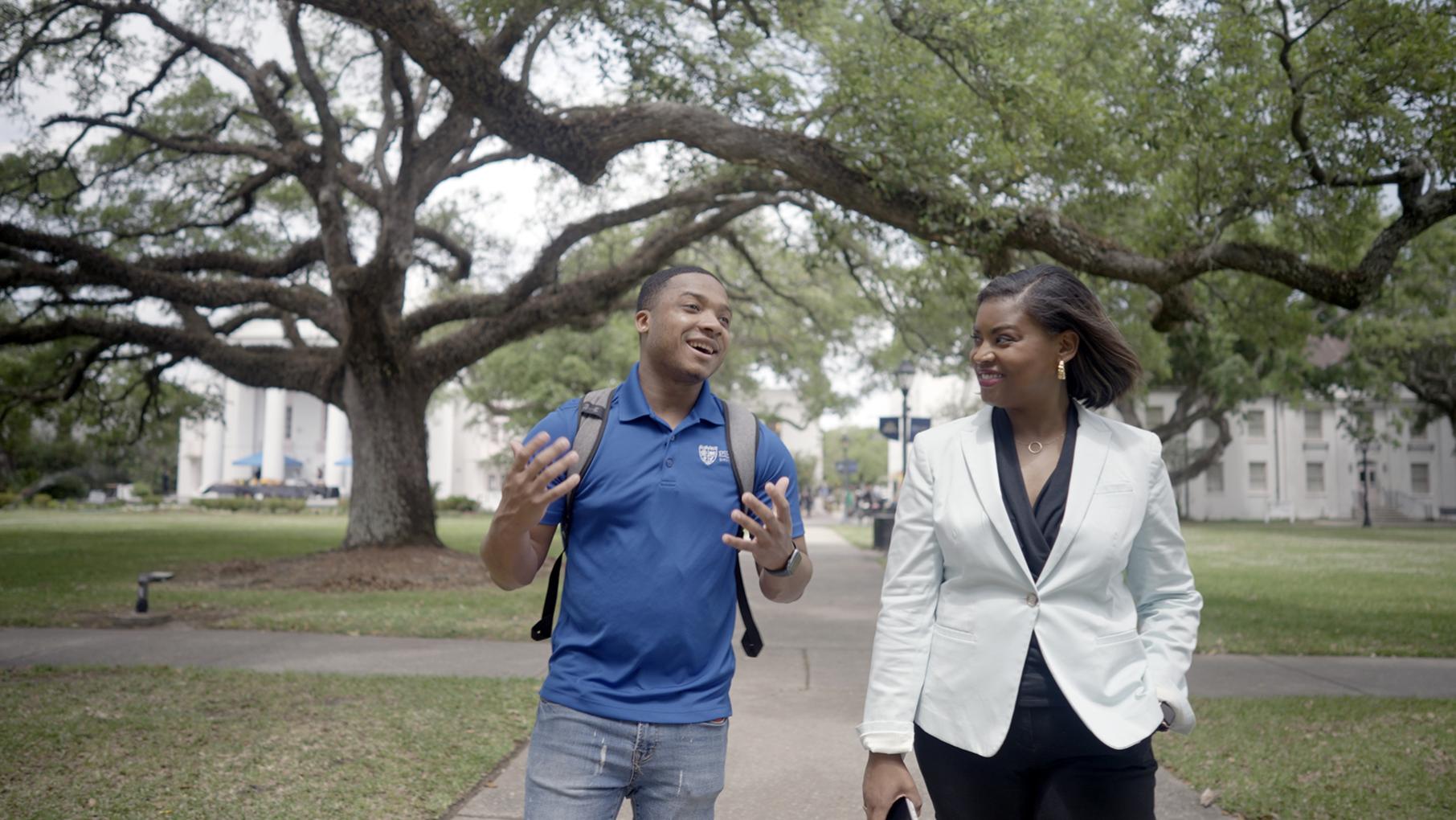
A new half-hour documentary hosted by Chicago Tonight anchor Brandis Friedman explores the history, misconceptions, and future of Historically Black Colleges and Universities, commonly called HBCUs. The film, Opportunity, Access, and Uplift: The Evolving Legacy of HBCUs, profiles five students from two different HBCUs – Dillard University (of which Friedman is an alum) and Delaware State University – as well as one high school student facing his college decision. WTTW spoke to Friedman about the documentary.
The following interview has been condensed and edited for clarity.
How did the idea for this documentary come about?
Friedman: Often when I tell people I went to college in New Orleans, they immediately ask, “Did you go to Tulane?” If I went to Tulane I would’ve said that! Then, I tell them I attended Dillard University. This leads to more questions. So, I explain that it’s a Historically Black University. This film gives me, and other HBCU grads, the opportunity to spread the word about the impact of HBCUs and introduce schools that not everyone has heard of. My parents, aunts, uncles, and sisters all attended HBCUs. It’s so familiar for us. So, when my co-producer David Duncan came to me with a seed of an idea, he reached out to me because he knew I attended an HBCU. And the rest is history.
HBCUs have been around for 190 years. What are some of the contributions of these institutions?
Friedman: Aside from the scores of well-known graduates (Chadwick Boseman, Oprah Winfrey, Phylicia Rashad, Megan Thee Stallion, Lionel Richie, Zora Neal Hurston, Stacey Abrams, Taraji P. Henson, former Vice President Kamala Harris, Michael Strahan, Samuel L. Jackson, Langston Hughes, and of course, Martin Luther King, Jr., to name a few), I think the greatest legacy of HBCUs is having produced the majority of the Black middle class (and some higher income Black graduates, too, obviously). Only in the last half or maybe the last third of the 20th century did predominantly white institutions (PWIs) begin to accept Black students. Over the years, millions of Blacks have graduated with college degrees and gone on to become teachers, doctors, judges, and so many other professionals who contribute to society. As I think the film shows, the schools have also become a foundation for many non-Black students who’ve found the academic, athletic, and social life they’re looking for in a college experience.
You interviewed five college students and one high school student with a variety of backgrounds. What did these students have in common in their experiences at HBCUs?
Friedman: One common thread I noticed in each interview, with each student, was the community they sought and found at their HBCUs. Each of them expressed finding familiarity and commonality with classmates, but also additional support from professors and staff in a way they hadn’t expected.
As the documentary points out, HBCUs are growing at twice the rate of other institutions, but they typically have lower endowments than predominantly white institutions. What did you discover are the biggest challenges – as well as opportunities – for the future of these institutions?
Friedman: The biggest challenges are likely the same challenges as other schools: funding. We hear UNCF President Michael Lomax say, “When America gets a cold, Black America gets the flu.” As the costs of higher education continue to rise, and universities notice funding cuts via the Department of Education or research grants being cut, those cuts hit schools with already smaller margins a bit harder. At the same time, these schools are demonstrating growth. So they’ll need to be able to accommodate that growth into the future.
One student talks about the importance of being seen in a wider variety of professional careers. She said she felt seen on an HBCU campus. What does her story reveal about the role these institutions play in providing students a sense of community?
Friedman: For me personally, attending an HBCU was a bit of a culture shock, going from a fairly diverse (or at least mostly Black and white) environment, to one that is predominantly Black. But I found it so fulfilling to spend time learning and growing with so many other Black students who come from varying communities and experiences.
The documentary briefly tells the story of a white civil rights activist who was kicked out of school for her political activity. She then attended an HBCU. These schools also welcomed Native American students. What does that say about the inclusive mission and values of HBCUs?
Friedman: I think it becomes pretty clear in the film that while HBCUs were started with the mission of educating Black students, it was never about educating only Black students. All students are welcome. Joan Trumpauer Mulholland, the Native American students you see in the film, and so many other faces and voices are reflective that HBCUs have always had a mission of inclusivity.
Why did this feel like the right time to tell the story of HBCUs in this way?
Friedman: It’s always the right time to tell the story of HBCUs. But I appreciate that this film is joining the conversation after the COVID pandemic, after the racial reckoning of 2020, and after the Supreme Court’s ruling on affirmative action. I think as HBCUs have demonstrated their openness and growth, they deserve to be remembered in the conversation about higher education.
What do you hope audiences take away from this documentary?
Friedman: I hope HBCU graduates take pride in seeing themselves and their experiences represented on-screen. And I hope folks who aren’t familiar with HBCUs come away with an appreciation for and an understanding of the contribution HBCUs have made, as well as their graduates.