A New Book Celebrates Chicago's Residential Architecture
Daniel Hautzinger
October 8, 2025
For a city with a history of devastating fires – a place that famously turned to fire-resistant materials after a hellish 1871 fire swept downtown – Chicago has a lot of wooden back porches. Multi-unit residential buildings were in fact required to have back porches by city building codes after the 1903 Iroquois Theater fire, which killed 602 people due in large part to design choices that ended up impeding panicked exits. So why choose flammable wood for an egress meant to save people from fire?
Wood is cheaper, and, “While it will burn, the wood should hold out long enough for the fire department to arrive – there are calculations for this that we just have to trust – and Chicago code specifies what wood must be used to ensure this is the case,” write Carla Bruni and Phil Thompson in their new book Chicago Homes: A Portrait of the City’s Everyday Architecture.
“I was really obsessed with back porches,” says Bruni. Not only their seeming vulnerability as a fire exit, but also their use as a public health tool. After the flu pandemic of the late 1910s, as germ science started to emerge, porches were a useful way to isolate a sick person in a crowded urban dwelling. “Uncle Joe is coughing up a lung inside your two-flat, and you stick him out on the porch like a sanitarium.”
The homes Chicagoans live in have both shaped and been shaped by the city’s history, as Chicago Homes reveals again and again. The materials they’re constructed from, their layouts, the size of lots they occupy: all of this has been dictated by the unique circumstances of Chicago, its geography, the movement of people, its politics. “Our homes are a physical expression of our history and if you know how to have a conversation with them, you can learn a whole lot about Chicago and its residents,” Bruni and Thompson write.
But Chicago’s residential architecture isn’t just a window into history, they argue – it’s also worth celebrating on its own, as rewarding of close attention as any of the more spectacular skyscrapers and public buildings that have made Chicago an influential, world-class architectural city.
“Downtown – I just don’t really care about it,” says Bruni with a laugh.
Instead, she prefers “learning about the vernacular and understanding how every city looks so different, especially as skyscrapers get increasingly ubiquitous. There are these glass and steel skyscrapers: you can be anywhere in the world, you see the same skyscrapers.” But the homes in the city’s neighborhoods? “I just am in love with them, and the little quirks of them.”
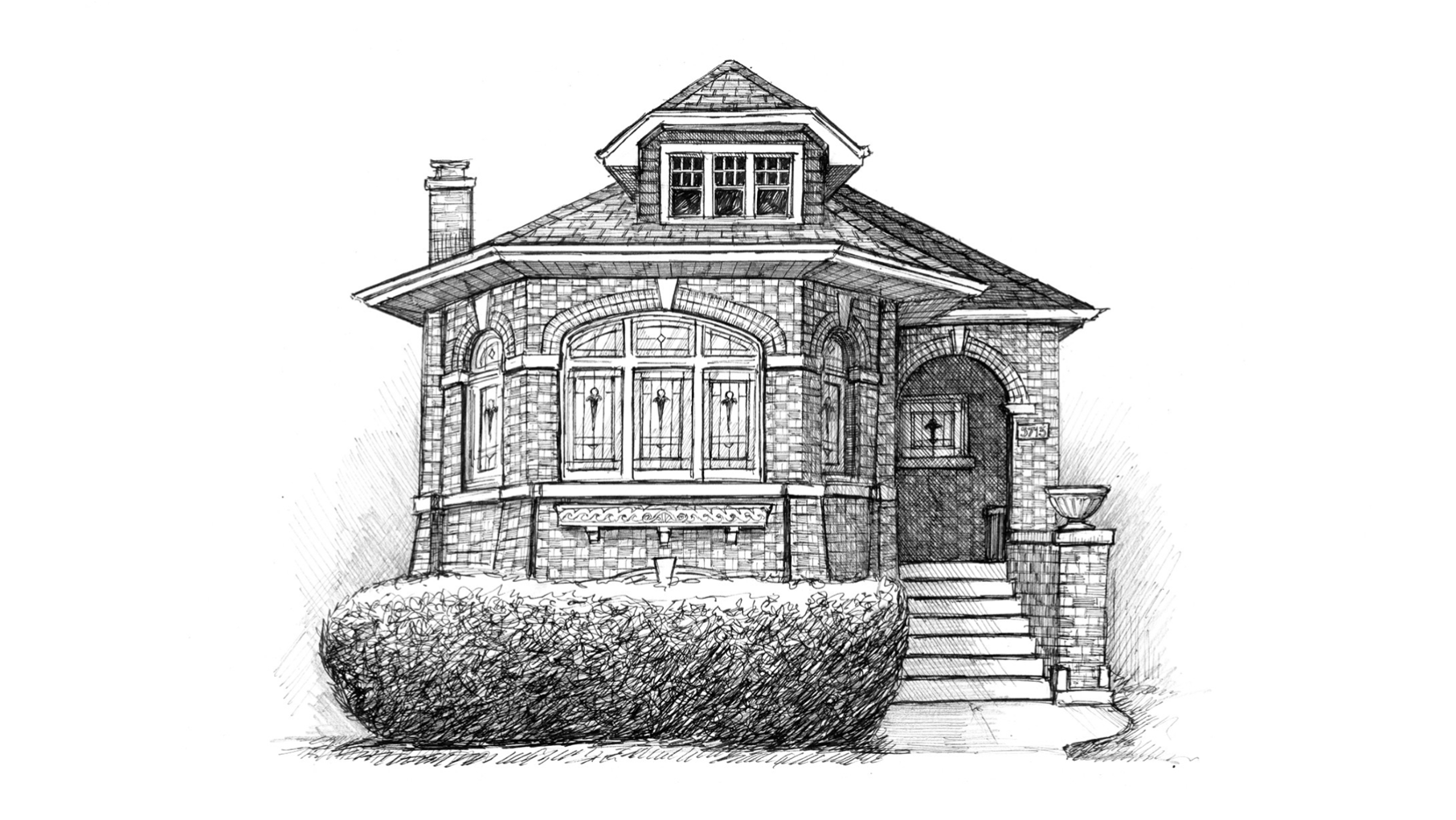
Those quirks are on vivid display in Chicago Homes via Thompson’s precise illustrations, even as the book outlines various architectural styles and home types to help “people who know what a greystone is but maybe not what a cornice is,” as the authors write, learn to identify features and discuss them.
Thompson is behind Wonder City Studio, which produces architectural drawings, maps, and more, including posters illustrating various types and styles of Chicago homes. “I’ve had an obsession with bottling the love and passion that I have for Chicago homes into some sort of artwork,” he says. “After a while, I decided that I wanted to do something that told more of the story of Chicago homes.”
For help, he turned to Bruni, an expert in historic preservation who has worked particularly closely with the Chicago Bungalow Association, helping to maintain and update those iconic Chicago homes. She had always wanted to write a book on architecture with an illustrator, so when Thompson approached her, she says, “I could not believe my luck.”
They found a publisher in Evanston-based Agate Publishing, which has an imprint focused on Chicago and the Midwest, and set about creating a book for a general audience “so that everybody can enjoy these things and talk about them,” in Bruni’s words.
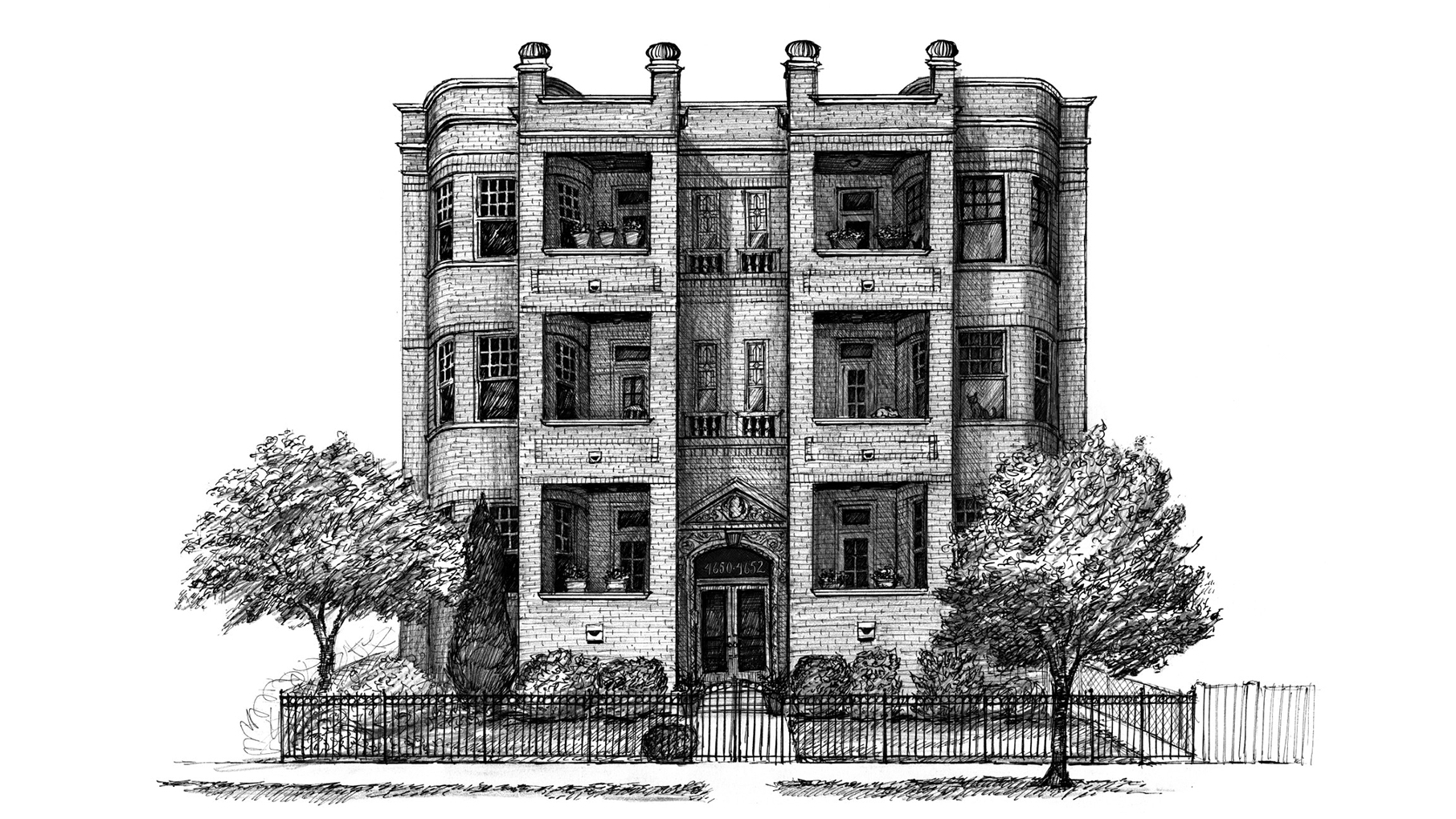
Thompson already had a vast archive of illustrations of homes, but he also drew many more to detail a specific historic period or style – including some homes that no longer exist, like that of Jean Baptiste Point DuSable, the first permanent, non-native settler of Chicago. An illustration of a 1912 six-flat that Thompson lived in for about a decade is included in the book.
“It’s just such a cool example of that middle housing that is so rare in this country, where it’s either single-family homes or gigantic apartment buildings,” he says of the six-flat, praising the community it creates.
Such historic multi-unit housing provides a lesson for today’s housing shortages that Bruni thinks is present in Chicago Homes, which ends its history with World War II. “We think we need a whole lot more space than we do,” she says. “From an environmental standpoint, it’s really critical that we work on density within existing buildings.”
Chicago Homes is meant in part to help people notice and cherish those existing historic buildings. “Taking care of what you have and seeing it as an investment for the future rather than just a flip would go a really long way,” Bruni says.