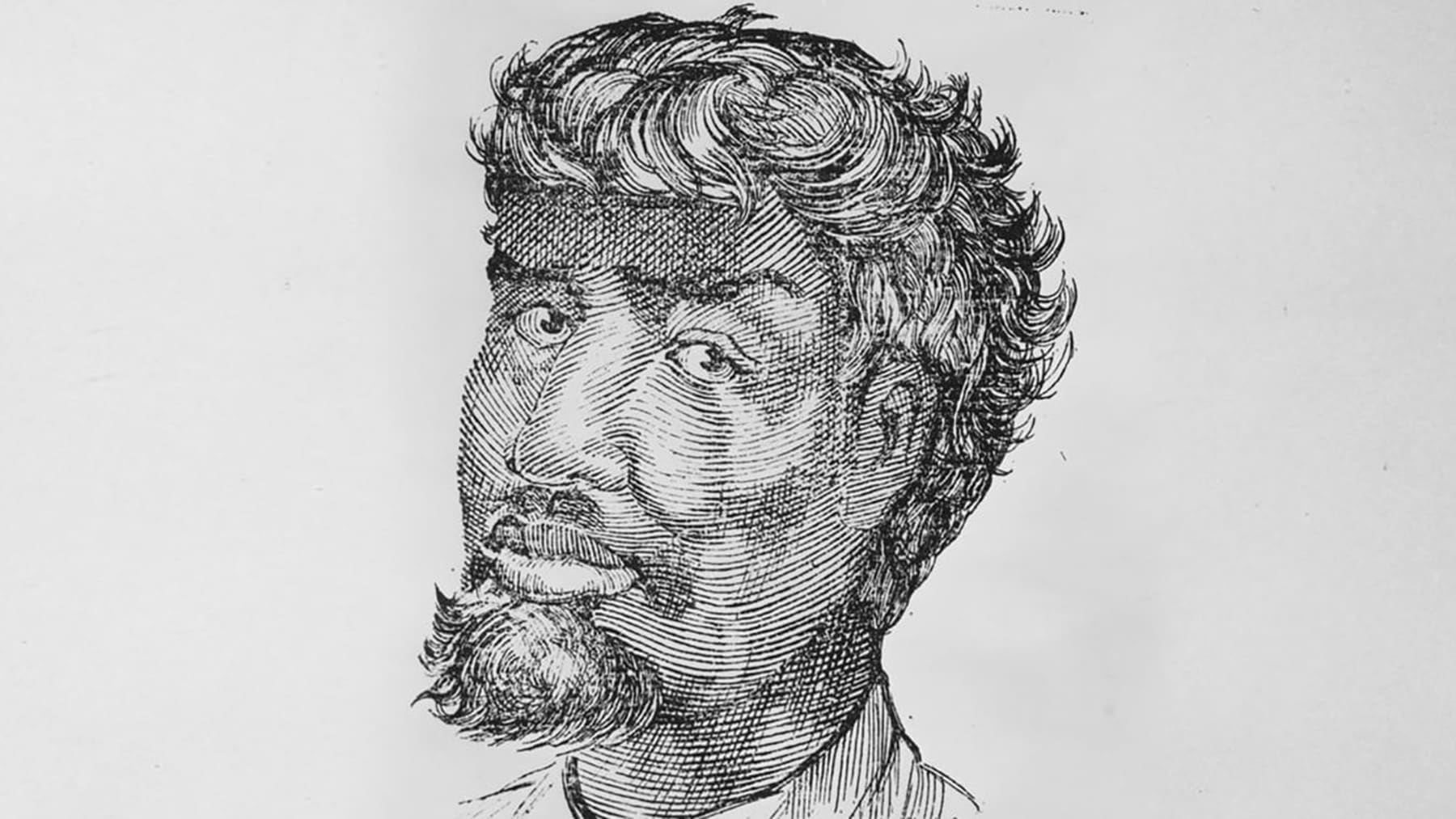
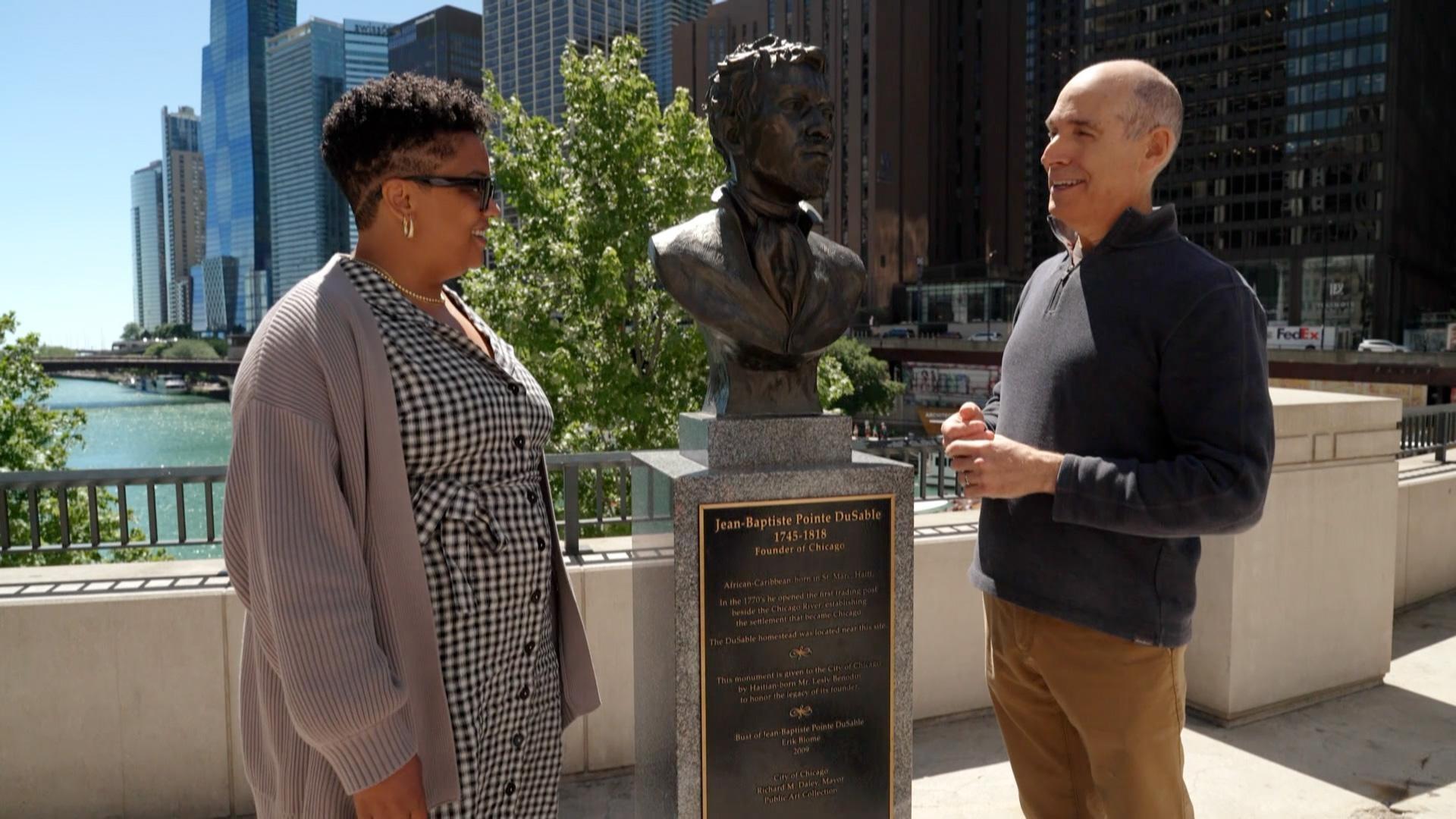
Just south of Tribune Tower at the Chicago River, among the throngs of tourists and bustle of commuters on Michigan Avenue, is a bust of a man who, in reality, we know very little about – including what he actually looked like. Throughout the city, there’s a major road named for him, plus a museum, a high school, a bridge, and a harbor. Jean Baptiste Point DuSable is recognized as the first permanent, non-native settler of Chicago, decades before it was formally established as a city in 1837, but many details of his life remain a mystery.
“Studying DuSable is not for the faint of heart,” said Courtney Pierre Joseph, associate professor of history and African American studies at Lake Forest College and an expert on DuSable.
One of her favorite archival sources about him describes him as a good host for the people who would come to trade with him at his post at the convergence of Lake Michigan and the Chicago River. The source also describes him as a “handsome Negro with an affinity for drink.”
“They said my man looked good! I was like, wow, how many times do you get that in a historical source? ‘An affinity for drink.’ Let me swipe right on that profile,” Joseph says with a laugh.
The remaining details of DuSable’s historical profile are a bit controversial among those who study him because some of what historians have learned come from oral history rather than written record.
“He’s a very contested figure, and it is largely because we don't have documentation about especially his early years of life,” Joseph said. “Most of what we know about him is from other people who knew him and wrote about him. We have few things from him in his own voice.”
So what do we know about DuSable?
DuSable’s Mysterious Early Life
DuSable was possibly born sometime around 1745 on the island of present day Haiti and the Dominican Republic. At that point, the island had been colonized by Spain and France, and its inhabitants were a blend of Indigenous peoples, Spanish, French, and enslaved people from Africa. Based on the oral history that endures, it is believed DuSable was born to a French father and an African mother. “Was she free? Was she enslaved? We don’t know,” Joseph said.
Joseph believes that DuSable had access to some kind of education or formal training through his father. He may have gone to school in France and learned how to sail and conduct maritime trade.
DuSable likely left the island around 1770 for other French territory, possibly New Orleans or parts of French Canada. He would have used waterways to travel, such as the Mississippi River, and that’s how he ended up in what is now Illinois. In DuSable’s travels, he encountered Indigenous tribes, including the Potawatami, and he married a Potawatami woman named Kitihawa (her name was recorded as Catherine in a Catholic marriage ceremony). By approximately 1780, he and Kitihawa settled at the convergence of the Chicago River and Lake Michigan in what would later be called Chicago, a name derived from words in the Algonquian language family, most commonly referring to the fragrant wild onions, leeks, or ramps that grew in the area.
At this point, Chicago was hardly a vast empty space. It was already a trading post inhabited by Indigenous peoples. But what makes DuSable stand out is this: “He decides to stay there and to build,” said Joseph. “He makes it Chicago 2.0.” He was the first non-Indigenous person to do so despite the brutal winters, which had scared off other potential settlers. The trading post began to boom.
What Was DuSable’s Life on Lake Michigan Like?
Historians know a little bit more about DuSable’s life in Chicago. Some of that information comes from a bill of sale for DuSable’s estate, dated 1800. If you were picturing DuSable’s homestead as a small cabin on a vacant frontier, you’d be mistaken. In the past, some historians have minimized the scope of DuSable’s estate and the extent of his presence. Joseph said the main house was impressive – with French-inspired doors, as well as French and indigenous art.
“The features on the bill of sale show us how expansive it is,” Joseph said.
In addition to the main house (noted as 40 feet by 20 feet), there was a horse mill, a bakehouse, a dairy, a smokehouse, a poultry house, a workshop, a stable, and a barn. The bill of sale also has a long list of equipment and household goods, plus 30 cattle, 2 calves, 38 hogs, 2 mules, and 44 hens.
So how did DuSable and his homestead manage to thrive? Joseph points to his relationship with the Indigenous peoples in the region.
“One of the things that makes him different or unique [from other settlers] is that he decides to really rely on the Indigenous folks who were living in the area and learn from them about the land and about trade,” Joseph said. “I think that his reverence for Indigenous people and indigenous culture is what makes him so successful.”
In fact, the British arrested DuSable during the American Revolution on suspicion of being an American sympathizer. “It was Indigenous people who demanded his release,” Joseph said.
His wife, Kitihawa, played an essential role in his positive relationship with tribes in the area. She likely translated for DuSable. If he was traveling the Midwestern waterways for the fur trade and if his homestead managed to survive and expand in a two-decade period, who was maintaining the business back at home?
“Has to be her!” Joseph said. “I think about Kitihawa as the engine of this story.”
DuSable and Kitihawa had two children together. At some point, Kitihawa died, as historians believe DuSable left Chicago without her in 1800.
How Did DuSable Shape the Future of Chicago?
DuSable died on August 28, 1818 in St. Charles, Missouri. He was buried in a cemetery that moved locations more than once, so his body is not with his grave marker.
If it were, historians and archeologists could reconstruct what he may have looked like or get answers about his heritage. Joseph also wishes that they had a birth certificate, the names of his parents, and where on the island he was born. But for now, those questions remain unanswered.
What is clear, however, is that DuSable and Kitihawa had a lasting impact on Chicago. He leveraged its waterways to expand it as a trading hub. A century later, Chicago had already become a major transportation and industrial hub for everything from meat processing to candy.
“It’s a bustling and important economic hub of the country and of the globe, and that’s because of what DuSable was able to build upon when he was here,” Joseph said.
Joseph, who grew up in Chicago and whose parents are Haitian immigrants, has found both personal connection and professional interest in DuSable’s story, which she believes is a positive reflection of the story of Chicago.
“When we talk about the history of Chicago, folks know all sorts of things that are often tied to violence…People will tell you about Al Capone. People talk to you about gang violence. People will talk to you about the corruption of our politicians,” she said. “The history of DuSable tells you a much better story about Chicago, a much fuller story about Chicago – one that makes it make sense as this space where all sorts of multi-ethnic communities live and build businesses and families and communities.”