How to Watch ‘The American Revolution’ – And A Complete List of Other Ken Burns Documentaries
Meredith Francis
November 13, 2025
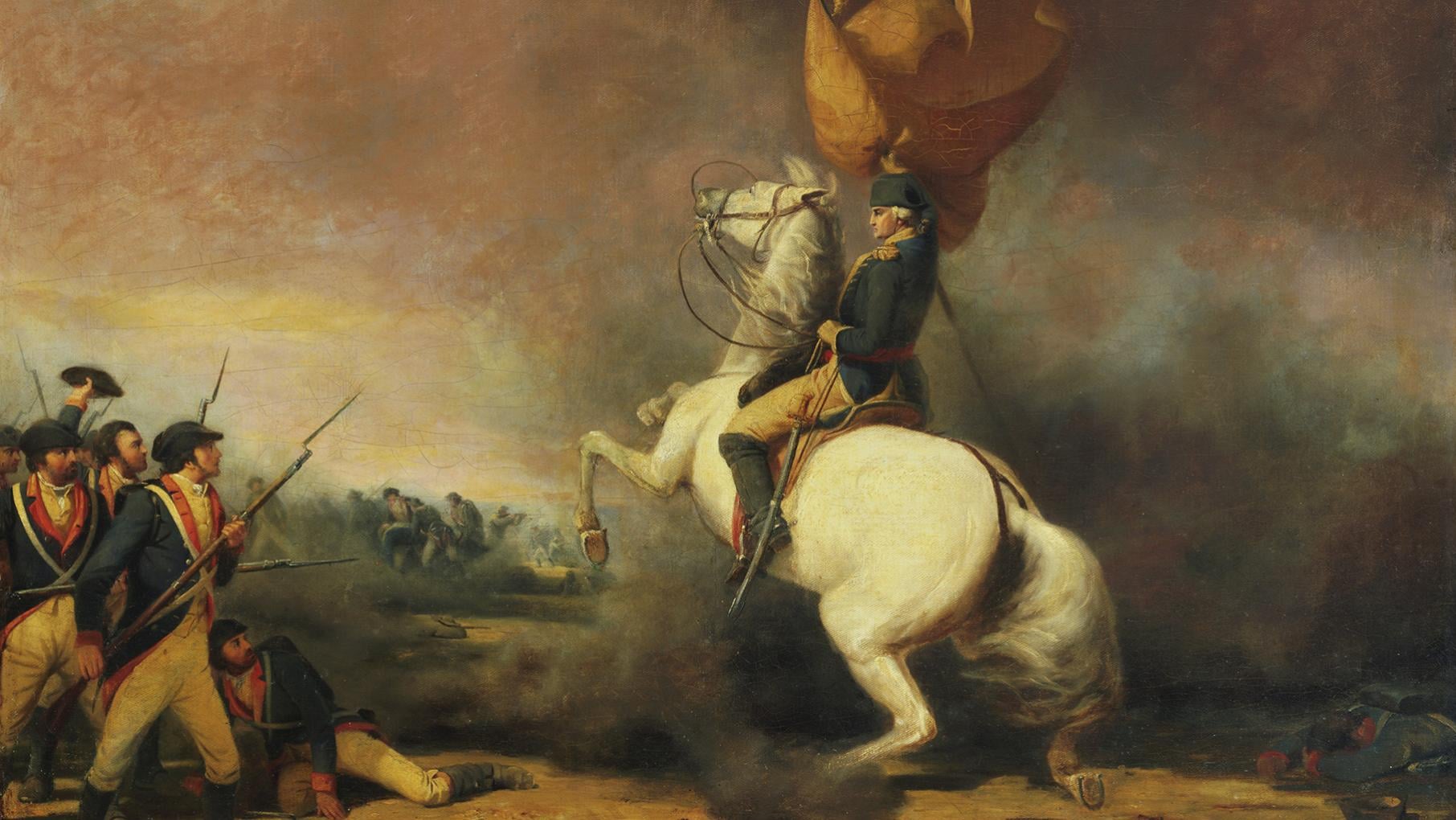
The American Revolution, a new 6-part film from Ken Burns, premieres on WTTW on Sunday, November 16 through Friday, November 21 at 7:00 pm. This sweeping documentary explores how 13 colonies rose against the British Empire, won independence, and launched a new form of government that reshaped the world.
All six parts of The American Revolution will be free to stream on the PBS app starting Sunday, November 16 at 7:00 pm and will be available until Sunday, December 14.
You can also watch it on WTTW as it airs (click here for additional air times):
Part 1: In Order to Be Free (1754–1775)
November 16 at 7:00 pm
Part 2: An Asylum for Mankind (May 1775 – July 1776)
November 17 at 7:00 pm
Part 3: The Times That Try Men’s Souls (July 1776 – January 1777)
November 18 at 7:00 pm
Part 4: Conquer by a Drawn Game (January 1777 – February 1778)
November 19 at 7:00 pm
Part 5: The Soul of All America (December 1777 – May 1780)
November 20 at 7:00 pm
Part 6: The Most Sacred Thing (May 1780 – Onward)
November 21 at 7:00 pm
Plus, with a WTTW Passport membership, you can stream the entire Ken Burns collection on the PBS app. Below is a complete list of the Ken Burns-directed documentaries you can stream, in reverse chronological order.
Leonardo da Vinci
2024
A 15th century polymath of soaring imagination and profound intellect, Leonardo da Vinci created some of the most revered works of art of all time, but his artistic endeavors often seemed peripheral to his pursuits in science and engineering. Through his paintings and thousands of pages of drawings and writings, Leonardo da Vinci explores one of humankind’s most curious and innovative minds. Discover more at wttw.com/davinci.
The American Buffalo
2023
The American Buffalo takes viewers on a journey through more than 10,000 years of North American history and across some of the continent’s most iconic landscapes, tracing the animal’s evolution, significance to the Great Plains, near demise, and relationship to the indigenous people of North America. Discover more at wttw.com/americanbuffalo.
The U.S. and the Holocaust
2022
The U.S. and the Holocaust examines the rise of Hitler and Nazism in Germany in the context of global antisemitism and racism, immigration, and eugenics in the United States, and race laws in the American South. Discover more at wttw.com/the-us-and-the-holocaust.
Benjamin Franklin
2022
Benjamin Franklin explores the revolutionary life of one of the 18th century’s most consequential figures, whose work and words unlocked the mystery of electricity and helped create the United States. Discover more at wttw.com/ken-burns-benjamin-franklin.
Muhammad Ali
2021
Muhammad Ali brings to life one of the most indelible figures of the 20th century, a three-time heavyweight boxing champion who captivated millions of fans across the world with his mesmerizing combination of speed, grace, and power in the ring, and charm and playful boasting outside of it. Ali insisted on being himself unconditionally and became a global icon and inspiration to people everywhere, and spent a significant amount of his life in Chicago. Discover more at wttw.com/muhammad-ali
Hemingway
2021
Hemingway examines the visionary work and the turbulent life of Ernest Hemingway, one of the greatest and most influential writers America has ever produced. (Hemingway was born in the Chicago suburb of Oak Park.) Interweaving his eventful biography – a life lived at the ultimately treacherous nexus of art, fame, and celebrity – with carefully selected excerpts from his iconic short stories, novels, and non-fiction, the series reveals the brilliant, ambitious, charismatic, and complicated man behind the myth, and the art he created. Discover more at wttw.com/hemingway.
Country Music
2019
Explore the history of a uniquely American art form: country music. From its deep and tangled roots in ballads, blues, and hymns performed in small settings to its worldwide popularity, learn how country music evolved over the course of the 20th century, as it eventually emerged to become America’s music. Country Music features never-before-seen footage and photographs, plus interviews with more than 80 country music artists. Discover more at wttw.com/country-music.
The Vietnam War
2017
The Vietnam War tells the epic story of one of the most consequential, divisive, and controversial events in American history as it has never before been told on film. Visceral and immersive, the series explores the human dimensions of the war through revelatory testimony of nearly 80 witnesses from all sides – Americans who fought in the war and others who opposed it, as well as combatants and civilians from North and South Vietnam. Discover more at wttw.com/vietnam-war.
Defying the Nazis
2016
Defying the Nazis: The Sharps’ War is an account of a daring rescue mission that occurred on the precipice of World War II. It tells the previously untold story of Waitstill and Martha Sharp, an American minister and his wife from Wellesley, Massachusetts, who left their children behind in the care of their parish and boldly committed to a life-threatening mission in Europe. Over two dangerous years they helped to save scores of imperiled Jews and refugees fleeing Nazi occupation across Europe.
Jackie Robinson
2016
Jackie Robinson tells the story of an American icon whose lifelong battle for first class citizenship for all African Americans transcends even his remarkable athletic achievements. “Jackie Robinson,” Martin Luther King Jr. once said, “was a sit-inner before sit-ins, a freedom rider before freedom rides.”
The Roosevelts: An Intimate History
2014
The Roosevelts: An Intimate History chronicles the lives of Theodore, Franklin, and Eleanor Roosevelt, three members of the most prominent and influential family in American politics. It is the first time in a major documentary television series that their individual stories have been interwoven into a single narrative. This seven-part, fourteen-hour film follows the Roosevelts for more than a century.
The Address
2014
At the tiny Greenwood School in Putney, Vermont, fifty boys, ages 11 to 17, struggle through myriad learning differences to memorize and recite the Gettysburg Address, a rite of passage at the school for the last 35 years. Interweaving the history of this most famous of American speeches with the contemporary journey of the boys at Greenwood, The Address reveals the timeless resonance of Lincoln’s words, while culminating in the triumph of the human spirit.
The Central Park Five
2012
In 1989, five black and Latino teenagers from Harlem were arrested and later convicted of raping a white woman in New York City’s Central Park. They spent between 6 and 13 years in prison before a serial rapist confessed that he alone had committed the crime, leading to their convictions being overturned. Set against a backdrop of a decaying city beset by violence and racial tension, The Central Park Five tells the story of that horrific crime, the rush to judgment by the police, a media clamoring for sensational stories, an outraged public, and the five lives upended by this miscarriage of justice.
The Dust Bowl
2012
It was the worst man-made ecological disaster in American history, in which the heedless actions of thousands of individual farmers, encouraged by their government and influenced by global markets, resulted in a collective tragedy that nearly swept away the breadbasket of the nation. The Dust Bowl chronicles this critical moment in American history in all its complexities and profound human drama. It is part oral history, using compelling interviews of 26 survivors of those hard times – what will probably be the last recorded testimony of the generation that lived through the Dust Bowl.
Prohibition
2011
Prohibition tells the story of the rise, rule, and fall of the Eighteenth Amendment to the U.S. Constitution and the entire era it encompassed. The culmination of nearly a century of activism, Prohibition was intended to improve, even to ennoble, the lives of all Americans, to protect individuals, families, and society at large from the devastating effects of alcohol abuse. But the enshrining of a faith-driven moral code in the Constitution paradoxically caused millions of Americans to rethink their definition of morality.
The Tenth Inning
2010
The Tenth Inning updates the landmark 1994 series, Baseball. Beginning where the original series left off, The Tenth Inning is based on the premise that this seemingly simple stick and ball game continues to be a window through which it is possible to see the best, as well as the worst, of America. Beginning in the early 1990s, the film tells the tumultuous story of our national pastime up to the present day, introducing an unforgettable array of players, teams and fans, celebrating the game’s resilience and enduring appeal, and showcasing a succession of extraordinary accomplishments and heroics – and devastating losses and disappointments.
The National Parks: America’s Best Idea
2009
Filmed over the course of more than six years at some of nature’s most spectacular locales – from Acadia to Yosemite, Yellowstone to the Grand Canyon, the Everglades of Florida to the Gates of the Arctic in Alaska – The National Parks: America’s Best Idea is nonetheless a story of people: people from every conceivable background who were willing to devote themselves to saving some precious portion of the land they loved and in doing so reminded their fellow citizens of the full meaning of democracy.
The War
2007
The War tells the story of the Second World War through the personal accounts of a handful of men and women from four quintessentially American towns. The series explores the most intimate human dimensions of the greatest cataclysm in history – a worldwide catastrophe that touched the lives of every family on every street in every town in America – and demonstrates that in extraordinary times, there are no ordinary lives.
Unforgivable Blackness: The Rise and Fall of Jack Johnson
2005
Unforgivable Blackness: The Rise and Fall of Jack Johnson tells the story of the first African American boxer to win the most coveted title in all of sports and his struggle, in and out of the ring, to live his life as a free man. The film follows Johnson’s remarkable journey from his humble beginnings in Galveston, Texas, as the son of former slaves, to his entry into the brutal world of professional boxing, where, in turn-of-the-century Jim Crow America, “Heavyweight Champion of the World” was an exclusively “white title.” Despite the odds, Johnson was able to batter his way up through the professional ranks, and in 1908 he became the first African American to earn the heavyweight championship.
Horatio’s Drive
2003
In the spring of 1903, on a whim and a fifty-dollar bet, Dr. Horatio Nelson Jackson set off from San Francisco in a 20-horsepower Winton touring car hoping to become the first person to cross the United States in the new-fangled “horseless carriage.” Horatio’s Drive tells the story of America’s first transcontinental road trip, which, like all road trips that would follow, included the usual mix of breakdowns and flat tires, inedible meals and uncomfortable beds, getting lost and enduring bad weather – and having a truly unforgettable experience crossing the nation’s vast landscape. Throughout it all, Jackson’s indomitable spirit and sheer enthusiasm would prove to be as indispensable as the fuel for his car.
Mark Twain
2002
Mark Twain tells the story of the writer’s extraordinary life – full of rollicking adventure, stupendous success and crushing defeat, hilarious comedy, and almost unbearable tragedy. Considered in his time the funniest man on earth, Twain was an unflinching critic of human nature who used his humor to attack hypocrisy, greed, and racism. By the end, the film helps us to see how Twain could claim with some justification, “I am not an American, I am the American.”
Jazz
2001
Jazz is a ten part series that explores the evolution – and the genius – of America’s greatest original art form, focusing on the extraordinary men and women who could do something remarkable: Create art on the spot. Jazz celebrates their profoundly enduring, endlessly varied, and infinitely alluring music in the context of the complicated country that gave birth to and influenced it, and was in turn transformed by it.
Not For Ourselves Alone: The Story of Elizabeth Cady Stanton & Susan B. Anthony
1999
Not For Ourselves Alone: The Story of Elizabeth Cady Stanton & Susan B. Anthony tells the little-known story of one of the most compelling political movements and friendships in American history. Elizabeth Cady Stanton and Susan B. Anthony were born into a world ruled entirely by men and for more than half a century led the fight to win the most basic civil rights for women. Their story is filled with love and loyalty, envy and betrayal, and raises larger questions of principle and compromise, achievement and ends, and the meaning of independence itself.
Frank Lloyd Wright
1998
Frank Lloyd Wright tells the story of the greatest of all American architects. Wright was an authentic American genius, a man who believed he was destined to redesign the world, creating everything anew. Over the course of his long career, he designed over eight hundred buildings, including such revolutionary structures as the Guggenheim Museum, the Johnson Wax Building, Fallingwater, Unity Temple, and Taliesin – many in and around Chicago. His buildings and his ideas changed the way we live, work, and see the world around us.
Lewis and Clark: The Journey of the Corps of Discovery
1997
Sent by President Thomas Jefferson in 1804 to find the fabled Northwest Passage, Meriwether Lewis and William Clark led the most important expedition in American history – a voyage of danger and discovery from St. Louis to the headwaters of the Missouri River, over the Continental Divide to the Pacific Ocean. It was the United States’ first exploration of the West and one of the nation’s most enduring adventures. Lewis & Clark: The Journey of the Corps of Discovery tells the remarkable story of the entire Corps of Discovery – not just of the two Captains, but the young army men, French-Canadian boatmen, Clark’s African-American slave, and the Shoshone woman named Sacagawea.
Thomas Jefferson
1997
Thomas Jefferson is a two-part portrait of one of the most fascinating and complicated figures ever to walk across America’s public stage – our enigmatic and brilliant third president. Thomas Jefferson embodies within his own life the most profound contradictions of American history: as the author of our most sacred document, the Declaration of Independence, he gave voice to our fervent desire for freedom, but he also owned more than 150 human beings and never saw fit to free them.
Baseball
1994
Baseball is a nine-part series that examines nearly 200 years of American history through the prism of our national pastime. Americans have played baseball in one form or another since the early 19th century, while they conquered a continent, warred with one another and with enemies abroad, struggled over labor and civil rights and the meaning of freedom. At the game’s heart lie mythic contradictions: it is a pastoral game that was actually born in crowded cities, an exhilarating democratic sport that tolerates cheating – and has excluded as many as it has included, a profoundly conservative game that has sometimes managed to be years ahead of its time.
Empire of the Air: The Men Who Made Radio
1991
For 50 years, radio dominated the airwaves and the American consciousness as the first “mass medium.” Empire of the Air examines the lives of three remarkable men who shared the primary responsibility for this invention and its early success, and whose genius, friendship, rivalry, and enmity combined in unexpected and often tragic ways. This is the story of Lee de Forest, a clergyman’s flamboyant son, who invented the audion tube; Edwin Howard Armstrong, a brilliant, withdrawn inventor who pioneered FM technology; and David Sarnoff, a hard-driving Russian immigrant who created the most powerful communications company on earth.
The Civil War
1990
The Civil War is a nine-part series that explores the most important conflict in our nation’s history. The war was fought in 10,000 places, more than 3 million Americans fought in it, and over 600,000 men – 2 percent of the population – died in it. It saw the end of slavery and the downfall of a Southern planter aristocracy. It was the watershed of a new political and economic order, and the beginning of big industry, big business, big government. It was the first modern war and, for Americans, the costliest, yielding the most American casualties and the greatest domestic suffering, spiritually and physically. It was the most horrible, necessary, intimate, acrimonious, mean-spirited, and heroic conflict the nation has ever known. The Civil War is the highest rated and the most celebrated documentary in public television’s history.
The Congress
1988
This portrait of the United States Congress explores the history and promise of one of the country’s most important and least understood institutions. It tells the story of the Capitol building itself – including its burning by the British in the War of 1812 and its completion in the midst of the Civil War – and chronicles the extraordinary personalities, events, and issues that have animated the first 200 years of Congress and, in turn, the country.
Thomas Hart Benton
1988
His paintings were burly, energetic, and as uncompromising as the midwestern landscapes and laborers they celebrated. Thomas Hart Benton was a self-reliant American emerging from the Depression. Today his works hang in museums. During his life, Benton preferred to hang them in saloons, where ordinary people could appreciate them in congenial settings. A fierce defender of the aesthetics of realism, Benton took on the art establishment and railed against abstraction. His reputation suffered as his star rose, fell, and rose once again. Thomas Hart Benton tells the bittersweet story of a great American artist who became emblematic of the price all artists must pay to remain true to their talents and themselves.
Huey Long
1985
He was a populist hero and a corrupt demagogue, hailed as a champion of the poor and reviled as a dictator. Louisiana’s Huey Long built his remarkable career as Governor and U.S. Senator on a platform of social reform and justice, all the while employing graft and corruption to get what he wanted. Long’s spellbinding personality and political machine might have taken him to the White House had he not been assassinated in 1935. Huey Long is a complex and comprehensive portrait of the man and the era, his politics and the power he so obsessively sought.
The Statue of Liberty
1985
For more than 135 years the Statue of Liberty has been a symbol of hope and refuge for generations of immigrants. In interviews with Americans from all walks of life, including former New York governor Mario Cuomo, the late congresswoman Barbara Jordan, and the late writers James Baldwin and Jerzy Kosinski, The Statue of Liberty examines the nature of liberty and the significance of the statue to American life.
The Shakers
1984
They called themselves the United Society of Believers in Christ’s Second Appearing, but because of their ecstatic dancing, the world called them “Shakers.” Though they were celibate, they constitute the most enduring religious experiment in American history. They believed in pacifism as well as natural health and hygiene; for more than 200 years, they insisted that their followers strive for simplicity and perfection in everything they did. The Shakers put their “hands to work and their hearts to God,” creating an exquisite legacy of fine furniture, glorious architecture, and beautiful music that will remain and inspire long after the last Shaker is gone.
Brooklyn Bridge
1981
The “Great East River Bridge” was the largest bridge of its era, a technical achievement of unparalleled scope, marked by enormous construction problems, equally ingenious solutions, and heroic human achievement. In unexpected and wonderful ways, the Brooklyn Bridge captured the imagination of all Americans, and in the process became a symbol in American culture of strength, vitality, ingenuity, and promise. Brooklyn Bridge tells the dramatic story of the larger-than-life men who imagined and built it, and the immense charm this granite and steel structure has exerted on generations of city dwellers.