Spinning J Celebrates Its Tenth Anniversary With a Behind-the-Scenes Podcast Revealing the Challenges of Independent Restaurants
Lisa Shames
November 20, 2025
Get more recipes, food news, and stories at wttw.com/food or by signing up for our Deep Dish newsletter.
Have a food story or recommendation? Email us at [email protected].
When celebrating a tenth wedding anniversary, gifts made from tin or aluminum (traditional) or diamonds (modern) are customary. But what do you get a small, independent restaurant that’s lasted a decade in today’s challenging market?
For Dinah Grossman, owner of Spinning J Bakery and Soda Fountain, the answer comes in the form of a podcast mini-series that tells the story of her Humboldt Park business, the obstacles she’s faced, and the long-time employees who have been instrumental in its survival and success.
For the four-part series, titled “Jewel Box: The Story of Spinning J," available with new episodes weekly wherever you listen to podcasts, Grossman partnered with local journalist and audio producer Cody Nelson.
“Part of this is in response to the flashiness of all the celebrity chefs and everyone's need to be the shiny, new thing,” says Grossman. “We're not shiny and new anymore, but why isn't it worth telling the stories about the people who are showing up day after day and doing the same thing in order be a part of people's everyday lives and help anchor the community?”
In July 2015, Grossman opened Spinning J after spending five years making her sought-after pies first out of her apartment and later in a shared professional kitchen.
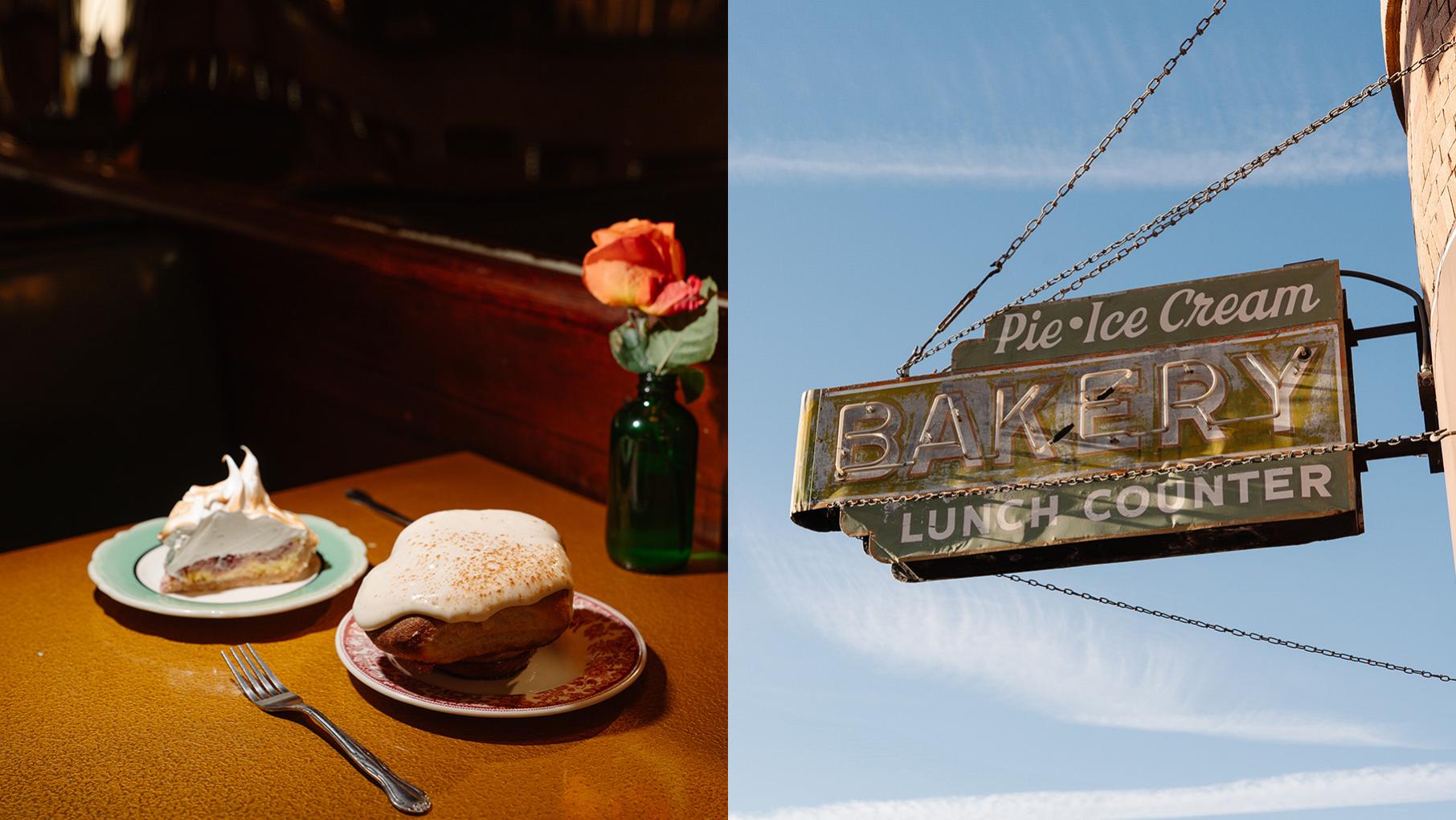
When a friend told her about a unique storefront for rent in Humboldt Park near to where she had been living for the last 15 years, she was intrigued. Once she saw the space, formerly an art gallery and a pharmacy before that, its vintage vibe felt right as the perfect complement to her traditional American style baked goods, which include buttery biscuits, savory pot pies, cinnamon rolls, and classic cookies in addition to pies.
“The landlord was receptive, and he took a chance on us, and we took a chance on the neighborhood, which was very different a decade ago,” says Grossman. “I'm really glad we did.”
Fitting the building’s 100-year-old history, Grossman decorated her “jewel box” with items that were either vintage or secondhand. That includes the 1928 Liquid Carbonic marble bar, barstools, and foot rail that were originally created for Sangor Drug in Milwaukee, the same soda fountain her grandmother visited as a child growing up in Wisconsin. Mix-matched soda glasses and china add to the throwback charm.
In the larger scheme of things, ten years might not seem that long, but in the hospitality industry it’s a different story. The running joke is that restaurant years are more akin to dog years, with many not making it to the five-year mark, let along ten. According to market research firm Datassential, 542 restaurants closed in Chicago between January and September of 2024, down from the previous year, which saw 898 closings.
None of that is lost on Grossman, who, in response to a June Chicago Tribune editorial blaming the elimination of the subminimum wage for tipped workers for the increase in independent restaurant closures, told her side of the story in a letter to the editor describing the challenges restaurateurs face today.
“Chicago restaurants are in crisis – but not because of their employees or the people advocating for them,” she wrote. “The crisis is structural. The math no longer adds up, but wages are just one line item. And yet, the only way through is with talented, fairly paid people. The day I look into replacing my bakers with robots is the day I close my doors for the last time. My people aren’t the problem. They never have been.”
That letter got a lot of support from other small business owners. “There are so many invisible factors that people just don’t understand that we’re dealing with every day,” says Grossman. “I’m hoping this podcast could help shine a light on what some of those challenges are and what it’s really like for all these small places that are struggling.”
The podcast benefits from the combination of Grossman’s and Nelson’s talent: Grossman has a background in creative writing and documentary studies, while Nelson has worked as an investigative reporter and radio producer.
“We have a really similar vision on the type of story we wanted to tell, of the low-key miracle that is keeping a business like hers alive, where you can pay people a living wage and be a place where people want to work for years and years,” says Nelson.
One such employee is Richard Ridinger, Spinning J’s overnight baker and longest-tenured employee, who was hired six months after the bakery opened. His partner, Brigid Schabes, is the pastry manager and another long-time employee. The two met while working at Spinning J. To tell their story, Nelson spent time at their home as well as their workplace.
“The sound-rich narrative-heavy podcasts have gone away,” says Nelson.
All the podcast episodes are almost entirely non-narrated. “It's a very old and largely forgotten style of making radio that’s a bit more of an intense listening experience,” says Nelson.
Another podcast topic addresses real estate and how dependent small businesses are on the relationships they have with their landlords. “We don't own the building, and that is always a source of instability,” says Grossman. “As long as you don't own your home, you never know that you're absolutely going to have one. It's a big issue for restaurants and small businesses.” Adds Nelson, “I don't believe there are guarantees in anything, but there are way fewer when you have a short-term contract.”
Grossman recently renewed her Spinning J lease for another five years, and with that comes changes. “Ten years marks something; we survived COVID and the full extent of our lease term, and we're starting again,” says Grossman. “What are we going to do to make it for another five to ten-plus years? What does that look like for us and what do we want to be besides a neighborhood spot, and how can we contribute to the conversation?”
The restaurant recently obtained a liquor license, a combination of a change in an antiquated law – “Chicago is not an easy place to run a business,” says Grossman – and the green light from their landlord.
Additionally, starting in January, Spinning J will reopen for dinner, something it hasn’t done since before COVID. The return of Friday pizza nights is in the works, too, as is house-made gelato, a new menu item.
While some things are changing, plenty is staying the same, including in-demand dishes like key lime hibiscus pie, breakfast sandwiches, and quiche. “We always have something new going on, but we also want to be a comforting place where people can come and get what they know they like and want,” says Grossman.
And then there’s Spinning J’s staff. “They've all worked together here for so long that there is a sense of community and family just within the restaurant, and that's hugely valuable to enjoy being around the people you work with,” says Grossman. “We've really taken care of each other over the years.”