How Kasama Became the Most Recognized Chicago Restaurant of the Decade
Daniel Hautzinger
April 15, 2026
Get more recipes, food news, and stories at wttw.com/food or by signing up for our Deep Dish newsletter.
Have a food story or recommendation? Email us at [email protected].
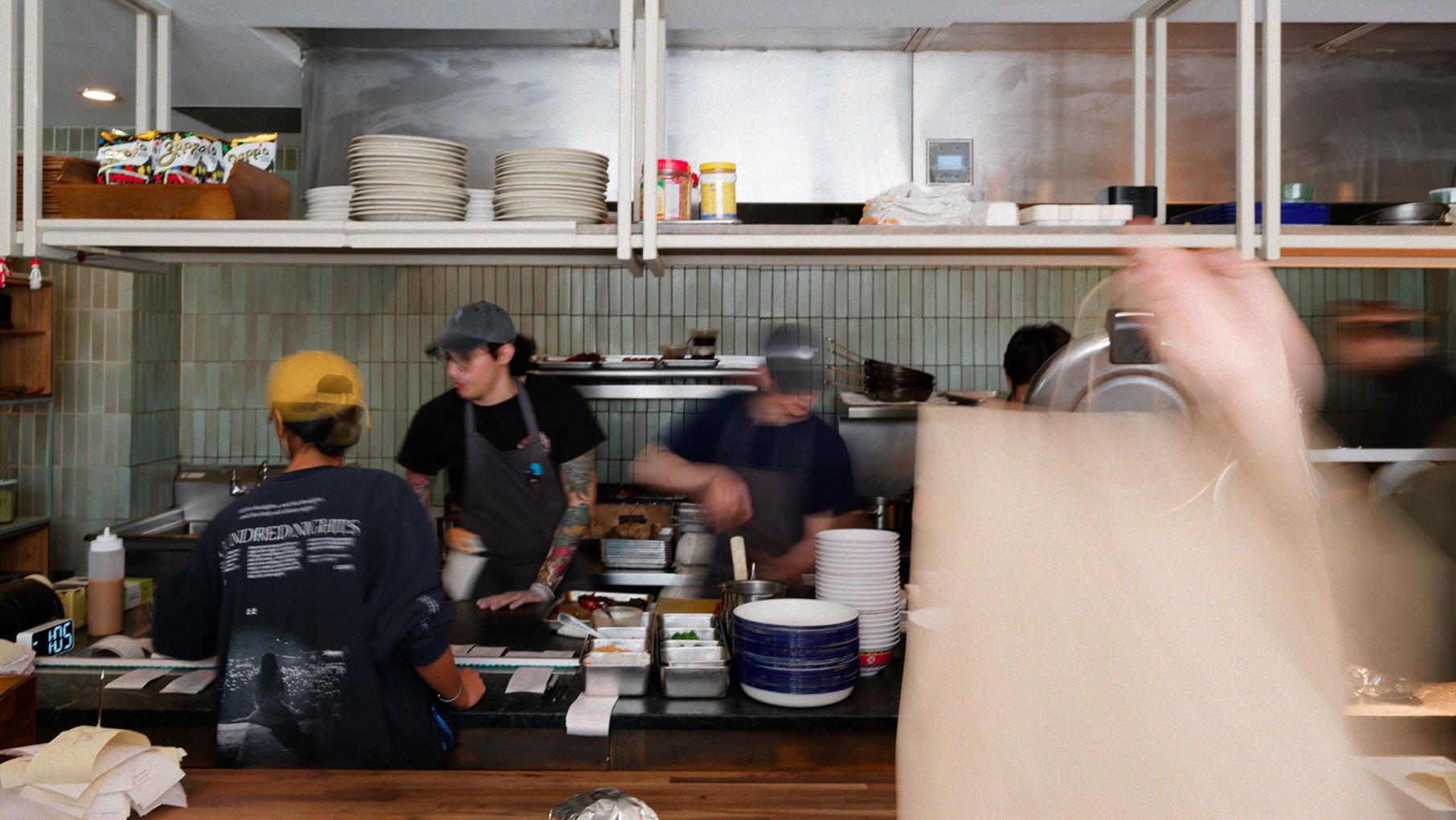
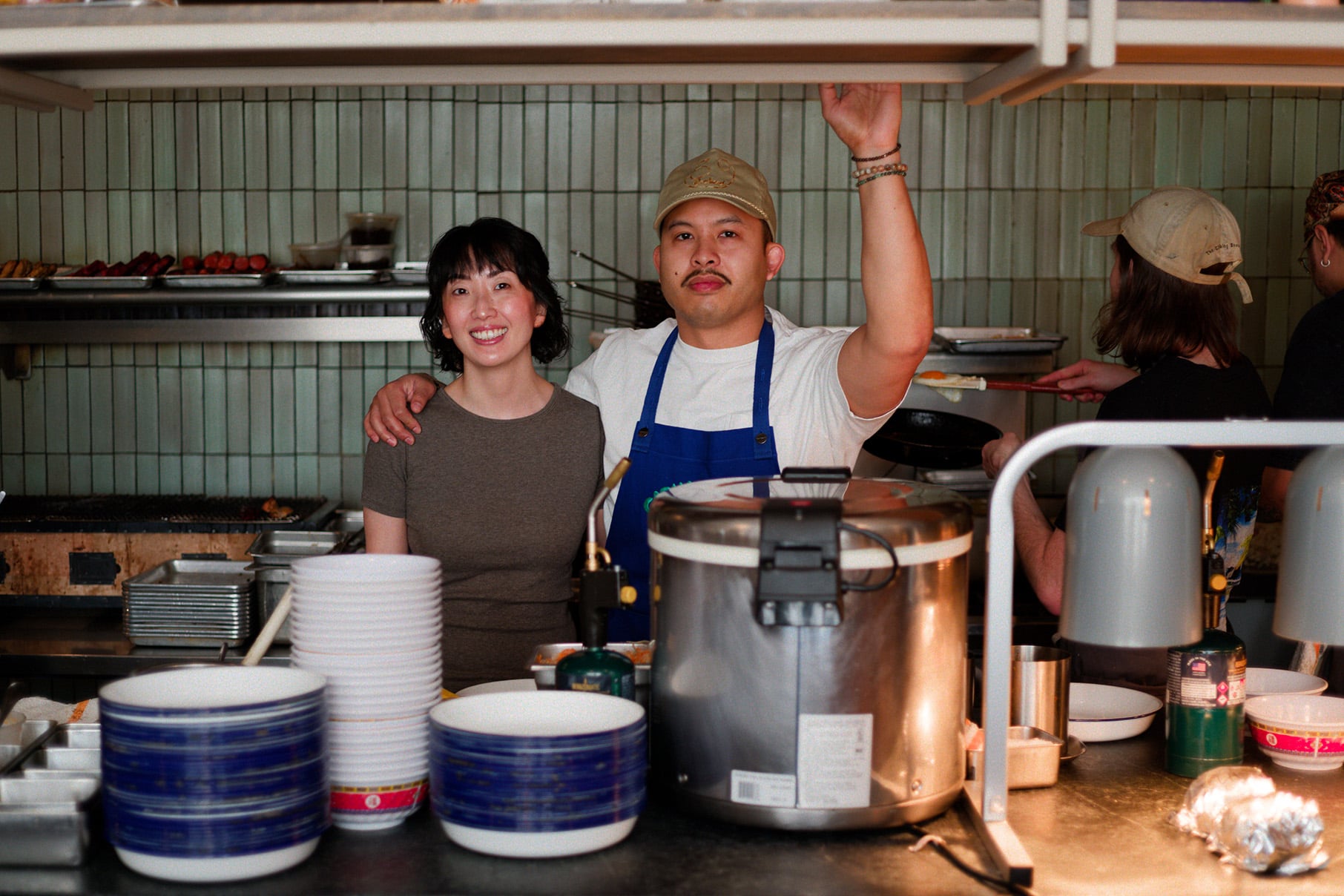
Kasama has two and a half hours to transform itself from a counter-service brunch place to a fine-dining spot with a 13-course tasting menu. There’s a lot of work to be done before the meticulous dinner crew can take over the main kitchen of the small Filipino restaurant from the breakfast sandwich-slinging morning cooks.
“Everything is coming off of the same line, so of course we have to wait for all of the daytime guests to be finished and leave,” said Genie Kwon, the pastry chef who owns Kasama with her husband, chef Tim Flores.
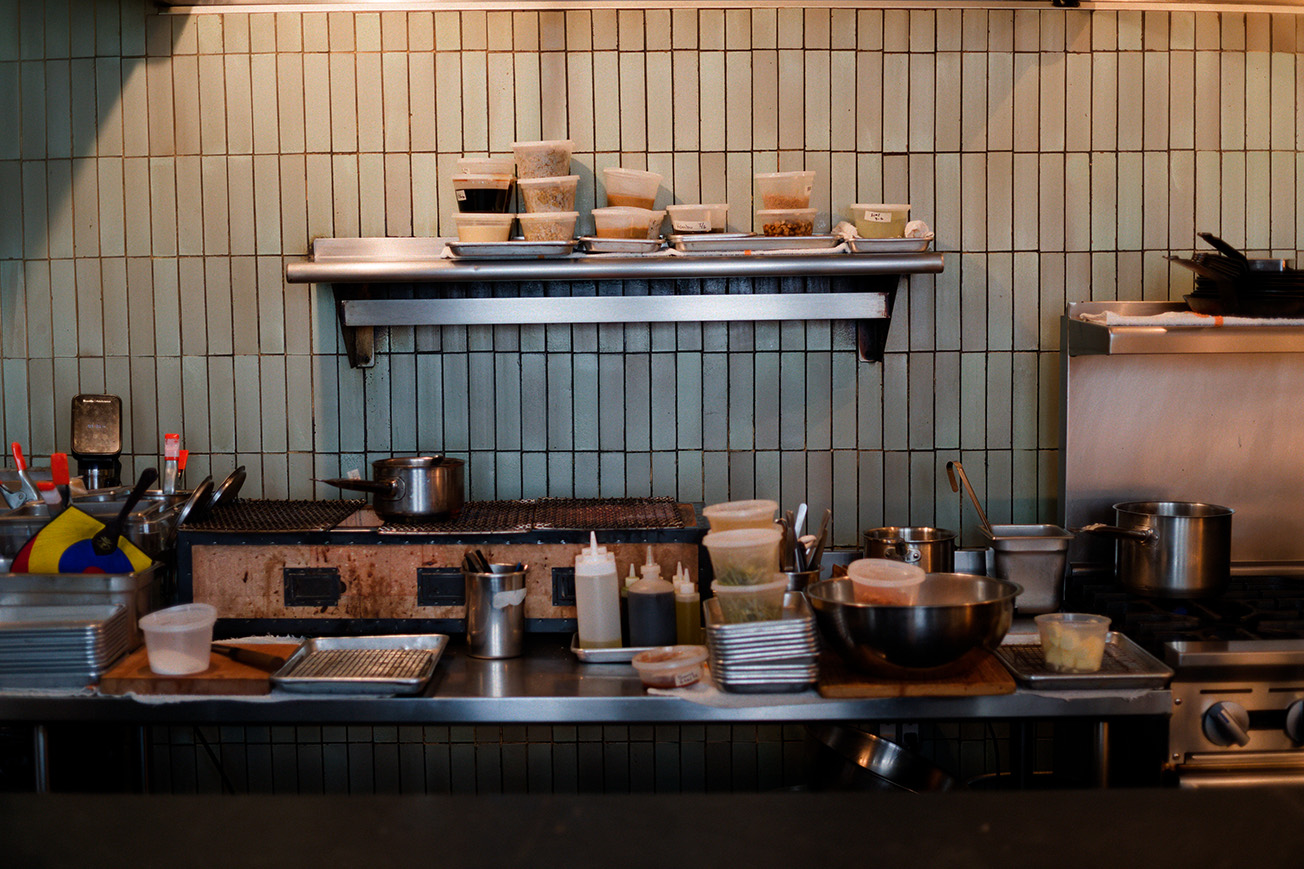
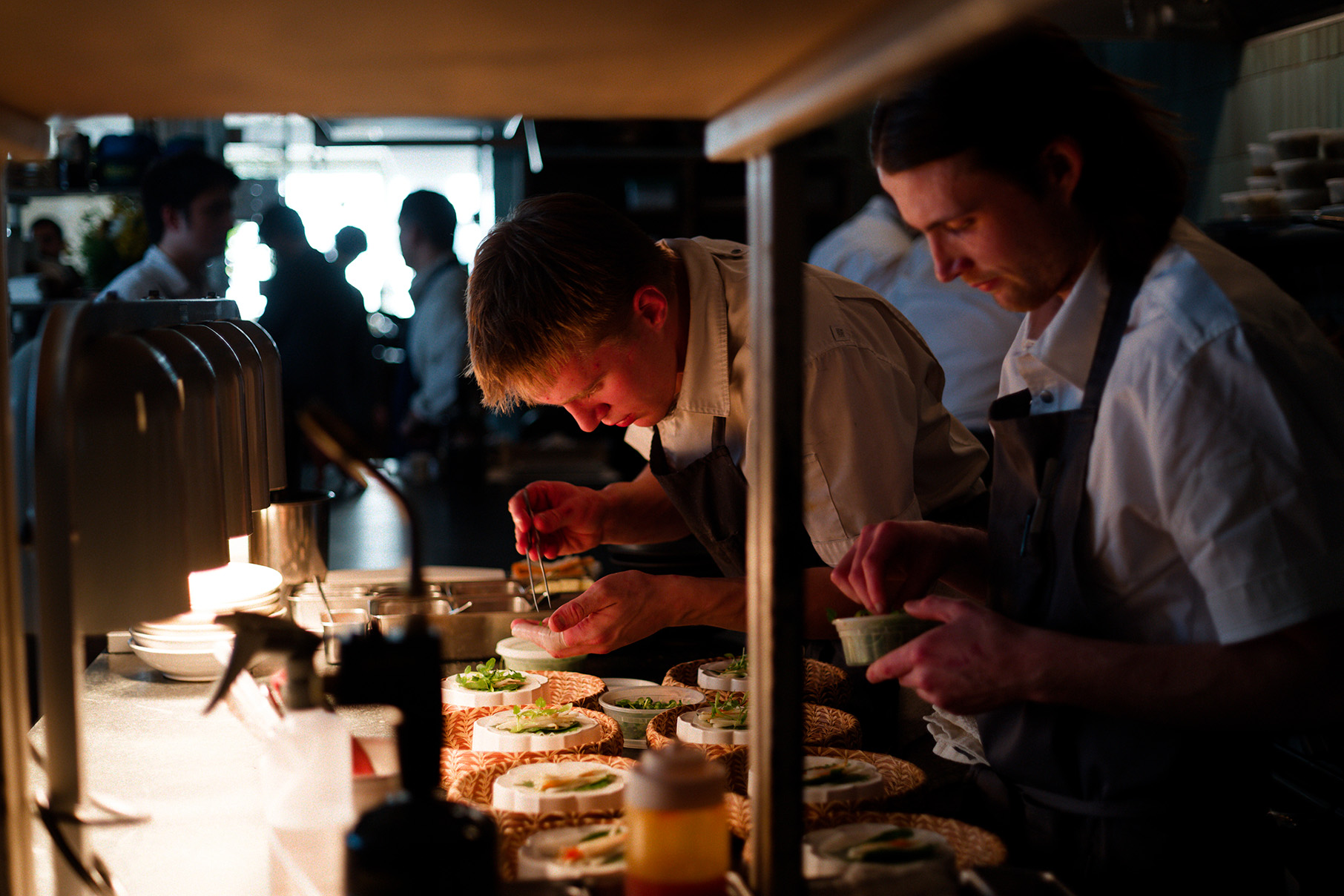
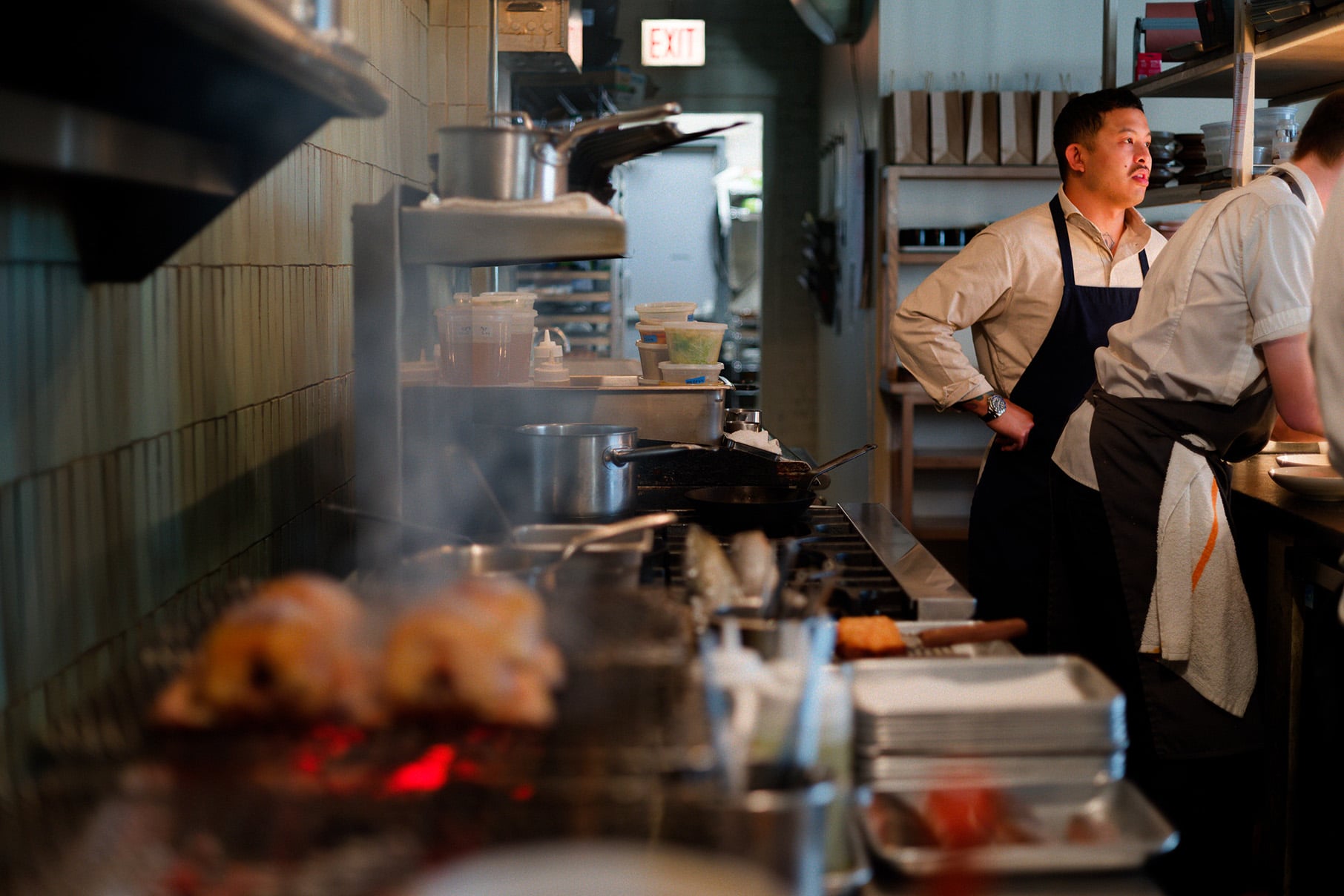
On a warm winter Sunday afternoon, front of house manager Molly Mrzlak smiled as she maneuvered a stroller belonging to the last morning customers, leading the couple and their baby past stores of ingredients through a back service door that was more accommodating to the stroller. The path led them past the open kitchen where the morning cooks finishing their day cleaned alongside evening staff early in their shifts. Once every surface was swept or wiped down and every counter and appliance restored, the evening team began to set up their stations. Cooks neatly arranged squeeze bottles of vinegar and oil and deli containers of okra and radishes from the upstairs prep kitchen near cooktops and plating stations. Bakers continued to work on flatbreads and truffle croissants for dinner upstairs. In the other half of the restaurant, the noisy morning bustle gave way to the friendly chatter of the front of house staff as they swept, mopped, vacuumed, and stowed the detritus of the morning.
“It seems like controlled chaos,” Kwon said. “It does take a lot of effort for our team, but they really do make it look pretty seamless and easy.”
She sat near the kitchen eating a bowl of fish chowder prepared upstairs by sous chef George Hardy for the staff meal. She was wearing a thrifted denim jacket with a large portrait of a bull terrier bedecked with an Elizabethan ruff and tiara on the back; she and Flores have two bull terriers named Longanisa and Egg, after two components of Kasama’s legendary breakfast sandwich. The only other person eating was Flores, who skipped straight to the dessert of cobbler a la mode.
“We’re just in the way at this point,” Kwon said, almost six years into refining the processes of the popular restaurant.
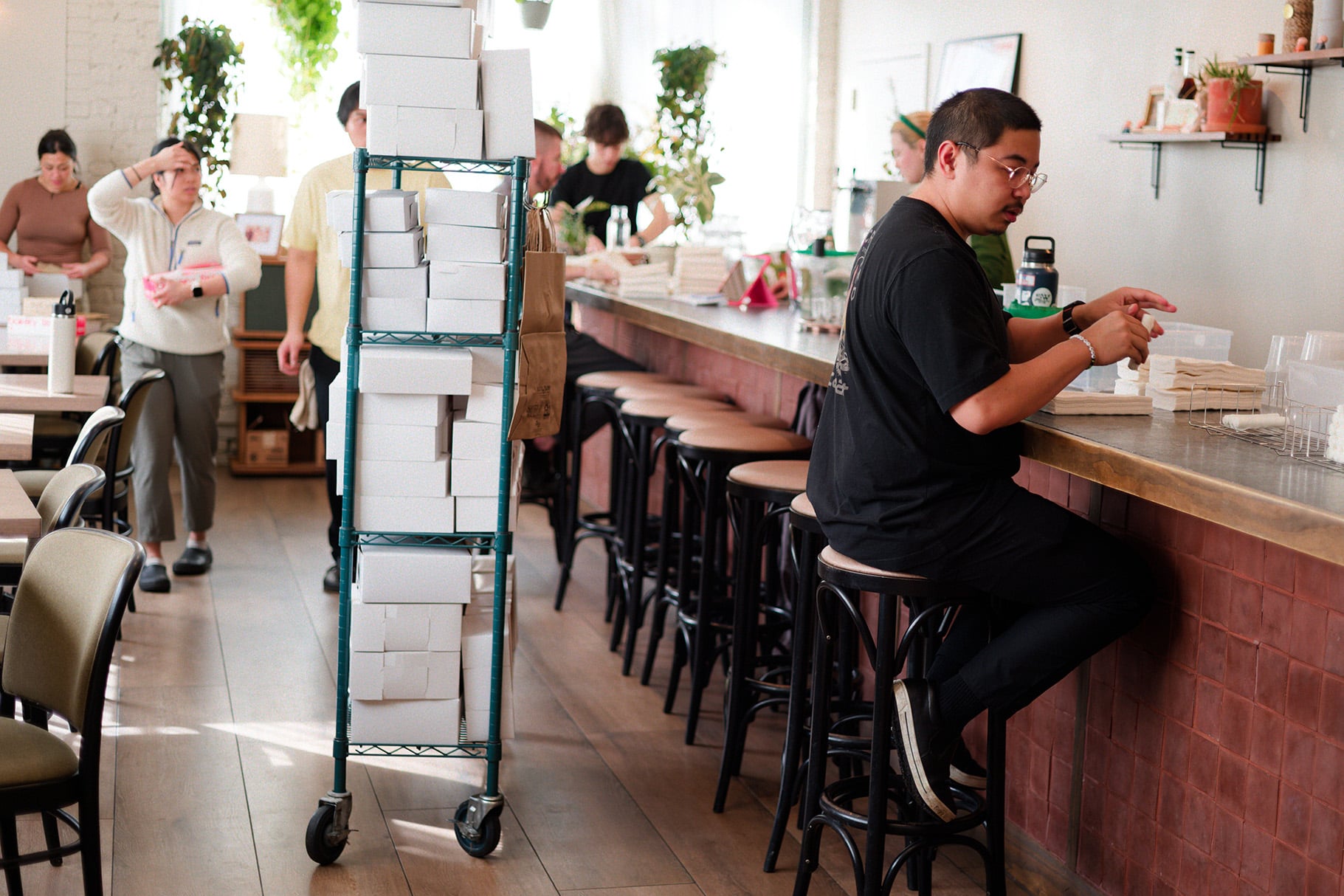
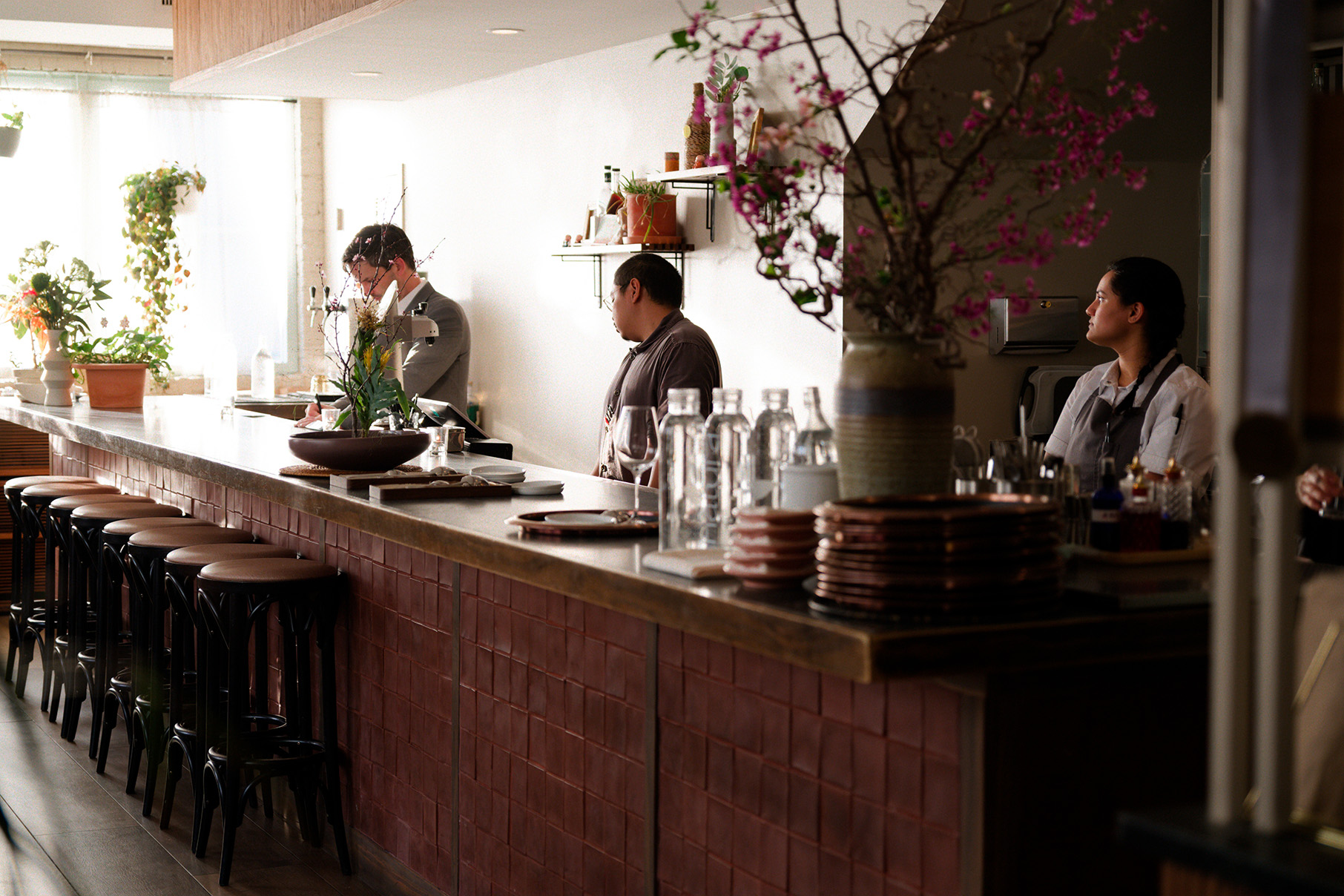
As dishwashers and cooks from both teams joined them to eat, the morning front of house staff assembled cardboard pastry boxes to be stored until the next morning service. Tables were removed to create more intimate settings for the tasting menu; a few received the attention of a screwdriver to alleviate wobbling. Evening servers rolled towels, cut paper into individual menus, and prepped the bar. Someone swapped out paper for cloth towels in the bathrooms. Floral arrangements bloomed throughout the restaurant.
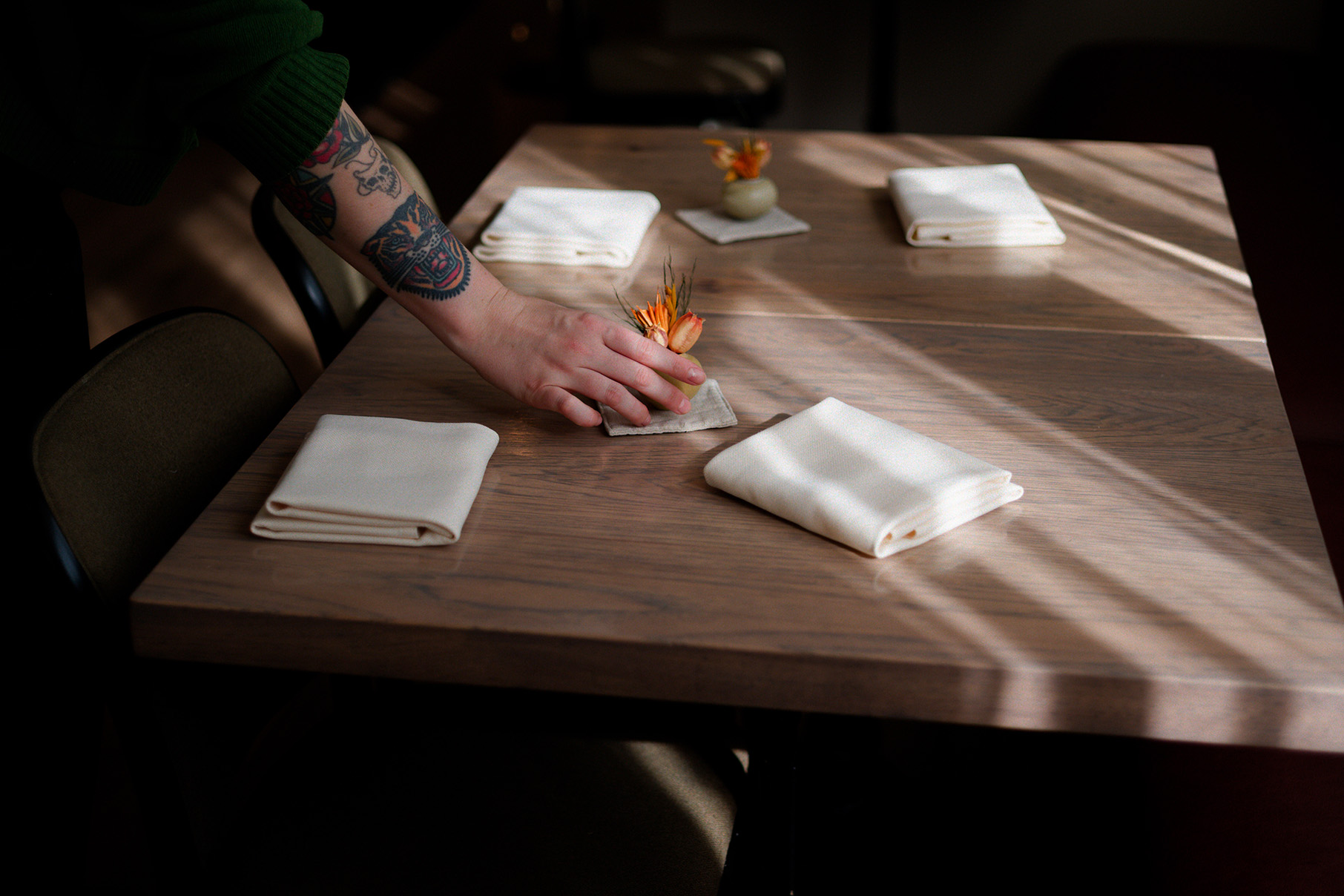
By the time the evening front of house staff sat down for their staff meal during a pre-shift meeting in which Flores, Hardy, and general manager Josh Daws outlined the allergens and special occasions of the evening’s diners, everyone else had eaten and the morning teams had left for the day. Whole squabs had replaced the morning’s chicken skewers on a charcoal grill and the breakfast sandwich station was now filled with fresh herbs and vegetables. There were caviar and careful portions of fish instead of fried eggs and bricks of meatloaf at the expo station. All the tables were set with napkins and tiny vases, candles flickered near flowers at the pastry case-turned host stand, and a hush had settled in with the golden evening light.
"A Culinary Chameleon"
Kasama is the most recognzied Chicago restaurant of the decade. The accolades keep coming: a James Beard Award, Food & Wine’s best restaurants in the U.S., the All-Time Eater 38, Robb Report’s Most Powerful People in American Fine Dining. It was the first Filipino restaurant to be awarded a Michelin star, and became one of only four Chicago restaurants with two stars last year. Both the restaurant’s food and Kwon have appeared in The Bear, and Kwon and Flores are in demand across the world for collaborative dinners. Kasama’s status as a travel destination is evident from the number of rolling suitcases you’ll see in the line that stretches down the block every morning that they’re open.
Kasama is the latest in a lineage of Chicago restaurants – Le Francais, Charlie Trotter’s, Alinea – that are influential nationwide and have gained widespread recognition outside the world of food elites. It was an early and prominent mixed-use restaurant in the U.S., a harbinger of restaurateurs maximizing their profit potential post-pandemic by offering different concepts – coffee, light lunch, wine bar, dinner – throughout the day. Kwon was a pastry chef who wanted to open a bakery before the pandemic led many other pastry chefs to do the same. She’s also in a vanguard of bakers incorporating global flavors into Western pastries, such as her matcha pandan éclair or famous ube and huckleberry Basque cake. Flores’ application of fine-dining technique to family recipes – especially those of a cuisine less known outside an immigrant community – is emblematic of some of the most admired restaurants in the country right now. Kasama is at the crest of a Filipino food renaissance in Chicago. The restaurant has even received media coverage in the Philippines.
“I think what’s most impressive is that chefs Tim and Genie and the rest of the Kasama team are able to run a restaurant that can pull triple duty as a fine dining spot, breakfast/lunch spot, and bakery,” emailed John Ringor, a Chicago staff writer for the restaurant review site The Infatuation. There are plenty of Filipino breakfast places serving silog (garlic rice, egg, and protein) plates, a number of Filipino bakeries, and even a few other tasting menus with Filipino dishes here, he points out. “But it’s Kasama’s ability to be a culinary chameleon and do a little bit of everything that makes it truly stand out.”
The multiplicity was born of necessity. Kwon and Flores initially imagined Kasama as a casual neighborhood restaurant whose a la carte dinner would support a bakery. “The pastry team’s always the one that gets shafted,” said Kwon.
She and Flores announced that they were purchasing the building at 1001 N. Winchester Ave. in Ukrainian Village in February of 2020. By the time they opened in July of that year, the pandemic had thrown restaurants into crisis. Since Kasama’s first meals were all to-go, Flores and Kwon asked the ceramicist they had hired to make plateware to shift gears and craft teal ceramic kitchen tiles that have become an icon of the restaurant. Flores designed their menus and took many of their photos himself.
The couple had wanted to leave fine dining behind after opening Chicago’s two Michelin-starred Oriole with Noah Sandoval. But as the pandemic and its effects lingered, they decided to introduce a tasting menu in late 2021 so that they could make more money from fewer diners in a time of fluctuating seating restrictions and fears over their own staff’s safety.
“In hindsight, it was a blessing,” Flores said. “It gave us basically two different concepts in one room, and I think that’s one of the things that helped propel Kasama.”
Not only was it unique; it also drew separate demographics. High-rolling travelers and gourmands could come for a grand evening with beverage pairings and say they had eaten at an out-of-the-way Filipino restaurant in Chicago. Everyday diners could stop in for an affordable pastry and mushroom adobo and say they had tried a Michelin-starred place.
“You have sandwich and pastry, and then you do fine dining,” said Giuseppe Tentori of Kasama. Flores and Kwon met while working at Tentori’s GT Fish & Oyster. “It’s not a normal thing to do.”
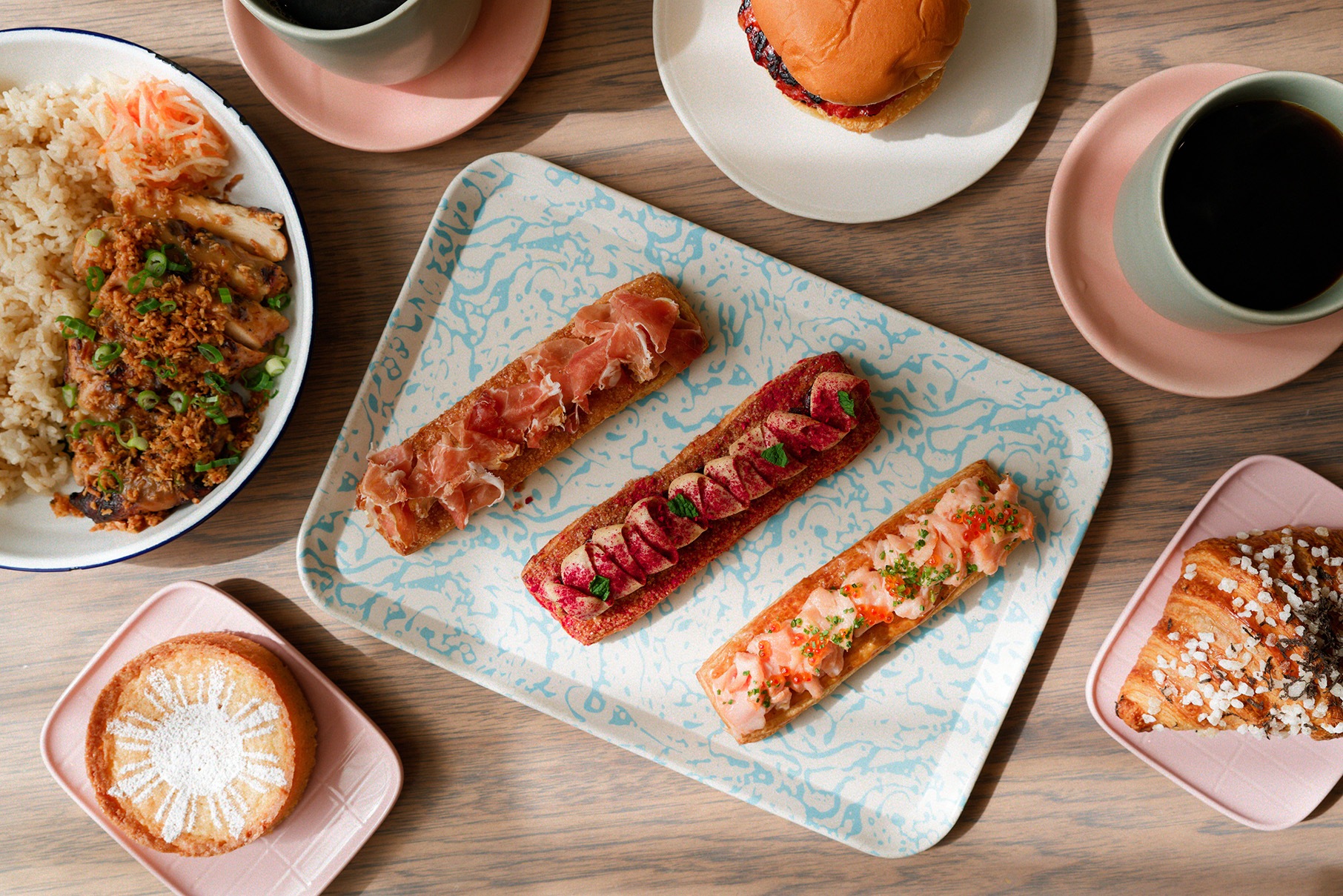
The separate concepts also allowed for cost savings. “You always want the perfect cuts and the perfect portions and everything for fine dining,” Kwon explained. That means trimmings and other bits might be discarded. But at Kasama, those can be used in the less exacting daytime menu. After foie gras has been cut to a certain size and shape for dinner, the leftovers are made into a mousse that adorns a Danish along with pistachio, sour cherry jam, freeze-dried raspberry, and mint.
“That’s like a dish that you would find on a fine dining tasting menu,” Kwon said – but anyone can walk in and order it to go from the pastry case.
“The whole point of breakfast was to be fast and efficient”
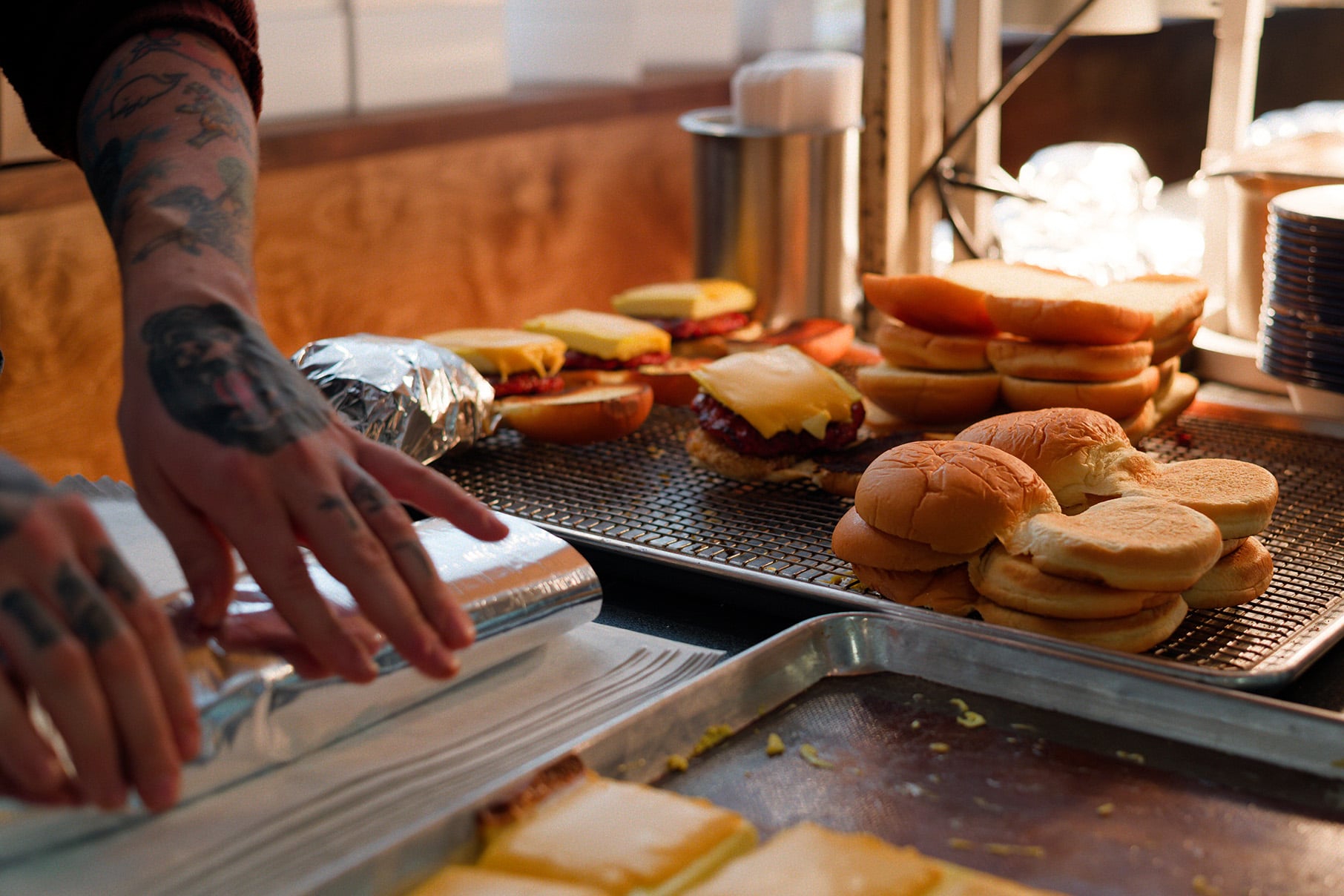
The breakfast sandwich at Kasama was designed to be ready within five minutes of an order. The version with a housemade longanisa (sweet red sausage) patty is the most popular item on the menu. It’s purposefully made without sauce, so that it is easy to eat on the go like a fast food sandwich, to which it bears a resemblance – especially when it’s beefed up with a hash brown rectangle.
“The whole point of breakfast was to be fast and efficient,” said Flores.
Churning out four to five hundred longanisa sandwiches a day while also frying rice and eggs, making espresso drinks, ensuring there is a continual supply of pastries, and organizing where all of these items go is a herculean feat of logistics. There’s a line of people who have been waiting for an hour to sit, who might have a flight to catch and are visiting just to try that blueberry muffin top they saw on social media. Fast food chain restaurants pull it off by mass-producing items in a central location, freezing them, and shipping them to individual stores. Kasama does nearly everything by hand in-house. (The buns for the sandwiches are commercial Martin’s potato rolls.)
General manager Josh Daws said that the most impressive thing about Kwon and Flores is their mastery of efficiency: “Seeing a system and seeing a person work in a system,” as he put it – something his previous bosses in the corporate hospitality world would have paid a consultant to analyze.
That’s how 60 staff members – split roughly in half for morning and evening services – are able to move through a space crammed with diners in the morning and still deliver consistent dishes for both in-house guests and online orders. Calls of “corner” and “door” echo as staffers bring dishes, pastries, and rice up and down from the tight prep kitchen upstairs, where the rice cooker and dish station reside and a single oven and mid-sized mixer produce all the pastries.
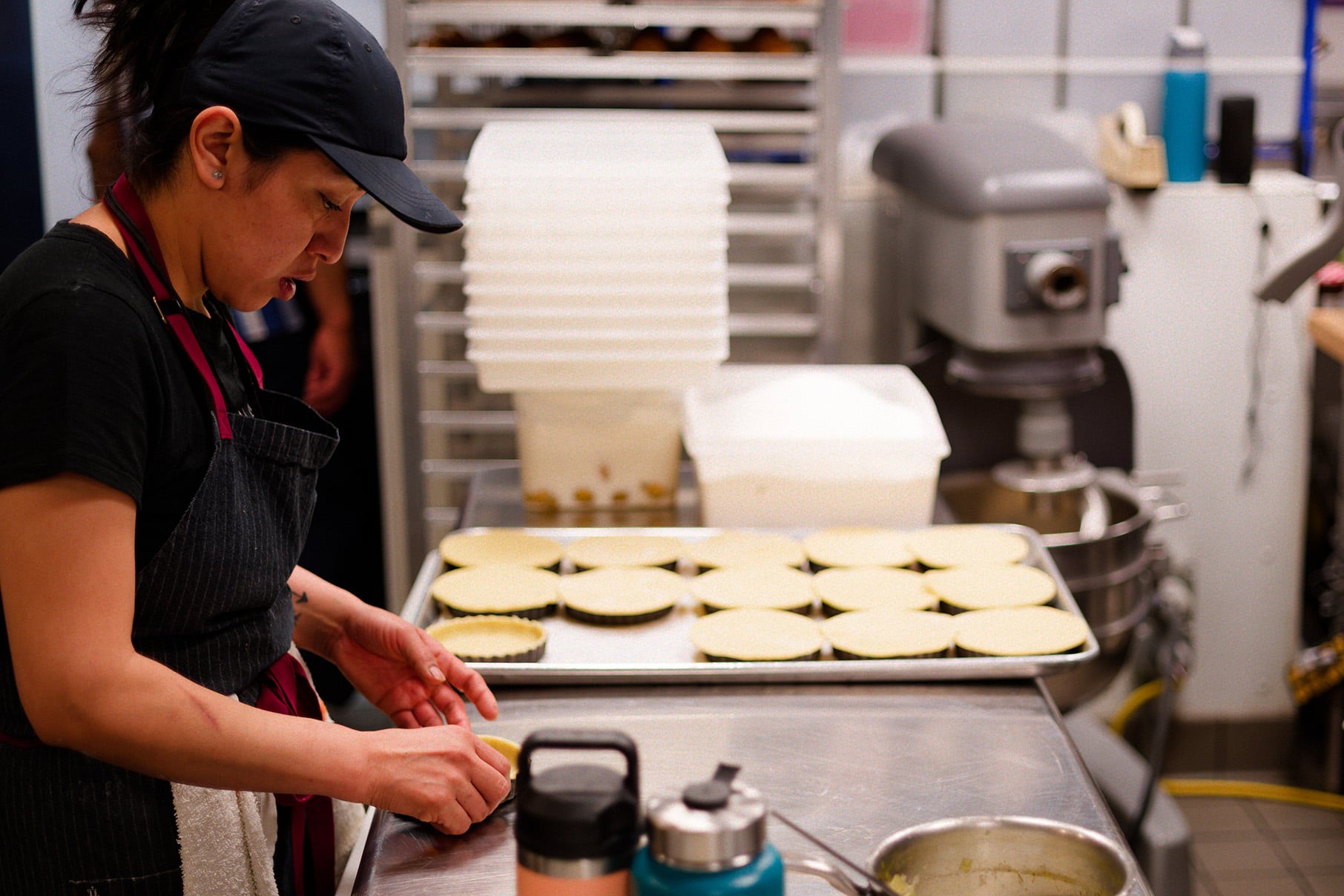
Kwon’s creations range from the basic – an oatmeal cream pie, a brownie – to the elaborate – a ham and cheese Danish with black pepper caramel, a banana tart with white chocolate mousse. Because she doesn’t want to run out of sweets before everyone in line has been served, she said they have made up to 1,500 pastries in a single day.
“We were as busy as we could possibly be – we thought – and then The Bear came out,” Kwon said. “But we were able to put in some different systems and figure it out.”
“Their pastries and breakfast or combo sandwiches are a great gateway to Filipino food,” wrote Ringor, pointing for example to the Kasama combo that swaps two iconic Chicago foods – Polish sausage and Italian beef – for the Filipino analogues of longanisa and shaved pork adobo. The evening dinner functions “like a Filipino 101 in tasting menu form,” he said, presenting classic dishes like adobo, pancit, and kare-kare “in ways that are exciting, innovative, and unexpected.” The sour soup sinigang becomes salmon or royal red prawn in a tamarind-beurre blanc sauce; the eggroll lumpia is presented two ways simultaneously, with fresh herbs alongside a fried lumpia in a rice paper wrap.
“But despite all of that being very different from what my family and I ate growing up, the flavors are so incredibly familiar,” said Ringor, who was born in the Philippines and grew up in Chicago. His parents were initially skeptical of a high-end take on Filipino food, but “they both were so pleasantly surprised by how much the food at Kasama really captures the soul and flavors of the motherland.”
A Complementary Team
The evening tasting menu is explicitly modeled on the dishes Flores’ mom made while he was growing up in a suburb of Chicago. His parents met in Chicago after immigrating from the Philippines, and both lived for a time near where Kasama is today.
“We think that if Tim’s mom had a choice in what she wanted to do in life, she would be a chef,” said Kwon. When Flores worked at Oriole, his mom would sometimes drop off food for the staff. She was the taste tester for Kasama’s recipes before it opened and still spends time at the restaurant, even going bowling with the staff. “She knows every ingredient and where everything is at Kasama even more so than we do,” Kwon said with a laugh.
Flores grew up watching PBS cooking shows hosted by Jacques Pépin, Julia Child, and Martin Yan, but he found his way into the hospitality industry by accident. A friend texted him with an offer to make some money polishing dishes at GT Fish & Oyster one day. He was invited back the next weekend, and soon started bussing, waiting tables, and eventually cooking.
“I still remember til this day, we had this shrimp and foie gras terrine,” recalled Tentori, GT’s chef co-owner. “You could tell when Tim made the terrine and when everybody else made the terrine. He had the touch.”
Flores was hungry to learn more, and Tentori connected him with chefs around the city to stage in their kitchen on days off. He eventually moved on and met Noah Sandoval at Senza, then opened Oriole with Sandoval.
“I could trust him to be [at Oriole] when I wasn’t,” Sandoval said, praising Flores’ “straight, to the point, no bullshit, just delicious food” – an attribute he also sees in Kwon’s cooking.
“My career has been very different from Tim’s in that he really worked for two main chefs, and I had a ton of different jobs in different cities,” Kwon said. Born in New Orleans to Korean parents, Kwon deviated from a biochemistry path to join the hospitality industry. She worked in top kitchens from Singapore to New York City, including the esteemed Eleven Madison Park, before ending up as a pastry chef for the Boka group at GT, where she met Flores. She, too, opened Oriole.
“She’s a hustler and her palate’s pretty perfect,” said Sandoval, who rates one of Kwon’s first desserts for Oriole – incorporating whiskey, tonka bean, and cocoa – “one of the best dishes I’ve ever had.”
Kwon and Flores were a good match: both left-handed, both the youngest child, both extremely driven but easy to get along with. When they attend splashy events, as they do more often these days, they wear matching outfits. Flores is an idealist; Kwon, who is more business-minded, tends to catastrophize. When they opened Kasama, which translates to “together,” they lived upstairs and barely left the building, which they own.
“If I got here, they were here, and when I left, they were there,” said Daws of the early days.
As Tentori put it, “Sleep and go to work.”
“The Food is the Easier Part”
The Kasama building is busy nearly all hours of the day, with the evening crew leaving as late as 1:00 am and the first morning baker arriving only a few hours later. But now there’s a team of 12 managers among the 60 employees, compared to the ten people who opened it.
“Every decision that we’ve made in the last five years has been in an effort to protect the livelihood of our team,” Kwon said. From the beginning, “we wanted to be able to provide health insurance and time off and good wages and a good culture and a good working environment.”
Many employees have been there for years. A porter, morning manager Janine Mendiola, and Daws all started within the first year or so of Kasama, while three of the evening servers have been there since the first dinner service.
“Working under Tim and Genie has been different from working under any other chefs,” said Scott Pamatmat, who has been at Kasama for four years and is now chef de cuisine. “They’re not just amazing chefs; they have a really strong ability to think ahead and plan for the future.”
Unusually for chefs of their stature, they haven’t opened another restaurant, published a cookbook, or started a retail line. (They do sell some Kasama merch at the restaurant.) But they are maintaining a presence. With a trusted team in Chicago, Flores and Kwon frequently travel to collaborate on dinners and events around the world, bringing a manager on each trip. The biggest accolades are awarded by national or international committees, so keeping Kasama visible everywhere is beneficial, Daws pointed out.
Flores maintained that he and Kwon aren’t pursuing accolades. “Our philosophy when it comes to dinner is that I only want to make changes that will benefit the guest experience as well as the staff,” he said. “We change the dish because we want to make it better. We substitute glassware because we want to make the drinks better.”
“It’s this balance of being innovative and new, but also staying the same and staying consistent,” he added. If he can suss out a reason for receiving a second Michelin star, consistency and continued improvement are it.
Kwon jokes that the second star – a rare and coveted achievement – came because of the floral arrangements, which are now handled by Flores, who has recently taken up the Japanese art of flower arranging known as ikebana. But as with everything else at Kasama, the flowers can’t be attributed to him alone. Several staffers, including bar manager Alexa Roberts, continually adjusted the arrangements one evening after he set them up. There’s a synchronicity to the team: when Flores wanted to tweak a sauce during service, Roberts quickly appeared with the necessary ingredient from the bar without a word.
Chefs can’t succeed in the cutthroat, thin-margin industry on talent alone. Michelin stars, appearances on The Bear, and other accolades have a documented financial benefit. As numerous people emphasized, Flores and Kwon’s unique success rests as much on their managerial, marketing, and financial acumen as on their determination and culinary skills.
“When it comes to food, I think that’s the least amount of pressure that we feel,” Flores said. “More of the pressure comes from running the business and making sure that we’re doing things correctly. The food is the easier part.”