Three (Mostly) New Chefs Shepherd Le Bouchon into Its 34th Year
Maggie Hennessy
June 24, 2026
Get more recipes, food news, and stories at wttw.com/food or by signing up for our Deep Dish newsletter.
Have a food story or recommendation? Email us at [email protected].
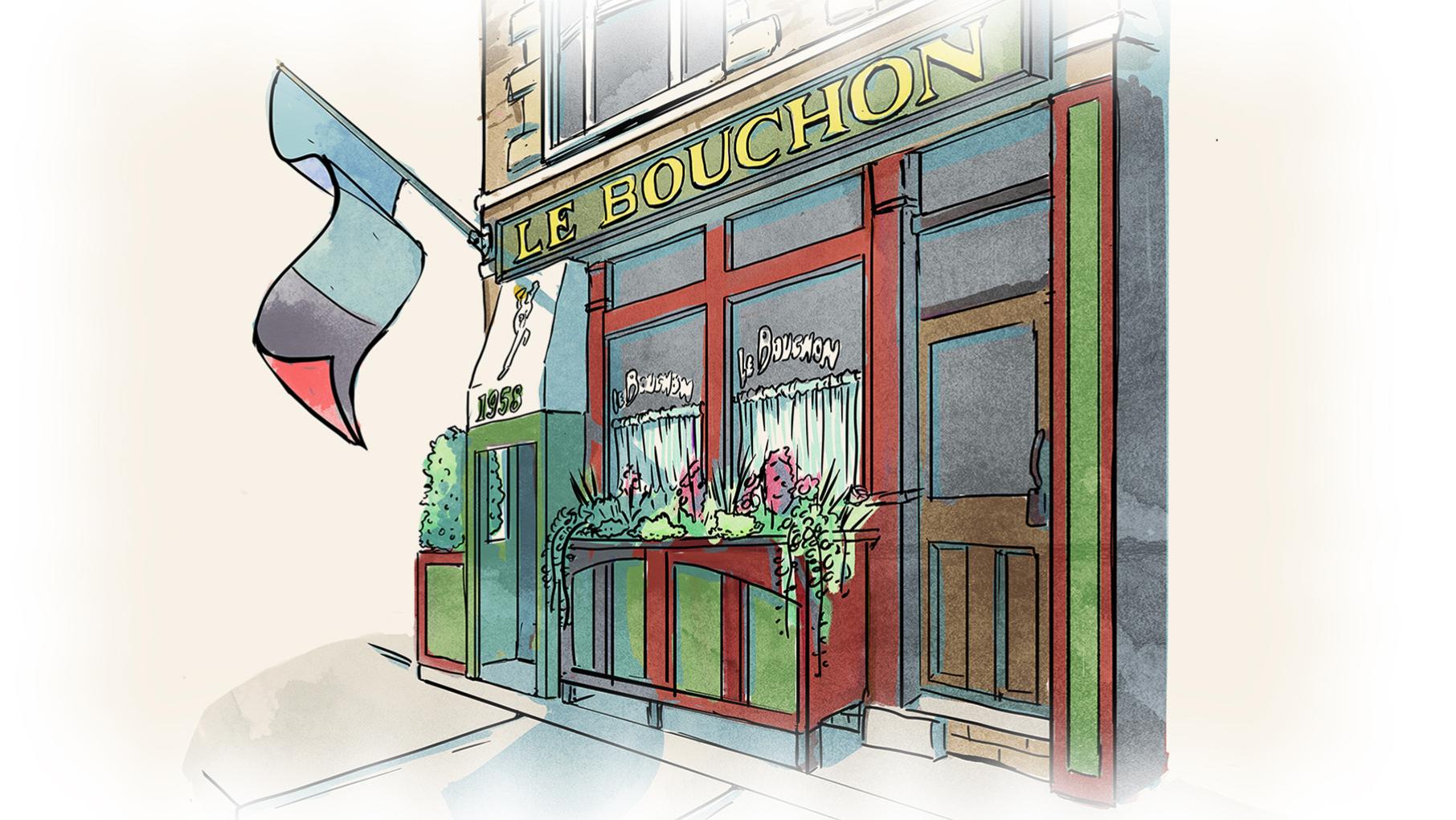
Dinner at Le Bouchon, the timeworn jewelry box of a bistro in Bucktown, may seem like the product of some cosmic magic. Everyone’s crammed in like sardines while servers navigate tight throughways with purpose, never panicking. Tables heave with wine bottles, bubbling escargots, and steak frites that hit the hedonistic spot as reliably today as 33 years ago, when Jean Claude and Susanne Poilevey debuted this magnetic little joint at Damen and Armitage Avenues. But achieving lightning in a bottle six nights (and days!) a week is the result of careful planning and choreography by a group of people who love this place like their own.
“This is a highly functioning restaurant, despite being so small and so busy all the time,” says Keagan Beresford, the chef here since January. “There are certain dishes that are so locked into a system of preparation and how exactly to cook them, even down to where in the oven you put the trout en croute or the snails. There's a way to do it, and you should not deviate from it.”
It’s thus intimidating to join the fold where a handful of venerable recipes stretch across decades and a whole continent, to Jean Claude’s native Lyon, France; where much of the staff and regular customers count their tenures in decades rather than years. Excavating a spoonful of onion soup – slippery-sweet caramelized onions in beefy, booze-tinged broth beneath a web of oozing cheese and deliciously sodden bread – has to hit the same sybaritic notes it did five, 10, even 20 years ago. No pressure, right?
“I just want it to be what it’s been for me; I’m just trying not to mess it up,” says fellow newbie chef Nate Tryman, who joined Le Bouchon this spring. “At the same time, it's been an inspiration to understand that I can kind of cook my food here and make it make sense.”
Tryman and Beresford, former co-chefs at Rootstock who also worked together at Obélix, were hired at a time of transition for Le Bouchon. Longtime executive chef Waldo Gallegos, who’s been with Bouchon since opening day (and worked with the Poileveys since the early 1980s), stepped back from his day-to-day responsibilities around the same time chef de cuisine Henry Zimmerman announced he was moving on. Chef and co-owner Oliver Poilevey dispensed with the traditional hierarchical structure (which was born in traditional French restaurants) in favor of a more democratic tack: appointing three co-chefs in Tryman, Beresford, and Lety Rodriguez. Bouchon’s daytime sous chef since 2018, Rodriguez started at the restaurant over 20 years ago as a dishwasher.
“I’m not super huge on the whole brigade system,” says Oliver Poilevey, who owns Le Bouchon (and Obélix) with his brother Nicolas Poilevey. “It has a point, but it’s a little outdated, you know? So we have this three-headed monster instead. And I think they all work really well together; they all check a different type of box.”
When I recently sat down with Rodriguez, Tryman, and Beresford, Rodriguez was ending a shift that had begun in the empty restaurant nine hours earlier, at 6:30 a.m. She is charged with making most of the sauces, dressings, and desserts, as well as coaxing the classic dishes into being day after day.
“I've been here so many years, it’s like, I don’t know, almost my home,” Rodriguez says in Spanish. “I’m very happy working here. It’s like a little family.”
She’s the reason Jean Claude’s onion tart still infallibly mingles savory, sweet, nutty, rich, and sharp flavors; that its shortbread-like crust crumbles then melts in the mouth with that luxe, slightly naughty, custard. She’s why Gallegos’ and Oliver’s trout en croute resembles a work of art, deftly layering velvety pea mousse and lush, ruby trout in crisp puff pastry before it’s blasted a la minute in the oven and set afloat in lemony sorrel sauce with a glistening trout roe garnish.
When she started in Bouchon’s dish pit at age 28, Oliver was just a teenager helping out part time and learning the ropes in his family’s restaurant.
“She was always the best dishwasher,” he recalls. “She didn’t move fast, but her efficiency and movements were always next level.”
After culinary school and a series of jobs cooking elsewhere, Oliver returned to Le Bouchon in 2012. Soon thereafter, at his behest, Rodriguez joined the line, working the garde manger station, while Oliver worked sauté and Waldo manned the grill.
“He said I was a really good worker and that I should be on the line, so I started on salads,” Rodriguez says. “I really liked it right away.”
As her skills improved and the restaurant got busier, so did the need for a sous chef to take on morning prep full time, a role Rodriguez took on eight years ago, two years after Jean Claude’s death in 2016.
Rodriguez doesn’t speak much English, but she doesn’t have to. She’s methodical in her approach and has a gift for calibrating flavors. She has also cooked with Oliver long enough that she’ll deliver pitch-perfect spring pea soup on her first attempt – the result of a combination of finely honed skills and knowing the audience’s palate.
“She seasons like I season, to the point where it’s almost too salty but right there, you know?” Oliver says. “She’s just super talented.”
Her column on Bouchon’s schedule a few weeks ago jokingly read “muchas horas.” She could probably navigate this old place blindfolded, though she notoriously likes everything in its right place – so bring back the olive oil, please, if you take it upstairs.
“I’m a little strict,” Rodriguez says with a grin. “We are in a group who only speak a little bit, but we communicate well.”
In addition to supporting Rodriguez’s execution of the classics while speaking minimal Spanish, Tryman and Beresford take on the seasonal, neo-bistro specials that occasionally nudge Bouchon’s denizens out of our garlic butter-soused comfort zones.
“It helps that Keagan and I have made hundreds of dishes together at this point, so it’s not like each one is completely unique,” Tryman says. “I think we also trust each other to be like, ‘I don't really know what you're talking about, but go for it,’ or to bring the final idea that kind of ties everything together.”
Each week, the three-headed monster sits down with Oliver to go over staff changes and the menu. At a recent meeting, a decidedly wintry stuffed rabbit saddle dish was in need of a refresh just as the Midwestern asparagus wave was cresting.
“We're tossing ideas around, because usually with the rabbit we would stuff it with something,” Beresford says. “Ok, what about with cheese and ham, like a cordon bleu?”
In the resulting dish, lean rabbit saddle is rolled up with ham and pungent, oozy raclette, caked in breadcrumbs and cooked till golden, then set atop a springy heap of shaved asparagus and herbaceous lovage in a brawny, Dijon-spiked brown sauce. Cheeky and modern, it’s also, unmistakably, Bouchon.
“It's a little goofy, but still extremely tasty,” Beresford adds. “It's novel, but it has that technique that demonstrates that we know how to do this. That was one that Oliver, Nate, and I talked into existence in about five minutes.”
It’s a balancing act, reinforcing the restaurant’s enduring pillars while carving out space to dream up the kinds of riotously good, envelope-pushing dishes that keep Bouchon top of mind among regulars and industry leaders, the latter of whom routinely pack the room on Sundays and Monday nights.
As Susanne Poilevey was fond of saying, a restaurant is a life form. It goes through phases, it changes, and eventually it will die. Oliver now lives by a similar mantra at Bouchon, which remains, blessedly, alive and well.
“I’m a big believer that a restaurant has to have lifetimes; it can’t stay the same forever,” he says. “To really thrive, you keep what makes it great, but you also have to let it go in different directions sometimes, whether that’s a new chef or changing a couple other things. It has to change a little bit to live on.”