A New Cooking Show Aims to Bring Indian Food into the Home Cook's Weekly Rotation
Daniel Hautzinger
April 21, 2026
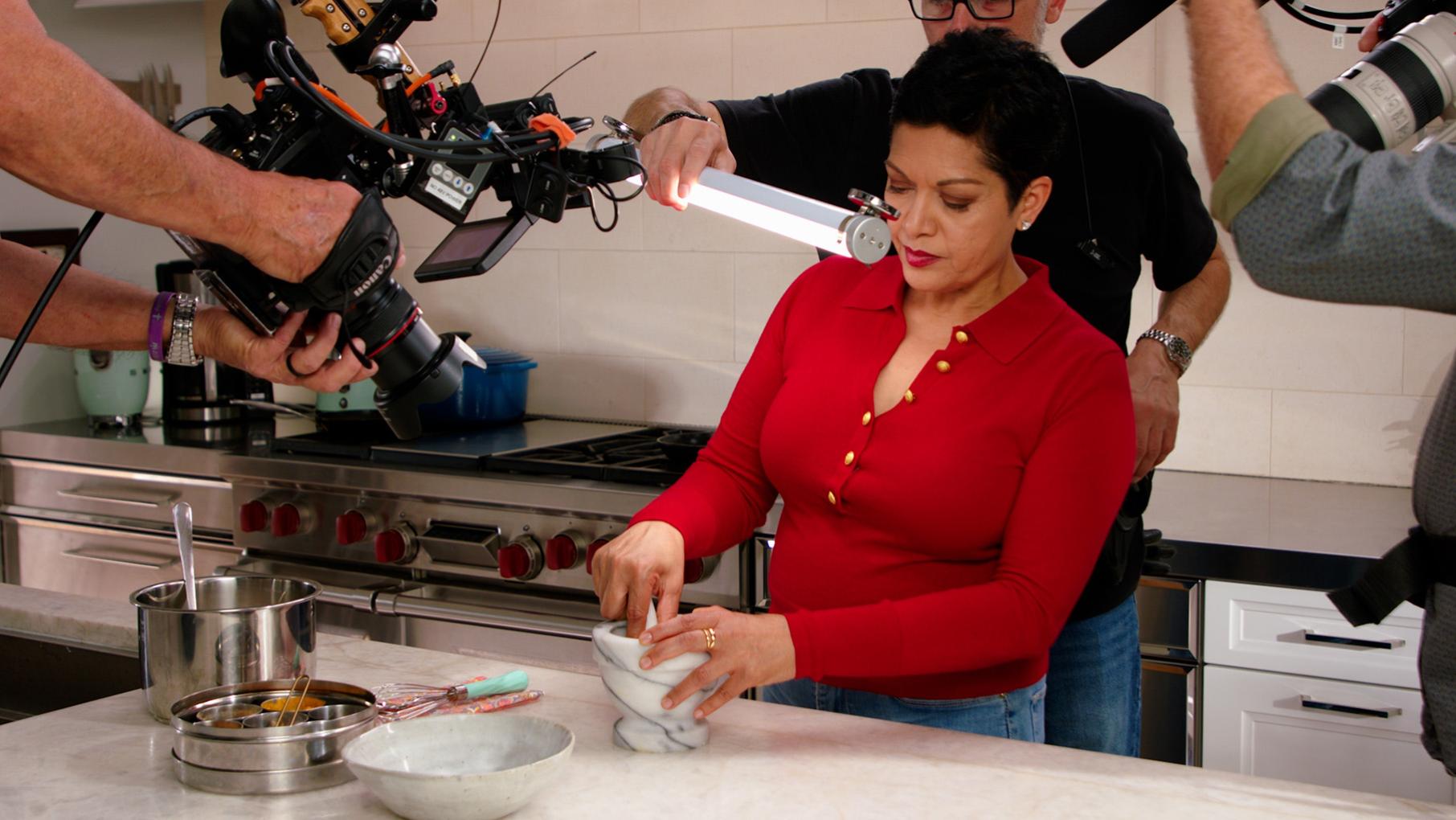
Indian As Apple Pie premieres on WTTW Saturdays at 4:00 pm beginning May 2 and will be available to stream via the PBS app beginning May 2.
Get more recipes, food news, and stories at wttw.com/food or by signing up for our Deep Dish newsletter.
Anupy Singla was born in the northern Indian state of Punjab and came to Pennsylvania with her family when she was three. “I had to learn English from Sesame Street; my first language was Hindi,” she told WTTW a few years ago. “I grew up with one foot in India and one foot in the U.S., because we would go back [to India] every year.”
She worked on Capitol Hill and then found her way to Chicago, where she worked in broadcast journalism before taking another career turn to become a cookbook author and food entrepreneur, selling Indian spices, sauces, and other ingredients under the name Indian As Apple Pie, a reflection of her background in two worlds.
Now she’s returning to broadcast with the cooking show Indian As Apple Pie, which premieres Saturdays at 4:00 pm on WTTW and will be available to stream via the PBS app. The show aims to not just demonstrate recipes for everything from roti to dal to street food, but also teach techniques, tricks, and shortcuts to make Indian food a part of a home cook’s weekly routine without losing the heart of the dish.
This interview has been condensed and edited for clarity.
Why did you want to make this show?
I have had this idea in my head since I was really, really, really young. I remember people would say, “Well, what is it that you really want to do?” and I was like, “Well I just want to host a travel cooking show for India, and I’ll be the host.” I think I've had such a love for India and such a huge love for growing up in America, that to be able to connect the two and show positive aspects of each has always been my goal. Taking Americans on this journey to understand India has been something I've really wanted to do from the very beginning.
How did you make food a career?
We came to this country when I was three. My mom had to work; we had to make ends meet. As she worked, she also wanted to make Indian food. Growing up in the ’80s, there was no place to go for Indian groceries or Indian ingredients. She was one of the first that I knew of that saw a crockpot and said, “That makes sense for Indian cooking: low heat, long cooking hours. I’m at work all day. This is the way to get Indian food on the table.” So she developed these recipes, and I always wanted to put her recipes in a book to celebrate her and everything she's done.
[Years later] I was the morning reporter for CLTV, and my husband traveled Monday through Friday for like 20 years, so I was like a single mom during the week, and it was hard to get food on the table. I took a break to write The Indian Slow Cooker, because I felt like it was going to help a lot of people, and especially Indian Americans, to not have to give up their day jobs. I’m not a trained chef; I’m a home cook who learned how to cook from my grandfather in the village in Punjab.
That book was top of the charts. We sold so many copies, and we continue to, because now people felt like they could understand Indian, whereas before it was this unapproachable type of eating. That started the process [that continues today] of, how do we simplify Indian food? My journalism background came together to make recipes really, really clear and approachable and easy.
Indian food in all its variety is becoming increasingly common and visible in acclaimed restaurants. Has that changed how you approach your recipes?
There’s been this misconception that Indian food is arriving or has arrived. What I always say is, unless the home cook is making Indian food at home once a week or twice a week, finding it approachable, we're not there yet. People are going to Indian restaurants more than ever. They want Indian food more than ever. But they still don't know how to lock in the flavors, and that's what my platform is about.
My perspective is to reach that home cook and say, “Here's how you do it,” by making it easier, but then also saying, “You don't have to lose the authenticity. You don't have to lose the flavor.” I kind of figured out the spots where you can take shortcuts. It's just about making it approachable. It’s basically giving them the path to making Indian food at home without having to give up their day jobs like I did.
How did you decide how to structure the show and what recipes to include?
We start from the very basics, like the basic spices and how to buy and store and use them. And then we take them to the next step of curry. There's so much misconception of what curry is. We show a chicken curry. Now you've gotten the curry and the spices down, let's do your one-pot meal of a biryani, which is complex, but uses the same sort of elements. And then here's your side;there's some complex sides, but then there's some really easy sides as well. So we just took them on a journey of teaching them from the basics and using the recipes as examples of those basic techniques, and then just started to stack on them.
What makes you want to share Indian food and get the everyday cook to incorporate it into their lives?
For me, the most important thing is that Indian food is incredibly healthy. Restaurant-style Indian food can be a little bit heavier, it isn't everyday food. I've raised my kids on homestyle Indian.
It’s also a gift to my kids, because I grew up where I was made fun of for eating Indian food. Everything I do is really just to show my kids that they can be proud of their roots and be American, too.