Near the Obama Center, an Artful Tea Salon and Bar Open in a Theaster Gates Project
Daniel Hautzinger
June 22, 2026
Get more recipes, food news, and stories at wttw.com/food or by signing up for our Deep Dish newsletter.
Have a food story or recommendation? Email us at [email protected].
Plenty of restaurants like to deem their food art. Not many get to actually be a work of art.
Han Cha is a high tea salon inside the Stony Island Arts Bank, an abandoned neoclassical bank in South Shore on Chicago’s South Side that was saved from demolition and restored by the artist Theaster Gates. The Arts Bank is one of a number of projects by Gates that seek to revitalize disinvested neighborhoods and communities through the arts, and is itself a sort of conceptual art project: He bought the distressed building from the city for $1 and then raised money to restore it by etching materials salvaged from it and selling them at an art fair as “bonds.”
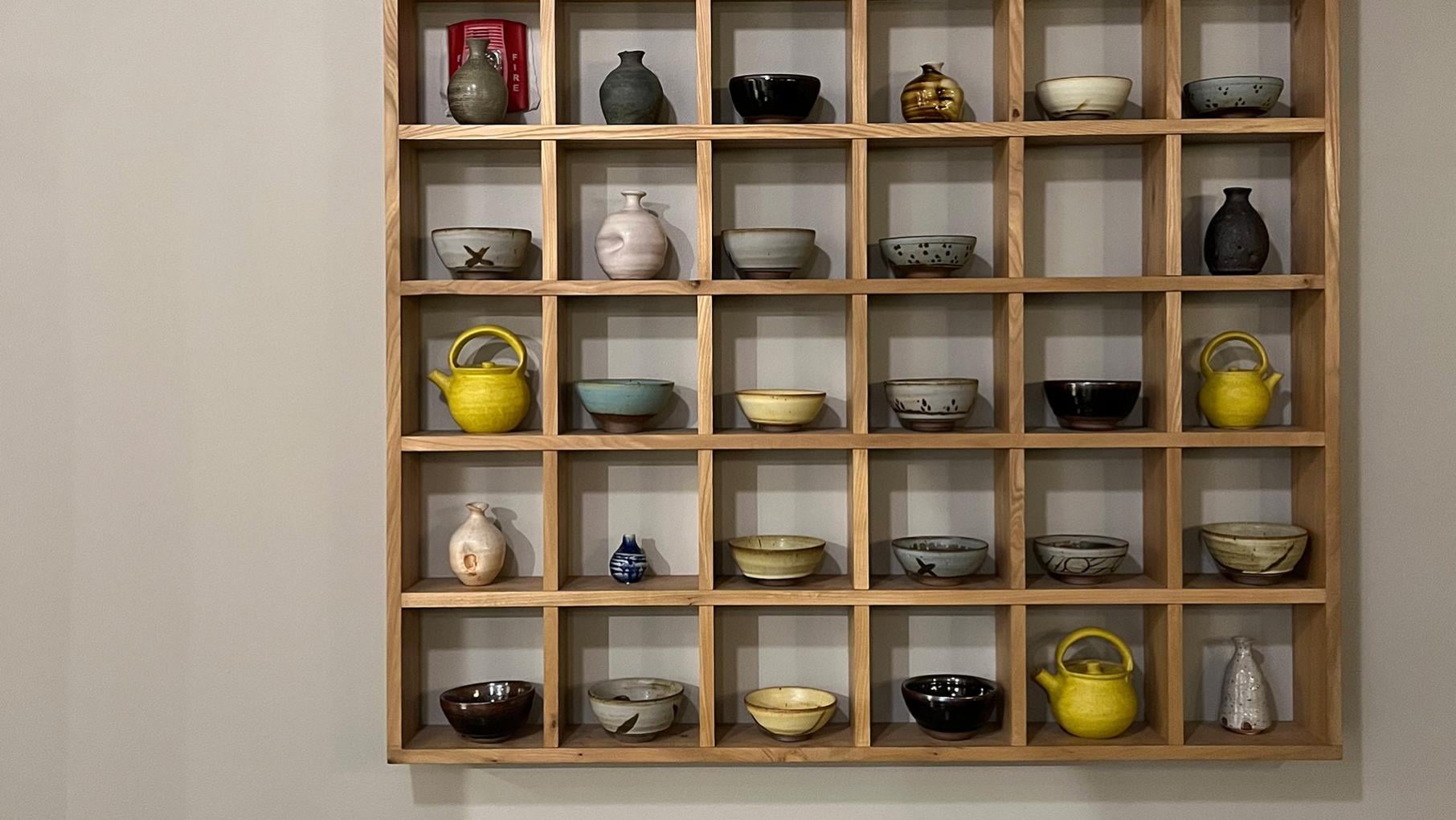
The Arts Bank doesn’t just hold the new tea salon and its compact partner bar and lounge, Yunomi; it also banks art, by Gates himself and friends. Gates’ ceramics and works drawing on archives like the Johnson Publishing Library housed on the second floor of the Arts Bank surround and even exist in Han Cha and Yunomi: The serving ware for Han Cha was crafted by Gates and his Dorchester Industries, as were the pieces on display at Yunomi, which is named for a handleless ceramic Japanese cup. Both hospitality concepts are new ventures from Gates and creative force Heiji Choy Black that bring food, drink, and hospitality directly into the gallery space, serving as their own kind of art projects with the bank as their frame. Museum cafes these are not.
Gates’ work and “art in general really asks you to unplug, and be thoughtful, and not be afraid of the quiet,” says Choy Black. “I really wanted that to be a part of the hospitality of this concept. Tea is one of those ways that you can bring that quiet there.”
When you enter the south-facing side room where Han Cha is located, you immediately feel that quiet. The stylish music from Yunomi drops to a murmur as you walk through an open archway. Sunlight filters through cloths of different sizes hanging over the window, a reminiscence of Seoul that plays up the calm, muted colors of the room.
Han Cha offers a British-style tea service with Korean and Japanese influences, an ideal fit for the space and the partnership between Choy Black and Gates. The contemplative, almost sacral aura Choy Black wants in Han Cha is intrinsic to art galleries and museums. Choy Black infused her Korean heritage through touches like those fabric window hanging and an almond biscuit with cinnamon, ginger, and honey inspired by a Korean tea, while Gates is deeply inspired by Japanese and Korean ceramics. Also, they both love tea.
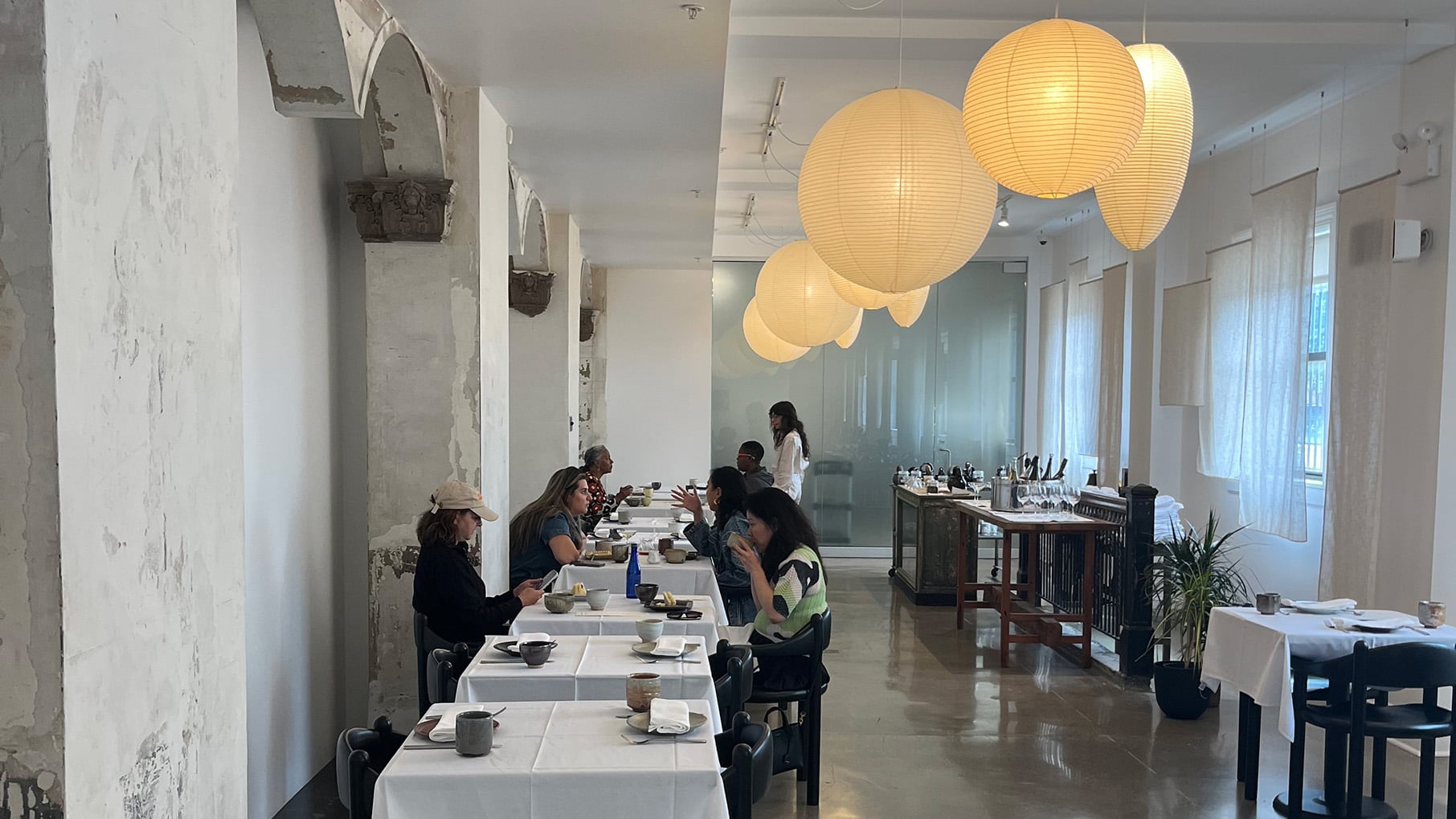
Since the Arts Bank is landmarked, renovations, such as for a full kitchen, are constrained. But the food for Han Cha’s $75, three-course tea service – such as tea sandwiches with Japanese egg salad, corn muffins, and Melona rice-flour caneles – doesn’t require a stove on site. The menu is from Jessica Vazquez, formerly a pastry chef at Momotaro, and Marguerite Singson, who has hawked pastries independently under the Instagram handle What Margie Made. All the tea is supplied by Chicago-based Spirit Tea. Choy Black has plans for collaborations with other bakers and chefs in the future, including the artist and cake maker Hyun Jung Jun of Dream Cake Test Kitchen and Hsing Chen of the hospitality group behind Asador Bastian and Andros Taverna.
The drink menu at Yunomi was created in collaboration with artists, whose names sign the cocktail they made. Theaster’s Gimlet, for instance, features mezcal, lime, blood orange syrup and a spritz of bourbon mist. You can sip it at an antique, 10-seat bar that Gates saved and brought to the Arts Bank when he first opened it in 2015. To your left is a gridded display of his ceramics. Behind you is the main gallery hall, with a DJ booth and a work by Gates that incorporates photography from the Johnson Publishing Company archive. The piece is a companion to an installation of photos by Gates in the Forum building of the Obama Presidential Center, which just opened up Stony Island Avenue from the Arts Bank. Choy Black hopes that visitors to the Center will also find their way to the Arts Bank, whether in search of more art, a drink, or a whole meal experience. (Han Cha is reservation only, with seatings in two-hour increments. It and Yunomi are open with the Arts Bank, which has free admission but a suggested donation, Thursday through Saturday.)
Gates has sought to bring art – and with it opportunities and investment – to South Side neighborhoods for most of his career. He started rehabilitating properties on Dorchester Avenue in Greater Grand Crossing in 2009, and recently opened The Land School, which is owned by the Rebuild Foundation, which once managed the Arts Bank, in a shuttered Catholic school at 72nd Street and Dorchester. There was room for a new project in the Arts Bank, so Gates brought on Choy Black, an old friend he met when she ran a fashion boutique in Wicker Park in the 2000s, and they decided to open Han Cha and Yunomi.
It’s not Gates’ first foray into hospitality or food as art: The erstwhile Currency Exchange Cafe at 305 E. Garfield Boulevard hosted food and drink pop-ups for several years, while an early provocation featured him serving “Japanese soul food” at an exhibition of a fictional Japanese potter who married a Black civil rights activist.
Choy Black has spent most of her career in fashion, including as the founder of the now defunct Jeune Otte. But she is married to a founder of Half Acre Beer and an investor with him in the distillery Judson & Moore, which was started by her Jeune Otte co-founder Elise Bergman. Unsurprisingly, Yunomi serves both Half Acre and Judson & Moore.
“I love being part of a community again. I miss that a lot about owning a business,” says Choy Black.
“Theaster has always been so generous and welcoming to both this community [in the Arts Bank’s neighborhood] and artists,” she says. She hopes that the “artful hospitality experience” she is striving for with Han Cha and Yunomi can continue that spirit of openness.
This has been updated to correctly refer to various aspects of Gates' artistic career and to his work in the Arts Bank.