The Brotherhood of the Traveling Barrel: Chicago's Off Color Contributes to a Craft Beer Lineage
Daniel Hautzinger
July 14, 2026
Get more recipes, food news, and stories at wttw.com/food or by signing up for our Deep Dish newsletter.
Have a food story or recommendation? Email us at [email protected].
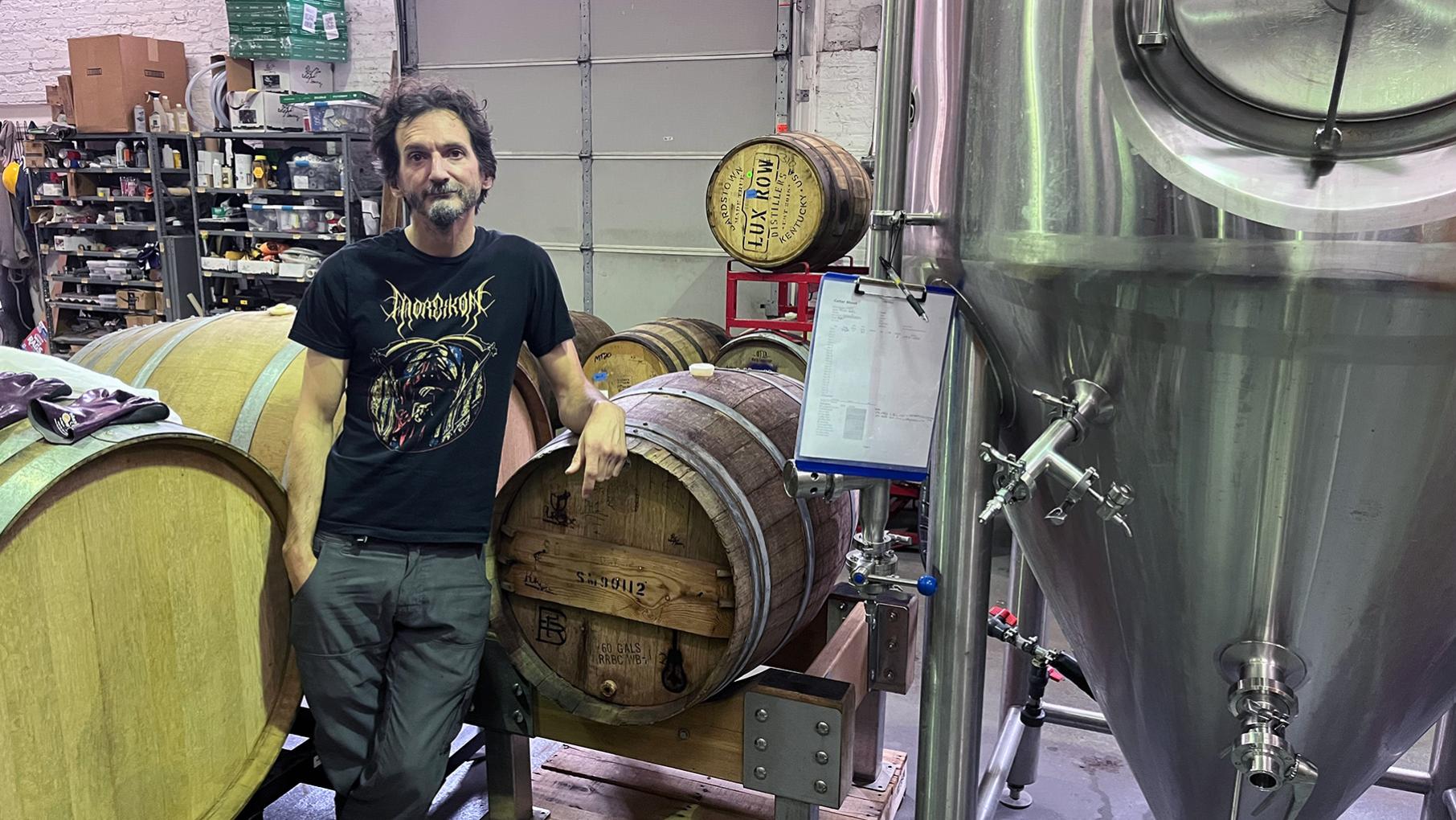
When John Laffler was starting Off Color Brewing with Dave Bleitner, he knew he wanted large, high-quality foedres – large barrels – in which to ferment wildly creative beers. So it felt like destiny when, after a year or so of searching, his broker found three – and then four, and then five – oak barrels that had been used to age Nebbiolo grapes into Barolo wine in the Piedmont region of northern Italy, where the Italian side of Laffler’s family has roots. Laffler rejiggered the layout of his in-progress brewery to fit the extra two 50-hectoliter barrels into the space.
Across the country and back a few years, an unlikelier stroke of fate reunited another former wine barrel with one of the people who had used it to help the kinds of exuberant sour beers Laffler makes find a foothold in the United States. The canonization of the barrel, known as pH1, was begun, setting it on a beer-producing journey through American breweries over the decades, with its latest stop in Chicago at Off Color. It is currently parked not far from those other star-crossed barrels, ready to show off its latest creation: A beer overseen by Laffler that he’s calling, simply, pH1.
A Sour Saga: The Story of a Barrel
Yes, I’m anthropomorphizing a barrel. But it’s not unlike a person in an important way: Its past informs its present. Just as the sum of your experiences makes you who you are, the brewers, beers, and yeasts that a barrel has experienced affect the beer produced in it.
“Once you put wild yeast into a barrel, into wood, you can’t really ever get it out,” says Laffler. “So there is something magical about that.”
Off Color is the sixth brewery to ferment wort into beer inside pH1, so the barrel retains some vestige of five of the most acclaimed breweries in the country. It’s like a chef who worked at numerous three-Michelin-starred restaurants around the world, or a researcher who got a Fulbright, Rhodes, and a Watson.
The beers that are made in pH1, or any wood barrel, are not the typical lagers and IPAs that dominate markets. They’re sour beers – lambics, wild ales, Berliner Weisses – that are fermented with wild yeasts that are present in the natural world rather than the cultivated brewer’s yeast that is purchasable from a store and used to make most of the world’s beer. (And plenty of its bread – sour beer is akin to sourdough.) Wild or mixed fermentation is an unconventional and unpredictable style of brewing that produces a wider range of complex flavors than standard brewing – and the pH1 barrel played a pivotal part in popularizing it in the U.S.
A few brewers in the U.S. had experimented with sour beers for commercial production in the ’90s – including two near Chicago, Dan Carey at Wisconsin’s New Glarus and John Isenhour at Joe’s Brewery in Champaign, Illinois – but New Belgium Brewing was one of the first places to draw attention to sours and produce them at scale. Belgium the country has a revered tradition of sour beers, and native Belgian Peter Bouckaert worked in it before coming to New Belgium in Fort Collins, Colorado. There, he began purchasing wine barrels in which to condition beers. Out of these came a now legendary beer called La Folie – literally “madness,” or a foolish undertaking, a folly. The barrels had been labeled, and although the one marked pH1 was deemed a keeper, it somehow got sent away from New Belgium.
Two years later, New Belgium employee Lauren Limbach, who had also worked on La Folie, was visiting Russian River Brewing in Santa Rosa, California when she spotted a barrel labeled “pH1.” Barrels are often turned into furniture or planters after they have been emptied, so it was fortuitous that pH1 was still being used to make beer – and that Limbach was there to find it.
The lore surrounding the barrel grew enough that a brewery was named after it. The Rare Barrel in Berkeley, California even got to use pH1, after Russian River eventually sent it back to New Belgium and then Limbach passed it on to The Rare Barrel. Each brewery has made a batch or a few in the barrel and then given it to a colleague working in the same tradition. The barrel made its way back to Bouckaert at the brewery he started after leaving New Belgium. From him it went to Side Project Brewing in St. Louis, Missouri, and from there it went to Laffler at Off Color. Each brewery has branded the barrel with their logo, and its arrival is always a surprise for the next brewer to receive it. Laffler has already decided who’s going to get the barrel next, but first he’s leaving his own imprint on it by producing two beers in it.
Beers Made with an Artist’s Palette
New Belgium’s La Folie was one of the first sour beers to make an impression on Laffler. It “just really knocked my socks off,” he says. After working at West Lakeview Liquors, known for its impressive selection of beers, he enrolled in the Siebel Institute in Chicago to study brewing. That’s where he met his Off Color business partner Dave Bleitner. The pair both went to work for the late Metropolitan Brewing before Bleitner set off for Two Brothers and Laffler landed at Goose Island. Laffler was in the famed barrel-aging program there, a forerunner to the types of wild fermentation he would do at Off Color. (A “barrel-aged” beer is not necessarily a sour beer: barrels used for spirits like bourbon do not contain yeast that causes fermentation, but simply add character to the beer from the wood.)
Laffler and Bleitner opened Off Color in 2013, deciding to stay small and explicitly avoiding the hop-forward IPAs that were topping sales at other breweries to produce more niche styles, and not just those made via mixed fermentation.
“We very intentionally wanted to have a smaller footprint because it’s more artistic freedom, more creative freedom. Operating as sort of a niche brewery, we’re not going to get bigger, but that means that we can do kind of what we want to do,” he says.
“I’ve always liked beers with more colors in them. Think of an artist’s palette: we can use acidity, we can use floral aromatics,” he explains. He sees limitations in IPAs, which are mainly distinguished by the type of hops. “It’s just not my bag,” he says, describing his beers as “delicate” or “pretty” in comparison to the general American beer, which is “bigger, bolder, brasher.”
Off Color is bold in its experiments, even if its beers are more nuanced. The brewery is constantly introducing new beers and iterating further on those beers. They might make a Berliner Weisse, then bring it back but add blueberries and yuzu. One of the foedres produces more acidic beers, a quality Laffler has emphasized by adding blackberry, cranberry, and pomegranate after it leaves the barrel. They’ve pulled from Italy with a bright pilsner, America with an easy-drinking cream ale, Germany for a malty maibock, Finland for juniper berry-accented sahti, and China by adding tea and osmanthus flowers to a lager. They have even ventured into the past, offering their recreation of an ancient, corn-based Peruvian brew. All of this while their flagship Apex Predator saison is accessible enough to be found in bars and restaurants across Chicago. Innocent line drawings of mice and other animals on the labels by a longtime friend of Laffler’s draw it all into a cohesive brand.
Apex Predator and other more traditionally brewed beers are produced in a facility separate from the space that houses Off Color’s Mousetrap taproom, to prevent the temperamental wild yeasts used in Laffler’s mixed fermentation beers from contaminating the others. Wild yeast can ruin a beverage; the strain Brettanomyces, or Brett., is considered a taint in most wine and non-wild beers, even as brewers have carefully harnessed its sharp flavors for particular sours.
Making mixed fermentation beers actually has a lot in common with winemaking, beyond using the same barrels. As beers ferment in wooden barrels or foedres, the brewer tastes them over time to determine their character and development, then can blend them with other beers to bring them to their fullest expression, just like winemakers do. Laffler even sometimes makes a co-ferment of wort and grapes, both for the striking end product and to restore some of his foedre’s wine character, which diminishes over time as beer pulls it out of the wood.
Each foedre at Off Color houses a different mixed culture of yeasts built up over years that impart a signature character. The Wildings foedre is based primarily on yeast harvested from blueberry skins, while Cygnet began with a rice base used to make sake. Miscellanea is not unlike pH1 in that it includes wild yeast from every mixed fermentation brewery Off Color has collaborated with.
“We’re just blending all this really interesting unique yeast, creating something which has a little bit of everybody in it,” says Laffler of the Miscellanea series. “For us, it’s a really tangible way of doing that community or being part of something a little bigger than us.”
A Brew Decades in the Making
After about a year, the beer Laffler made in pH1 is nearly ready. He put both a saison and Belgian Witbier wort in the barrel, choosing something “light and delicate to really let the barrel shine.” He had never tried a beer fermented in the barrel, purposefully waiting to sample the Side Project pH1 beer he was gifted so as not to be influenced by a predecessor.
“We wanted to put not too much of our own spin on the barrel, but also just have it be our contribution to this lineage,” he says.
His pH1 beer has been decades in the making, but it tastes of this July moment: Floral summertime nectarines, a rounded tartness, a light golden hay color. If all goes to plan, it will be released by the end of the month.
Then Peter Bouckaert, the progenitor of the pH1 legend, will come into town with his head brewer and they’ll produce something new with Laffler to put in pH1. Once that beer is ready, Laffler will pass the barrel on to the next in the growing lineage.
"It's a special barrle, but it's more of a totem or an artifact," says Laffler.
“Brewing, like anything else, is about relationships and building community and being part of a larger culture,” he continues. Including the unique culture of yeast that lives inside a barrel.