You Can Thank the Midwest for Your Favorite Holiday Ingredients
Daniel Hautzinger
October 26, 2026
Get more recipes, food news, and stories at wttw.com/food or by signing up for our Deep Dish newsletter.
The little corner of the Midwest around Chicago is responsible for many of your favorite holiday flavors. Illinois is the country’s biggest producer of pumpkins, so it’s likely the pumpkin pie on your Thanksgiving table was made with canned pumpkin from here. Wisconsin grows more cranberries than anywhere else in the U.S., so your holiday cranberry sauce may be from our northern neighbor. And northern Indiana is a significant raiser of mint, whose oil flavors peppermint patties given out on Halloween or candy canes sticky-ing children’s hands around Christmas.
The “Pumpkin Capital of the World”
The town of Morton in central Illinois was named the “Pumpkin Capital of the World” by Illinois governor Jim Thompson in 1978. The Nestlé Libby’s factory there processes some 85% of the world’s canned pumpkin, and the majority of pumpkins destined for canning in the U.S. are grown within a 60-mile radius of Morton. Illinois itself produced around 533 million pounds of pumpkin in 2025, according to the U.S. Department of Agriculture (USDA), more than the next four biggest production states’ output combined.
Illinois is also an outlier in that the vast majority of its pumpkin is processed for canning, while nearly all the pumpkins grown in other high-producing states are sold whole, for ornamental or cooking purposes. So while the pumpkin you buy for your jack-o’-lantern may have been grown in Indiana or Michigan, the one in your pie is probably from Illinois.
Overtaking Massachusetts in Cranberries
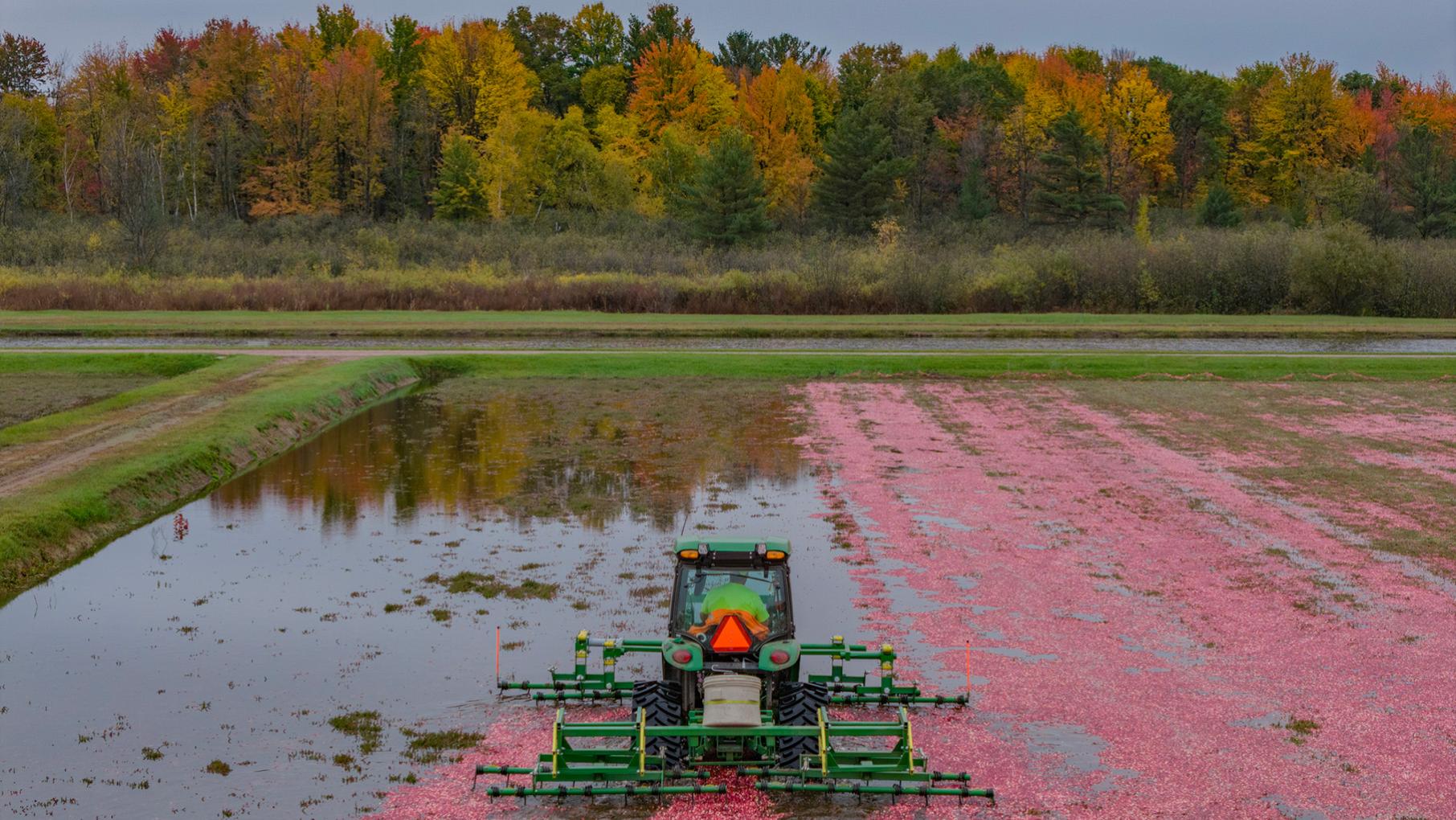
Illinois is a great pumpkin producer, but Wisconsin looms even larger in cranberry production. (Both cranberries and pumpkins are native North American fruits.) Around 60% of the national cranberry crop comes from Wisconsin, according to the USDA. Massachusetts may have a stronger association with cranberries – Ocean Spray is headquartered there, and cranberry is represented in its official state juice, colors, and foods – but it produces less than half as much of the crop as Wisconsin – around 25% of the total.
While Native Americans harvested cranberries in what is now Wisconsin before Europeans arrived and commercial growing began there in the 1850s, it wasn’t until 1994 that the Midwestern state overtook Massachusetts in cranberry production, according to the Wisconsin State Climatology Office. Central and northern Wisconsin are both ideal for cranberries, with their sandy, poorly drained, acidic soils. (Cranberries don’t grow in water; rather, their bogs are flooded in the autumn for harvesting and to protect the vines over winter.)
Because Wisconsin’s growing season is shorter, the state’s cranberries were historically less vibrantly red, according to the Climatology Office – a weakness for them when it came to sales. But the University of Wisconsin-Madison developed a hybrid that matures earlier and has more pigment.
“Mint City”
The story of mint in Indiana is the opposite of that of cranberries in Wisconsin. Currently the fourth largest grower of mint in the U.S., Indiana was once the country’s leading producer, according to Purdue University’s College of Agriculture. The northwestern and north-central region of the state, in addition to southern Michigan and Wisconsin, grows both spearmint and peppermint that is distilled into oil used in everything from toothpaste to chewing gum, but the acreage devoted to mint there has decreased while Oregon and Washington have increased their production since the 1950s. Bremen, Indiana is still nicknamed “Mint City,” and once refined half the world’s peppermint and spearmint oil, according to a local news story.
Indiana’s minty fresh heyday coincided with the rise in nearby Chicago of a booming candy industry that included Wm. Wrigley Jr. Company, maker of Spearmint and Doublemint gums. Founder William Wrigley was a master marketer – he got into the gum business because the free gum he offered to boost soap sales proved more popular than the soap – and advertised his company with bold graphics and bright colors. One advertising coup was the Doublemint twins; the original models hired to play them fittingly came from Hammond in northwest Indiana, according to northwest Indiana’s Post-Tribune.
Without the Great Lakes states, the holidays would be a lot more bland.