Taxi and Rideshare Drivers Gather for a Taste of Home at Mogadishu Restaurant – With a Side of Banana
David Hammond
October 29, 2026
Get more recipes, food news, and stories at wttw.com/food or by signing up for our Deep Dish newsletter.
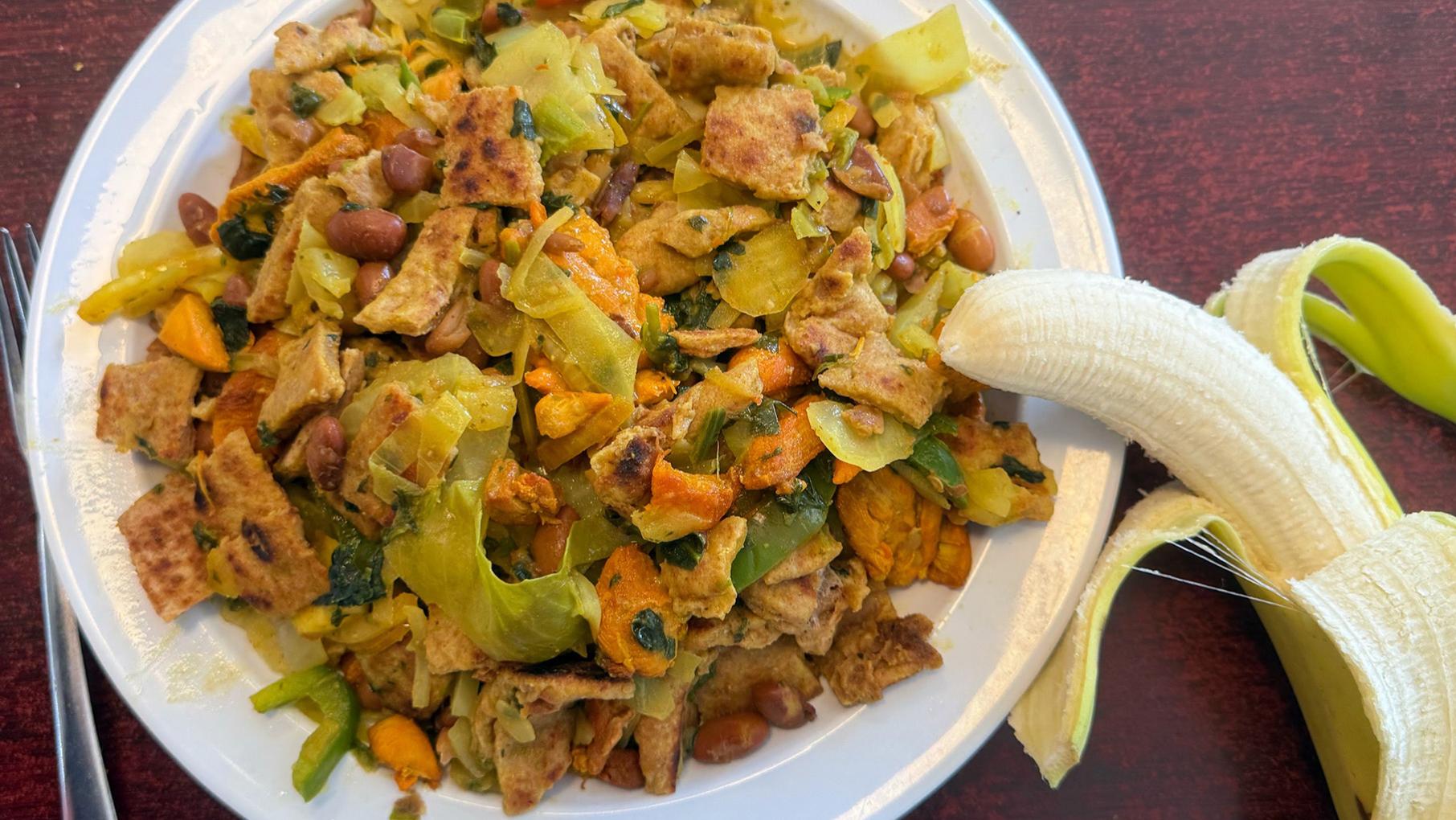
My first mouthful of Somali food was at a small restaurant in Minneapolis. Walking in, I was greeted by a friendly man who showed me my seat and casually placed an unpeeled banana on my table. I looked around; everyone else was munching bananas, so I took the cue. Throughout the meal, diners got up to help themselves to another from a big bunch in the corner.
Bananas are also an expected side dish at Mogadishu Restaurant at 931 N. Orleans St. in Chicago, a place where taxi and rideshare drivers gather between fares for bites and banter. During a recent lunch hour, many people in the dining room seemed to know each other. All around me, men spoke in soft tones, one or two solo diners sat silently, and the front counter was crowded with people picking up food to go. The customers here have found a friendly place where they can sit, relax, speak their native language, and taste again the food of their homeland at modest, working-class prices.
This stretch of Orleans has long offered working drivers a meal close to River North, the Gold Coast, and Michigan Avenue, prime areas for picking up fares; there’s a reason Mogadishu Restaurant is open from early in the morning until almost midnight. Nearby are restaurants serving Yemeni and Nepalese food. In the early aughts, I ate at a Pakistani taxi joint on or near the spot Mogadishu now occupies. Back then, this neighborhood looked like it hadn’t seen new construction for decades. But the last tower at Cabrini-Green came down in 2011. New steel and glass buildings have appeared, coffee shops and bars have opened, and gentrification moves on apace.
While I was at Mogadishu Restaurant, all the tables were occupied by men, which seems likely to be usual at this place. Unlike the Somali restaurant in Minneapolis, there was not a separate room for women and children – the majority of Somalians are Muslims – though the only women I saw were there to pick up take-out orders.
So, what are people eating at Mogadishu Restaurant?
Somali food is often seasoned with xawaash, a spice blend that can include cumin, coriander, cardamom, cloves, cinnamon, turmeric, and black pepper. Xawaash flavors bariis iskukaris, a Somali version of the near-universal combination of rice and meat; the name means "rice cooked together." There’s hot sauce on the tables if you need to spice things up. Some diners also added slices of banana to the rice. The fruit, which is abudant in East Africa, is an integral part of the Somali meal, offering a subtle sweetness in counterpoint to seasoned rice and meat.
In addition to the banana, bariis iskukaris also comes with salad and pasta at Mogadishu Restaurant, a legacy of Italian colonial rule in southern Somalia.
Trade across the Indian Ocean with South Asia has also shaped Somali food, as evident in kay kay, beef or chicken mixed with vegetables and chopped chapati, the Indian flatbread, which absorbs the juices and knits all the flavors together. It’s a huge portion, a workingman’s meal.
The hilib ari fried dinner features goat simmered with spices and pan‑fried. For a breakfast that breaks big time with bacon and eggs, there’s baby goat liver simmered with onion and garlic.
There’s camel too, served cubed. Having cooked camel at home – purchased from the now-closed Czimer’s Game & Sea Foods in Homer Glen – I know how lean it can be. Mogadishu solves this problem by preparing camel with ghee: the clarified butter adds moisture, richness, and flavor. The day I visited Mogadishu Restaurant, they were out of goat and several other dishes, but for a smaller place with a big menu, that’s very understandable.
Then there is anjera, a fermented pancake that invites comparison with injera, which you may have enjoyed at Ethiopian restaurants. This spongy flatbread is useful for gathering food and absorbing sauce. It’s also served at breakfast with tea and accompaniments such as butter or ghee, sugar or honey, all mushed up together with the hands.
A few diners at Mogadishu Restaurant were eating with their hands, using fingertips to gather a bite. When I sat down to eat, the server – recognizing me for the gringo that I am – brought me a knife and fork, but I was determined to eat with my fingers. I learned to eat with the hands in India, and I was never proficient. Still, I ate the kay kay with my fingers, fumbling only a little. If you want to give eating with the hands a shot, start with a small amount held lightly in your fingertips. Use your right hand (never, ever your left) to gather and shape a manageable bite, then use your opposable thumb as a bumper to help move the food into your mouth.
There’s pleasure eating with your hands, a sense of texture and temperature that a fork keeps at a distance. When I discuss eating with fingertips with people who grew up eating that way, that sensual pleasure of "feeling" your food invariably enters the conversation.
Looking around Mogadishu Restaurant, it’s clear that much of the restaurant’s appeal takes place between bites. Diners share news, stories, and the enjoyment of not having to explain everything about the Horn of Africa to other people who also still think of Somalia as “home.”
Mogadishu Restaurant and other small immigrant restaurants all over the city are part of what makes Chicago such a remarkable dining destination. To be able to support humbler places like Mogadishu Restaurant, a city needs to have a critical mass of foreign nationals who will gravitate toward those foods and support those restaurants. These are places – whether Mexican, Polish, Puerto Rican, or Somalian – that give newly arrived Chicagoans a place to feel at home while also inviting the rest of us to experience something new, whether it’s goat, camel, or simply the pleasure of eating with our fingers. Every neighborhood restaurant like this adds another facet to Chicago’s culinary personality. And sometimes, if you’re lucky, with a good meal from a country you’ll probably never visit, you also get a banana.