A New 'American Masters' on the Go-To Cultural Architects Behind the High Line and Museums Across the Country
Daniel Hautzinger
November 24, 2026
American Masters – Liz Diller and Ric Scofidio: Architect Provocateurs premieres on WTTW Tuesday, November 24 at 8:00 pm and will be available to stream via the PBS app.
The architects Elizabeth Diller and Ricardo Scofidio had not had many physical buildings constructed when they were chosen to help design one of the most successful urban spaces of the 21st century: New York City’s High Line. The linear park that replaced abandoned, elevated railroad tracks draws millions of visitors a year, inspired imitators around the world – including the 606 in Chicago – and drove a construction and property value boom around it.
Diller and Scofidio had gained notoriety for conceptual work that interrogated the conventions of how we live – arguably more art than architecture – but their career in physical, concrete and glass buildings had only just started to take off in the 2000s. After years of drawing on New York’s avant-garde downtown art scene, they had engineered a “building” of fog for a 2002 exposition in Switzerland, but the surprise win of a commission for the Institute of Contemporary Art in Boston became their breakthrough.
“What was fascinating to me,” says Jeff Bieber, the director of a new American Masters documentary about Diller and Scofidio, “was, here were these two people, Liz Diller and Ric Scofidio, who kind of shun being architects.”
Then there was the High Line, and then, seemingly overnight, their firm of Diller Scofidio + Renfro was the go-to for cultural buildings around the world, including New York’s performance venue The Shed, London’s new V&A East Storehouse, and The Broad art museum in Los Angeles. The “architect provocateurs,” as the subtitle of Bieber’s film calls them, were now establishment figures.
The most trenchant illustration of this was the controversy over the expansion of New York’s Museum of Modern Art (MoMA). MoMA had already decided to demolish the neighboring building, which had been designed for the American Folk Art Museum by Tod Williams and Billie Tsien, when Diller Scofidio signed on to design its expansion plan. The distinctive structure was barely over a decade old. It became a rare instance in which the architectural community was generally against Diller Scofidio, who are more often critical darlings.
Despite their powerful institutional clients and the expense of many of the projects which they are hired to enact, Bieber says that he has been impressed by Diller and Scofidio’s commitment to a democratic philosophy they typically enshrine in their plans via public gathering spaces, among others. “They work really hard to stay true to their vision and their values,” he says.
A coda to the film shows that Diller and Scofidio, who died in 2025, value architectural preservation as well. Set in their new building for MIT’s architecture school, it surveys their repurposing of portions of an 1894 brick warehouse building for modern use.
“Buildings carry memories,” Diller says as she tours the school.
Bieber sought to explore how Diller’s own history shaped her and her output. He went to high school with her but only reconnected decades later when he learned about her burgeoning career.
“We cut school together,” he recalls. “We would hang out in Central Park.”
She was born in Poland to Jewish parents who had survived the Holocaust and eventually moved to New York.
“For years, her parents didn’t speak that much about what happened during the war,” Bieber says.
“I don’t know what she would say about this, but I do feel that her looking at the world a little differently, through a different prism, is somewhat influenced by that history.”
As a Jewish woman, she was – and is – an outlier in the world of architecture. She found a partner who was also an outsider in Scofidio, who is half Black. (And Charles Renfro, the third named partner, is gay.) It was a “conscious choice,” Bieber says, to put Diller’s name first on their firm.
“What Liz and her firm do is break down those walls, to try to create a more welcoming, inclusive cultural space,” says Bieber of Diller Scofidio’s renovation and opening up of New York’s performing arts mecca of Lincoln Center. “I think where they come from, it really does influence the work that they create.”
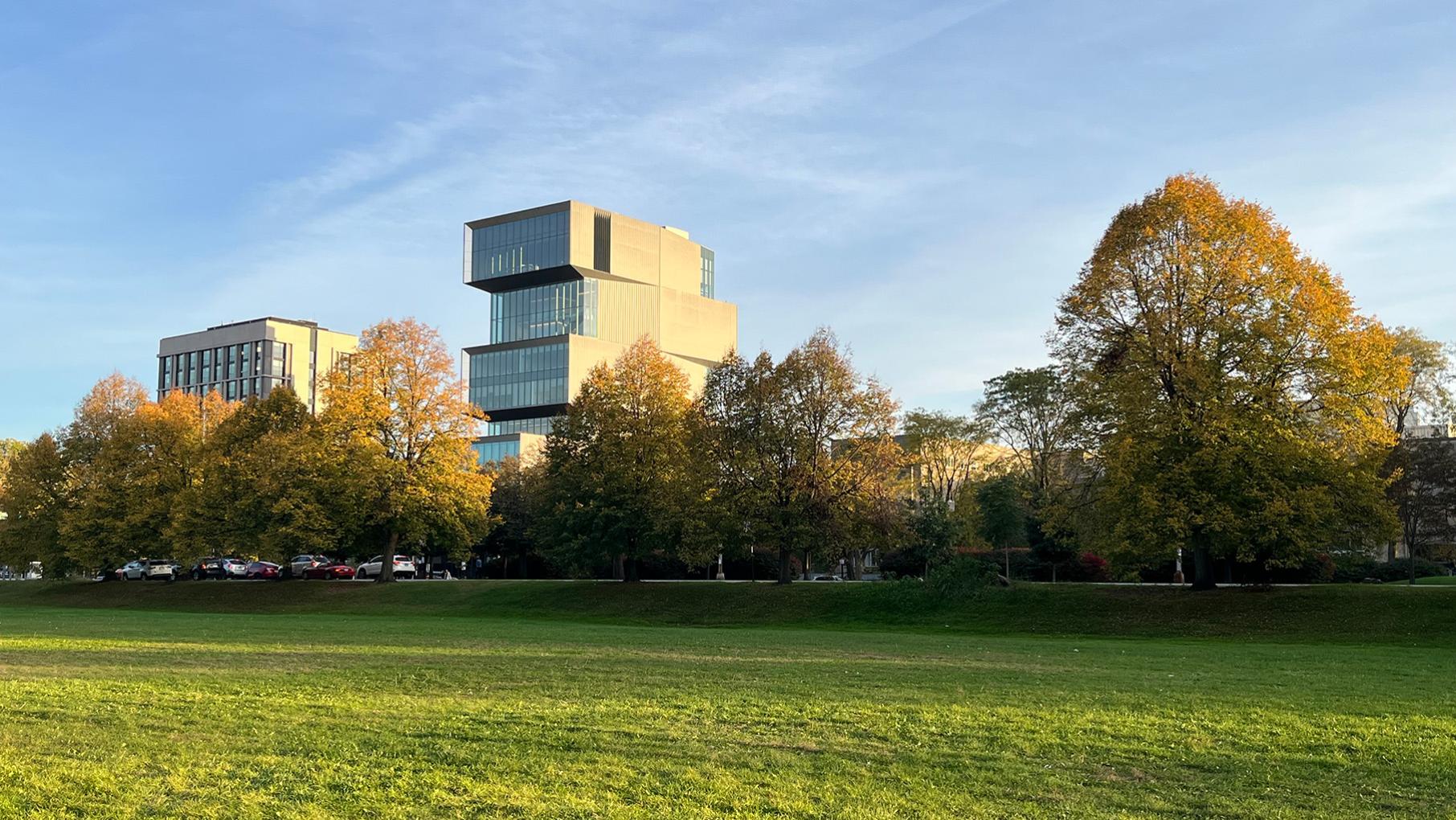
He is particularly struck by Diller Scofidio’s Al-Mujadilah Center and Mosque for Women in Qatar, which features a vast, undulating roof over a campus. If that’s a little far afield for Chicagoans, you can find a Diller Scofidio building on the campus of the University of Chicago, teetering above the Midway Plaisance like an akimbo stack of bricks. The David Rubenstein Forum sits near two buildings by Tod Williams and Billie Tsien, the architects of the now-demolished American Folk Art Museum: UChicago’s Logan Center for the Arts, and the Obama Presidential Center. They all host busy assemblages of people convening for art, history, and discussion, forming new memories that they might, per Diller's view, carry within them for as long as they stand.