Amid growing concerns over the safety and security of elections throughout the U.S. and a renewed push by President Donald Trump for the federal government to nationalize the process, how confident should voters feel about the integrity of their ballots?
That’s top of mind for Minnesota Secretary of State Steve Simon, who last month told CNN that federal interference in the upcoming midterm elections this fall was a certainty along the lines of a “weather event, like a bomb threat, like a power outage” that must be anticipated and prepared for.
Election security has always been a crucial matter in American politics, but concerns have only grown in recent years, driven largely by foreign efforts to undermine overall faith in the voting system and rhetoric from Trump.
So when it comes time for voters across Chicago and Illinois to cast their ballots this year, how much faith should they have that they not only will be counted, but counted accurately?
“Elections are more secure today than they have been in modern history, at least since we digitized voting in the United States,” said Jacob Braun, executive director of the Cyber Policy Initiative at the University of Chicago. “That being said, our election systems are still woefully insecure.”
Braun, who served as the White House’s acting principal deputy national cyber director under President Joe Biden, said that belief is driven in part by the fact that many election officials have come to understand that there are real threats to election security and that improvements are necessary.
The process of prepping for this year’s midterms in Chicago began last summer, according to Max Bever, director of public information with the city’s Board of Elections.
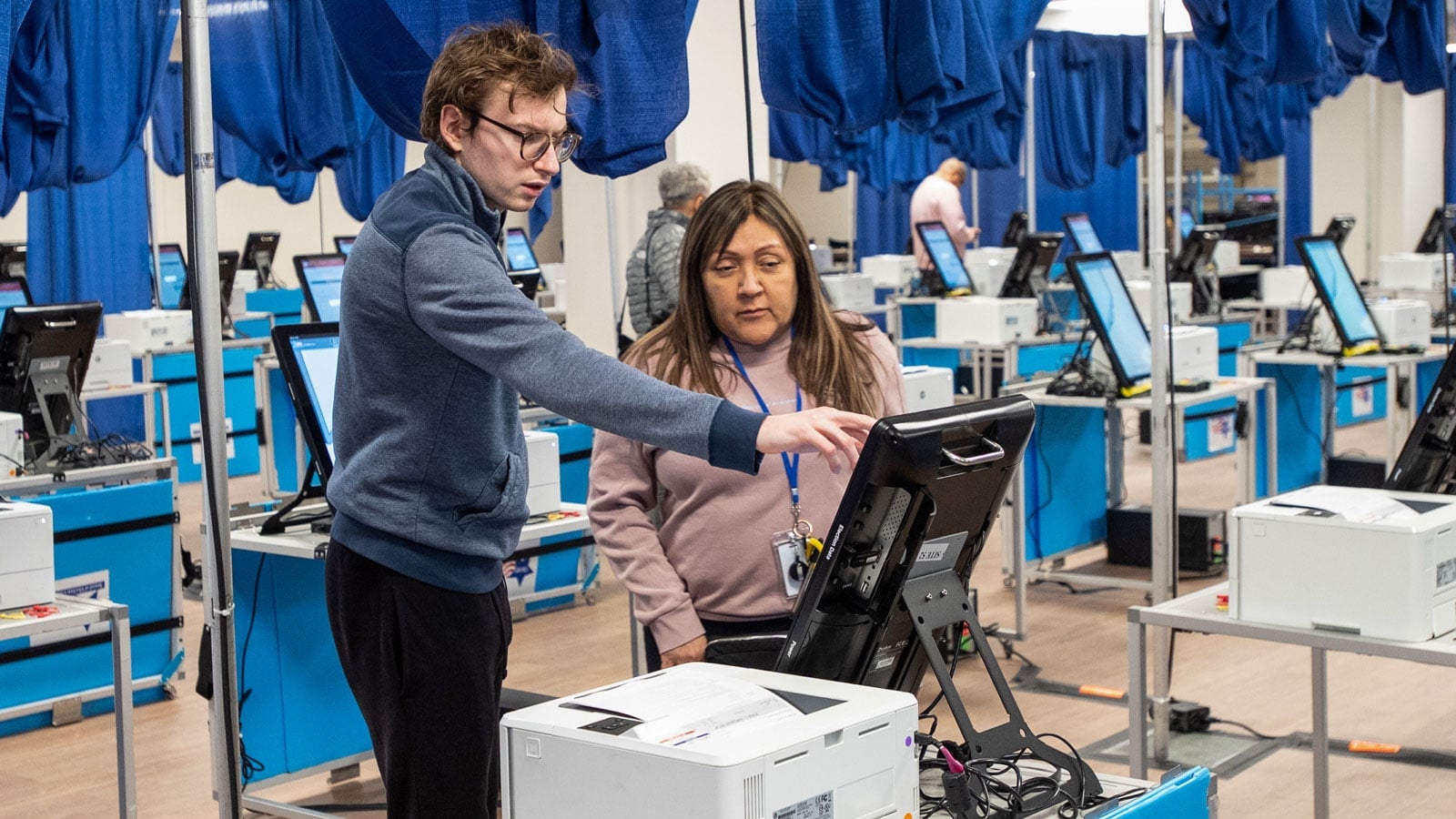
That includes weeks of pretesting touchscreen voting machines, ensuring submitted votes match the expected outcome of the test, uploading results for publication and documenting that testing within a chain of custody. After that’s finished, the machines are secured with a tamperproof seal and locked away in a secure area until it’s time for use.
“Ultimately we know that the security of our voting machines is the essential part of a trustworthy process for people,” Bever said.
According to Bever, far more attention has been paid to the cyber security, testing and proofing of election equipment since the 2020 election, when Trump supporters stormed the U.S. Capitol in an effort to prevent the certification of Biden’s victory in an attack that resulted in multiple deaths.
But sometimes change can be a slow process.
In 2018, participants at the DEF CON Voting Machine Hacking Village were tasked with attempting to hack a replica version of Florida’s Secretary of State’s election website. One of those participants, an 11-year-old-girl, was successful within minutes at changing the displayed vote totals.
“First, you open the site,” the girl, Bianca Lewis, told the New Yorker at the time, “then you type a few lines of code into the search bar, and you can delete things and change votes. I deleted Trump. I deleted every single vote for him.”
Braun, one of the organizers for that event, said that even years later, some states are still relying on the same security technology that a preteen hacked in just minutes.
“Can you imagine if some entity hacked the Michigan, Pennsylvania and Wisconsin secretary of state websites on Election Day — or for that matter the secretary of state of Illinois — and changed the voting results around?” Braun said. “It would cause total chaos even though that’s not official results.”
How Is Voting Secured in Chicago?
After those weeks of testing, when official ballots start coming in — be it through the mail, dropboxes, early voting or on Election Day itself — officials in Chicago maintain a papertrail so they can track each one and ensure its validity.
To prevent potential hacks, voting machines are never connected to the internet in any way, Bever said, while the machines themselves remain under watch by election officials, judges, coordinators, investigators and poll watchers.
Unofficial results are transmitted by secured cellular service and each ballot scanner contains a memory card, which is secured and transported along with finished paper ballots back to the board.
The data from those cards is then fed directly into the board’s servers, which, like the machines themselves, are never connected to the internet, Bever said.
“It’s a very manual system,” he said, “all the way down to collecting this data and these results.”
When an election is finished, all voting equipment and materials are returned to the Board of Elections while maintaining a chain of custody to verify safety during transport. The board then checks for any obvious discrepancies across the city’s 1,291 precincts during its regular canvass of the results.
Chicago and all other jurisdictions across Illinois are also subject to a postelection audit in which the Illinois State Board of Elections selects 5% of precincts at random for additional inspection to ensure those align with voting results.
“Especially with Chicago’s history, there is this tendency towards the dramatic, the history of corruption that took place,” Bever said, “but what a modern election system looks like is extraordinarily safe, transparent and really streamlined, even on top of all of these hundreds of laws and rules within the election code.”
What About Mail-In Ballots?
Illinois voters who request a mail-in ballot must first sign an application form, which election officials compare to the one on file with their voter registration. If they don’t match, the voter will be asked to submit a new signature or otherwise confirm their identity.
The ballots themselves contain a barcode that’s specific to each individual voter and are mailed out alongside a security envelope used to return the completed ballot. Voters must also sign that envelope, and that signature is again compared to the voter’s signature on record.
If that envelope isn’t properly sealed or the signatures don’t match, election authorities have 48 hours to contact the voter to rectify the problem, according to the Illinois State Board of Elections. If the envelope appears to have been tampered with or has other issues, election authorities may “spoil” that ballot and send out a replacement one to the voter.
Once the voter’s signature is verified and the envelope successfully returned, an election judge will remove the ballot and feed it into a tabulator. The envelope’s barcode will also be scanned and the election authority’s system will mark that person as having voted.
If that voter then attempts to go and cast a ballot in person, election judges will see the voter already voted by mail and will not issue them a new ballot, according to the state Board of Elections. For those who have received a mail-in ballot, but instead wish to vote in person, they will be required to sign an affidavit indicating they no longer want to vote by mail and that mail-in ballot will be voided.
Trump has sought to end mail-in voting and called the process itself “corrupt.”
In January 2026, the U.S. Supreme Court ruled that a lawsuit brought by an Illinois congressman challenging the state’s election laws can move forward.
Republican U.S. Rep. Mike Bost has argued that the state’s law allowing late-arriving mail-in ballots to be counted up to 14 days after the polls close violates the federal law establishing an “Election Day.”
Any mail-in ballot must be postmarked by Election Day in order to be counted. That case will now move forward in a lower court.
In issuing the majority opinion, Chief Justice John Roberts wrote: “Candidates have a concrete and particularized interest in the rules that govern the counting of votes in their election, regardless whether those rules harm their electoral prospects or increase the cost of their campaigns. Their interest extends to the integrity of the election — and the democratic process by which they earn or lose the support of the people they seek to represent.”
But Braun said that when it comes to mail-in ballot interference, the juice likely isn’t worth the squeeze. It would take a massive undertaking targeting thousands and thousands of individual ballots to really impact an election.
“You’re better off running TV ads for or against the candidate you wanna support,” Braun said. “And that’s legal and you won’t go to jail for it.”
So … How Secure Are Our Elections?
If there is an attempt to interfere with this year’s elections in Illinois, it wouldn’t be the first time.
As detailed in the 2019 Mueller Report, Russian intelligence agents attempted to hack Illinois government computer networks during the 2016 election, and succeeded in breaching the state election board’s computer network.
They then “gained access to a database containing information on millions of registered Illinois voters, and extracted data related to thousands of U.S. voters before the malicious activity was identified.”
“It’s incredibly rare that some nation state actually really cares about electing this person or that person,” Braun said. “What they want is chaos in America so we can’t fulfill our role in the world.”
He believes that any voter who fills out a handmarked paper ballot should have a “very high level of confidence” their vote will be counted correctly. Those who do not “should have concerns,” he said, but things like postelection audits, increased awareness of election disinformation and improved security technology can help mitigate potential interference.
“I think there is an acceptance now that there is a real threat out there,” Braun said.
Beyond securing the ballots themselves, Bever said the Chicago Board of Elections’ IT staff also runs regular vulnerability scans and backs up election data.
The board’s results page is also protected by two-factor authentication while the results themselves are stored in a separate server so they can be returned almost instantly in the event of an attempted hack.
“A Chicago voter should have complete faith that their ballot is being counted,” Bever said, “because they are the ones that are putting it into the voting machines and they are watching it be accepted in real-time.”