Since August of 2024, Chicago police leaders have rarely missed an opportunity to highlight what they see as officers’ skillful handling of the days of sustained protests that swirled around the Democratic National Convention.
Not only had the Chicago Police Department exorcised the ghosts of the police riot that tarnished the 1968 DNC, but officers also banished the shadow cast by the department’s botched handling of the protests and unrest triggered by the police murder of George Floyd in 2020, police leaders in November told the judge overseeing the federal court order requiring officers to stop routinely violating Black and Latino residents’ constitutional rights.
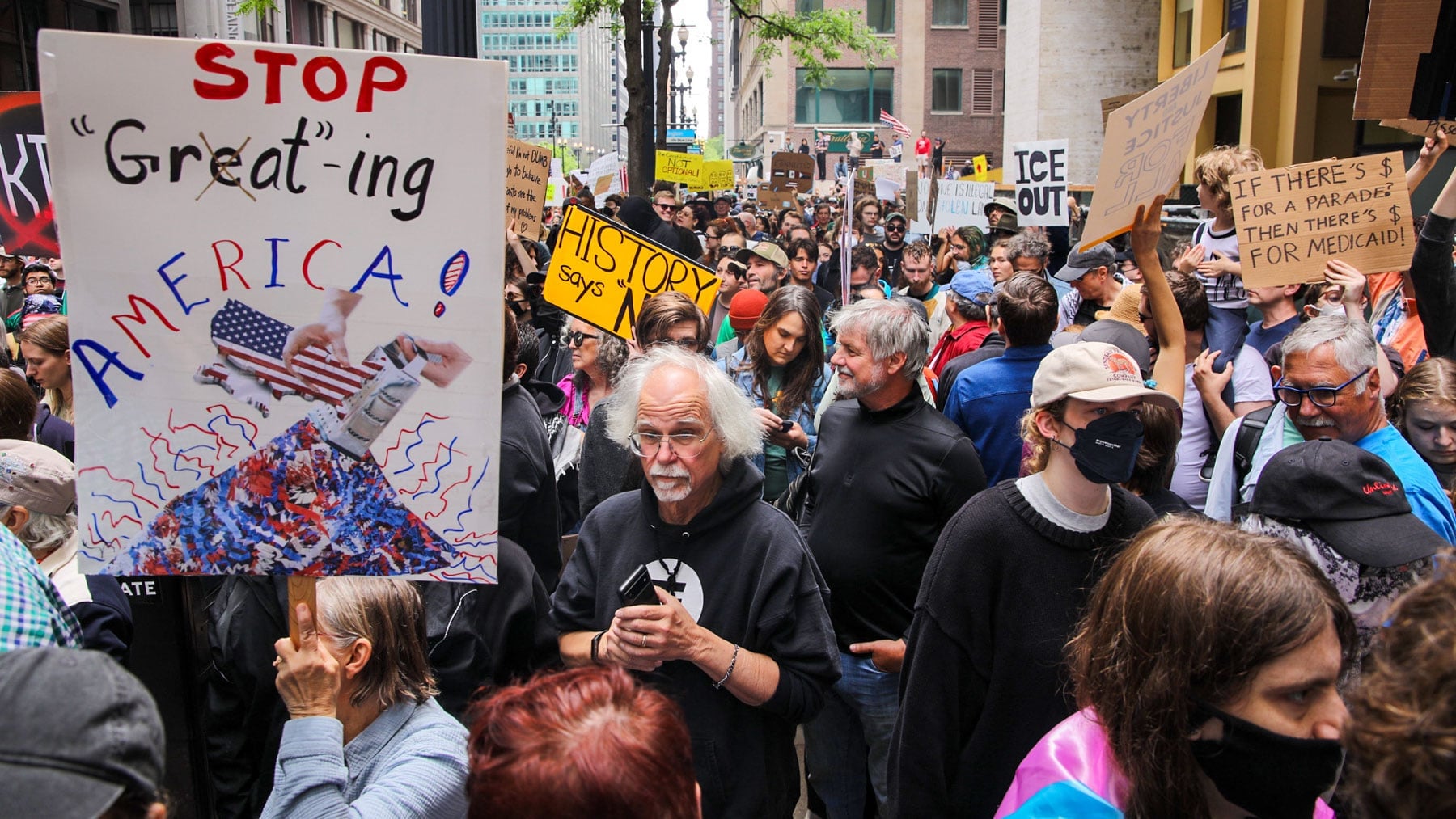
In recent months, CPD officers have also policed without serious incident dozens of protests of all sizes against President Donald Trump and the aggressive immigration raids his administration launched as part of the largest mass deportation effort in U.S. history during the past year.
The policy responsible for that series of successes was crafted after tense negotiations with the coalition of police reform groups that sued the city and forced officials to agree to the consent decree, the federal court order requiring CPD to change the way it trains, supervises and disciplines officers.
There’s no doubt that policy created a “better environment” for all Chicagoans to express their First Amendment rights, said Ed Yohnka, communications director for the American Civil Liberties Union of Illinois.
“Things are never going to be perfect, but they are better,” Yohnka said.
CPD ‘Underprepared, Ill-Equipped’: Watchdog
The city’s inspector general concluded that CPD botched nearly every aspect of its response to the protests and unrest triggered by Floyd’s May 25, 2020, murder.
CPD was “underprepared and ill-equipped, and thus critically disserved both its own front-line members and members of the public,” according to the inspector general’s report.
More than 600 complaints were filed against CPD officers during the summer of 2020, records show. More than five years later, taxpayers have spent $12.8 million to defend and settle lawsuits alleging officers committed a wide range of misconduct, according to a WTTW News analysis.
To ensure that conduct was not repeated, the independent monitoring team charged with enforcing the consent decree ordered CPD to undertake “immediate, deliberate, and transparent efforts” to “protect First Amendment speech while reducing the use of force and violence toward people and property.”
The consent decree expanded to include new rules governing how CPD prepared for and responded to large protests and civil unrest to requirements that officers’ body-worn cameras be reviewed after incidents.
In response, CPD adopted a new First Amendment Rights policy, which prohibited officers from arresting those engaged in protests for “minor or petty offenses … or for actions that pose no immediate threat to the safety of the community, or others, or of causing property damage.”
The policy also required officers to give protesters an opportunity to comply before they are subject to arrest or detention.
In the run-up to the DNC, police officials proposed revising that policy to dictate when and how officers could make mass arrests, a major issue identified by both the inspector general and the monitoring team in the wake of the 2020 protests.
If allowed to take effect, the policy would limit the ability of investigators to hold officers accountable for unjustifiably using force against Chicagoans, according to the coalition.
Warning that the policy as proposed by CPD would “eviscerate protections required by the First Amendment, the Consent Decree and CPD’s existing First Amendment policy,” the ACLU asked U.S. District Court Judge Rebecca Pallmeyer to order changes.
Inspector General Deborah Witzburg echoed those concerns, saying she was worried officers would be once again "ill-equipped to distinguish between lawful and unlawful demonstrators, potentially subjecting lawful demonstrators to unconstitutional policing tactics."
Before Pallmeyer could intervene, CPD agreed to some of the changes demanded by the coalition.
The revised policy required officers to take additional steps to protect the First Amendment rights of protesters and “remain unbiased and opinion neutral in any communication with individuals within the crowd while affirming that the First Amendment rights of lawful participants are protected.”
Protesters can only be arrested as a last resort, when police have evidence that their actions pose an immediate threat to the lives of others or may cause property damage, according to the policy.
In addition, only specific protesters who pose a threat to people or property can be arrested — not everyone participating in the protest, a provision that is designed to reduce the need for CPD to make mass arrests, according to the policy.
.jpg)
Chicago Police Supt. Larry Snelling discusses plans for a rally and march down Michigan Avenue on Sunday, Aug. 18, 2024. Photo: Heather Cherone / WTTW News
DNC Response Becomes A Template
Just eight complaints of police misconduct were filed with the Civilian Office of Police Accountability between Aug. 18-22, 2024, when the DNC was in town, records show. By comparison, there were 591 misconduct complaints filed between May 29, 2020, and June 11, 2020, the height of the protests after Floyd’s murder.
There were no mass arrests during the convention.
CPD used hundreds of police officers on bicycles, wearing neon reflective vests, to police the protests by lining up along each edge of the marches and protests.
Snelling was present during a majority of the protests and wore a body camera.
In some cases, there were just as many officers as there were marchers, the ACLU’s Yohnka said.
“CPD really put on an overwhelming show of force,” Yohnka said, adding that he was concerned that just the presence of so many officers could chill the “vigorous expression” of people’s First Amendment rights.
“Nevertheless, the spirit of the policy was respected,” Yohnka said.
CPD only deployed officers in riot gear after a dozen protesters broke down a section of the perimeter around the United Center erected by the Secret Service on the first day of the convention and during a protest outside the Israeli consulate.
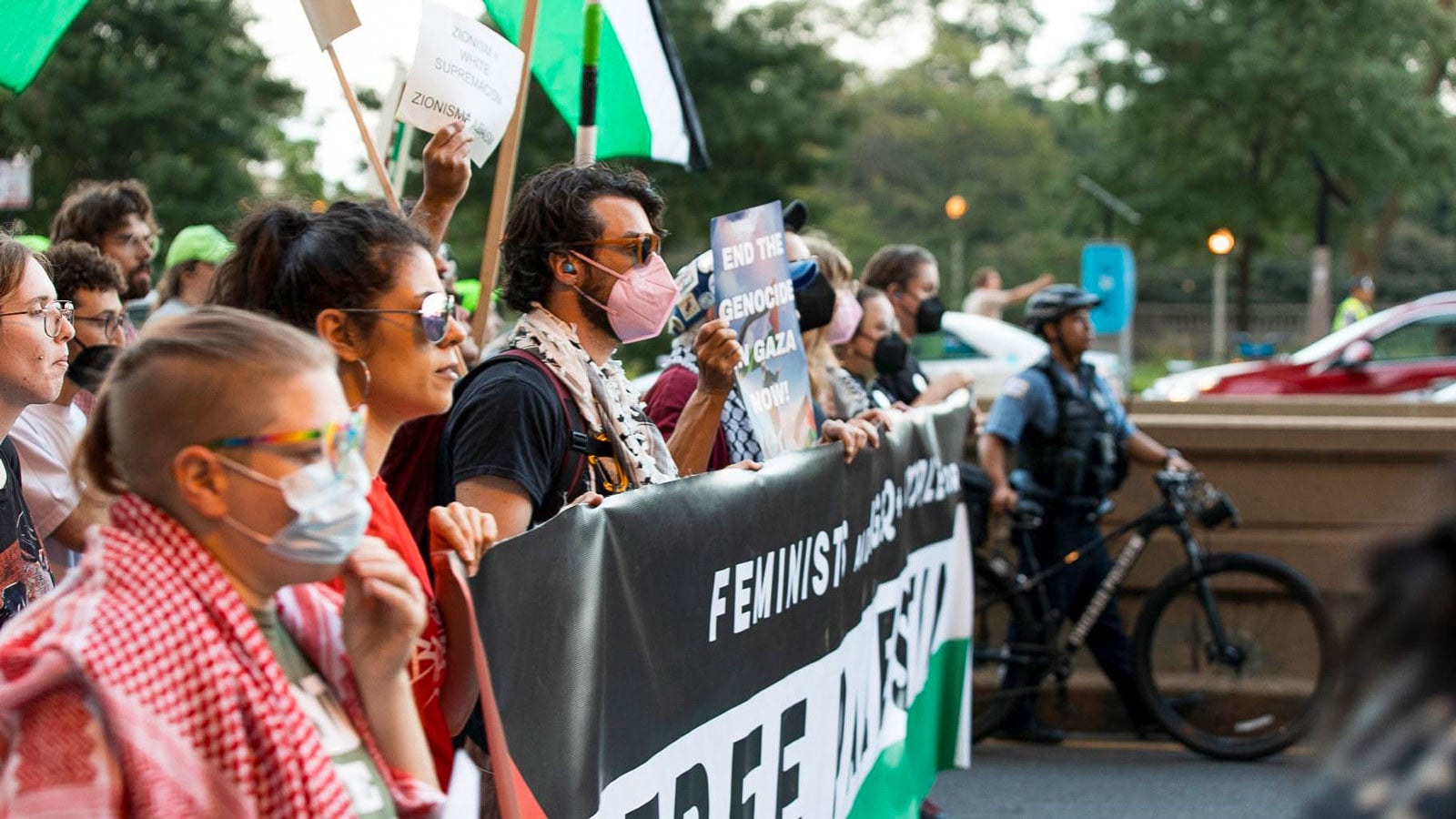
Protesters march down Michigan Avenue in Chicago on Sunday, Aug. 18, 2025, ahead of the start of the Democratic National Convention. Photo: Michael Izquierdo / WTTW News
In all, 74 people were arrested during protests related to the convention. Two protesters suffered minor injuries, while an officer sustained a concussion after being pushed, officials said.
Hatem Abudayyeh, a spokesperson for the Coalition and U.S. Palestinian Community Network who helped organize and lead the protests, said CPD’s decision to line the coalition’s marches with CPD officers on bicycles on both sides “put us in unsafe situations, forcing our marshals to struggle to navigate around the bicycles to maintain safety.”
CPD used its response to the DNC as a template to respond to the protests that erupted after Trump was reelected in 2024 and attempted to make good on his promise to deport thousands of undocumented immigrants.
The largest protest drew an estimated 100,000 people to Grant Park in October, at the height of a series of increasingly aggressive immigration enforcement actions during what the Trump administration called “Operation Midway Blitz.”
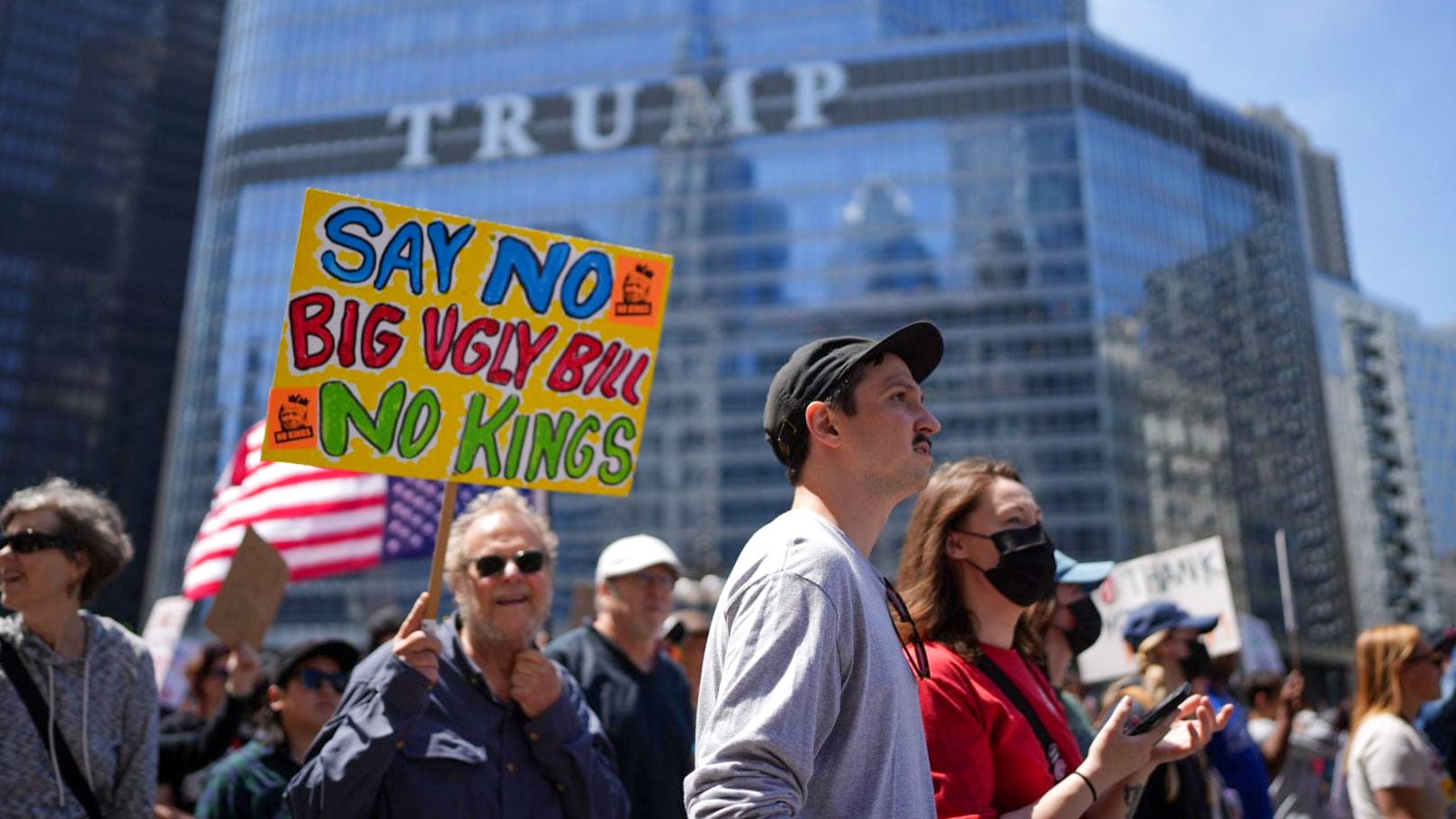
Protesters gather in downtown Chicago for a “No Kings” protest on June 14, 2025. Photo: Emily Soto / WTTW News
No incidents were reported during that protest, which was planned months in advance and had official permits to take place in a specific area of the city, much like the protests around the DNC.
Protest organizers told WTTW News that CPD’s response to protests has been a “mixed bag,” with some officers making the gatherings safer and others escalating tensions for no apparent reason.
But there have been no mass arrests, injuries or complaints of excessive force at any of the protests, including those scheduled with little notice after federal agents shot and killed Renee Nicole Good on Jan. 7 and Alex Pretti on Jan. 24 in Minneapolis.
The coalition worked hard to press CPD to revise its First Amendment policy after the debacle of CPD’s response to the protests after Floyd’s murder, knowing that Chicagoans would eventually take to the streets once again, Yohnka said.
“That work paid off,” Yohnka said.