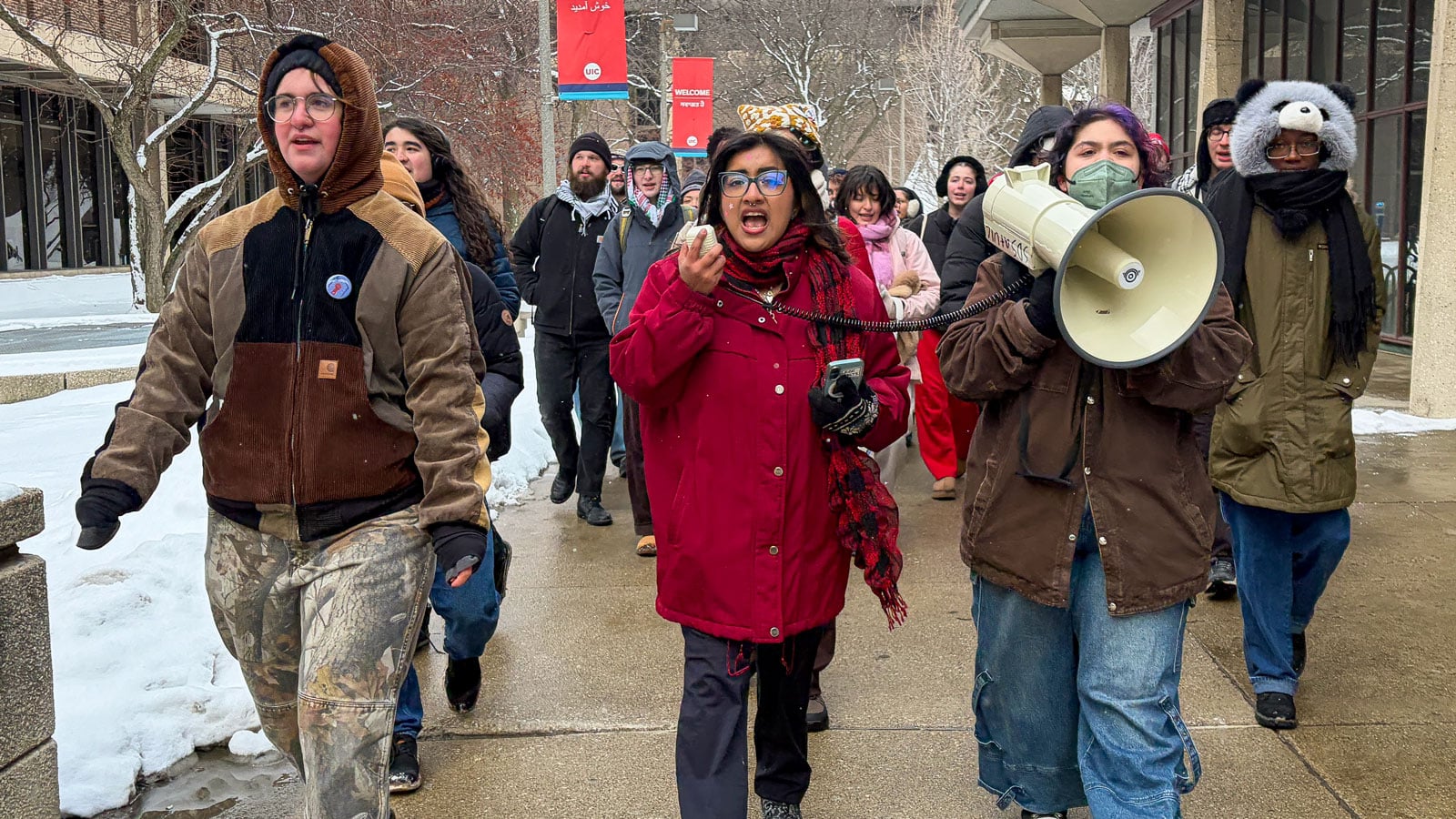
The University of Illinois Chicago’s main courtyard quickly cleared out on a recent Friday afternoon as the passing period neared its end. What was left were a small, and slowly growing, contingent of students. One student held a megaphone in their hand.
“When they come, we don’t freeze! We organize, we take the streets!”
Student groups at universities across the city staged a walkout Jan. 30 as part of a nationwide day of action to demand federal immigration agents out of communities and to stand in solidarity with Minneapolis following the recent shooting deaths of Renee Good and Alex Pretti.
Recent student walkouts at universities and high schools in Chicago offer a glimpse into just one way young people – some of whom might not even be old enough to vote – are finding opportunities to become civically engaged. But, barriers such as not believing one person can make a difference, can hold young people back from getting involved in the issues that matter to them, a recent study found.
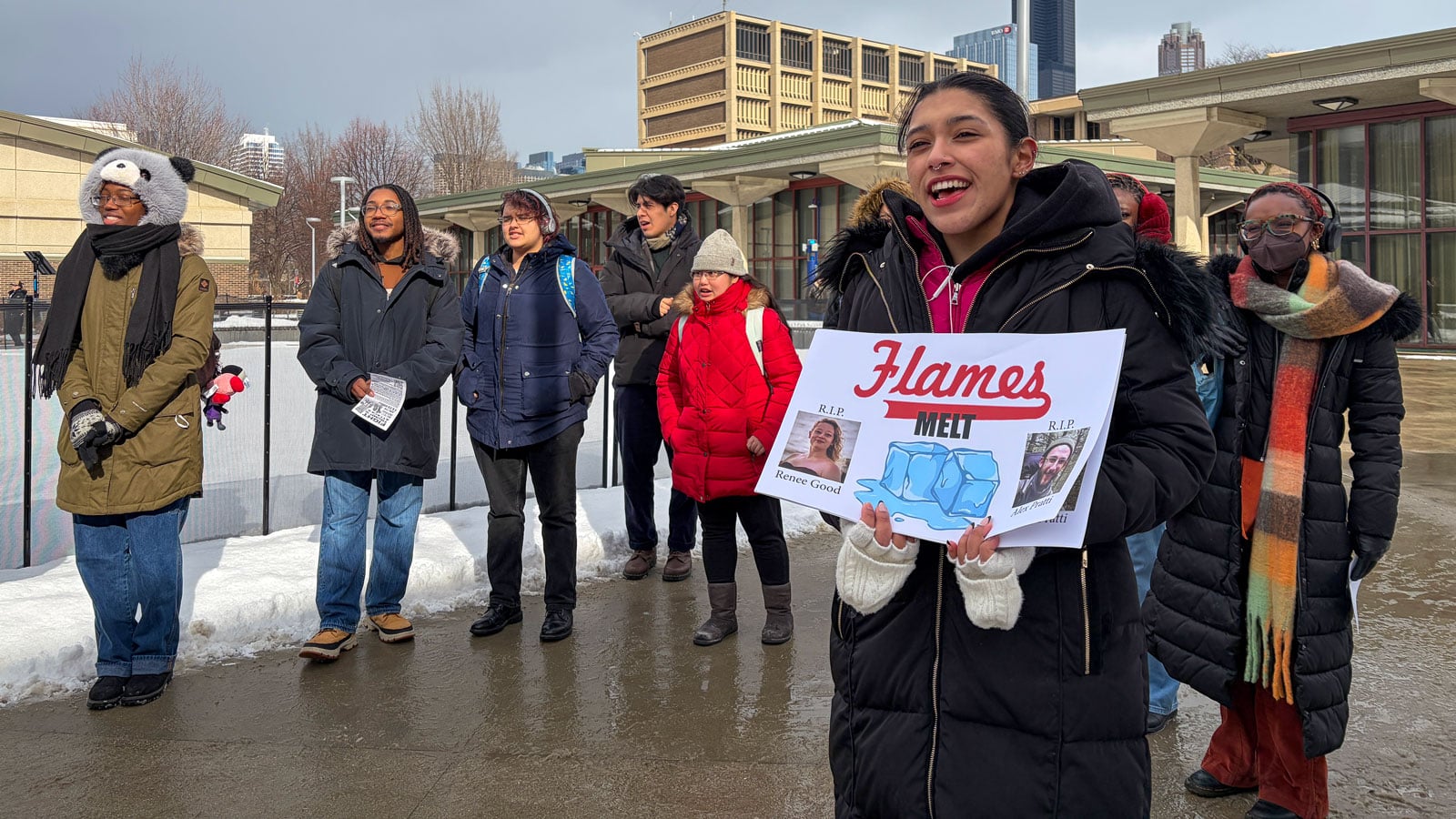
Students at the University of Illinois Chicago gather on Jan. 30, 2026, as part of a nationwide student walkout in solidarity with Minneapolis and to protest federal immigration policy. Photo: Eunice Alpasan / WTTW News
River Argyilan, co-chair for New Students for a Democratic Society at UIC, whose organization helped organize the student walkout, said while they often see “a lot of the same faces” at events, there are always new people interested in getting involved.
“There’s no better time,” Argyilan said. “The youth have always made an impact on history. We see that with the protests during Vietnam, the original SDS. The youth have a specific capability to really show up with a lot of energy and fight until we win.”
During the walkout, UIC students also spoke out to demand more funding for the university’s cultural centers and push university leadership to do more to protect the campus community from federal immigration agents.
Following a speaker portion, students then began to march and chant in opposition to U.S. Immigration and Customs Enforcement and federal immigration policies. Ileanne Cecilio, a co-lead for Mexican Students de Aztlán at UIC’s education, resistance and activism committee, led chants around UIC’s campus as the rest of the students followed behind.
“A lot of my friends here are undocumented or come from a family of immigrants, and I've seen, firsthand, the fear,” Cecilio said. “One of the things that really keeps me going is that I have a lot of comrades, a lot of friends who are also ready to mobilize, ready to be there, and knowing that I'm not alone is one of the big things that moves me.”
Gen Z and Engagement
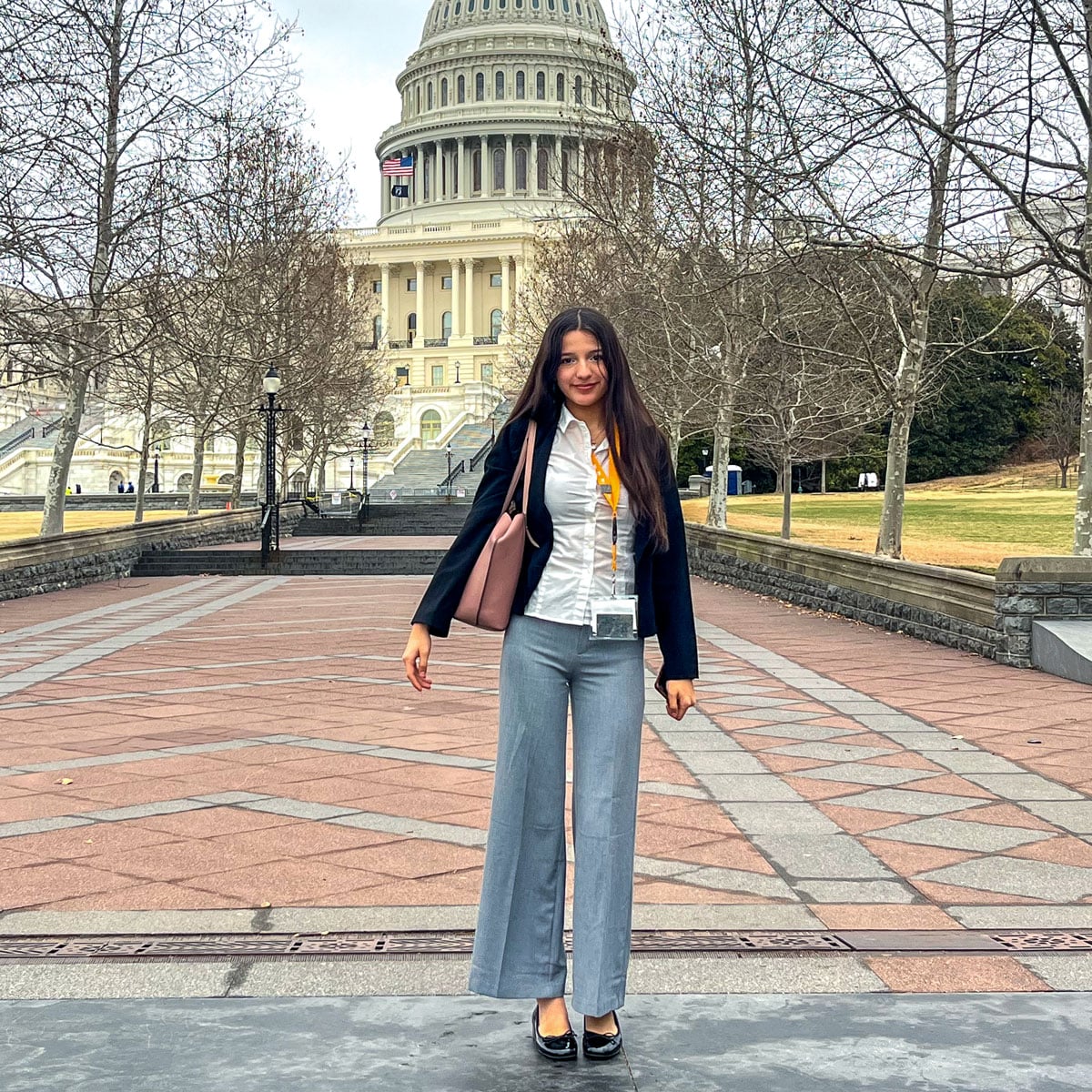
Lincoln Park High School senior Cielo Camarena in front of the U.S. Capitol on March 5, 2025 as part of YMCA s Youth Advocate Program. Photo: Courtesy of Jill Edelblute
Cielo Camarena, a senior at Lincoln Park High School, said living on the West Side of the city and experiencing redlining, systemic racism and educational inequality firsthand fueled her interest in politics and a desire to become civically engaged.
Camarena remembers her parents bringing her along to protests and meetings with local elected representatives. Her first own moment of civic engagement came when she participated in a student walkout following the 2018 Parkland school shooting when she was 10 years old.
“I remember walking out with my friends and we made signs protesting against gun violence,” Camarena said. “Even though I didn’t completely understand what was going on and the systematic issues, it really marked a moment within my life in which I was like, ‘I really care about what’s going on currently and I do have a voice.’”
The motivation to be civically engaged can change with age, according to a Gen Z Civic Vibe Check study from the Institute for Citizens & Scholars, measuring civic engagement among Gen Z. The study surveyed about 1,000 young people nationwide aged 14 to 22.
The study found younger teenagers tend to be motivated by what their peers are doing, getting into a good school or receiving scholarships. Young adults tend to be more motivated by injustice, economic struggles or leaders abusing power, according to the study.
Camarena is in her third year participating in YMCA of Metro Chicago’s Youth & Government program, a six-month mock government program for high school students.
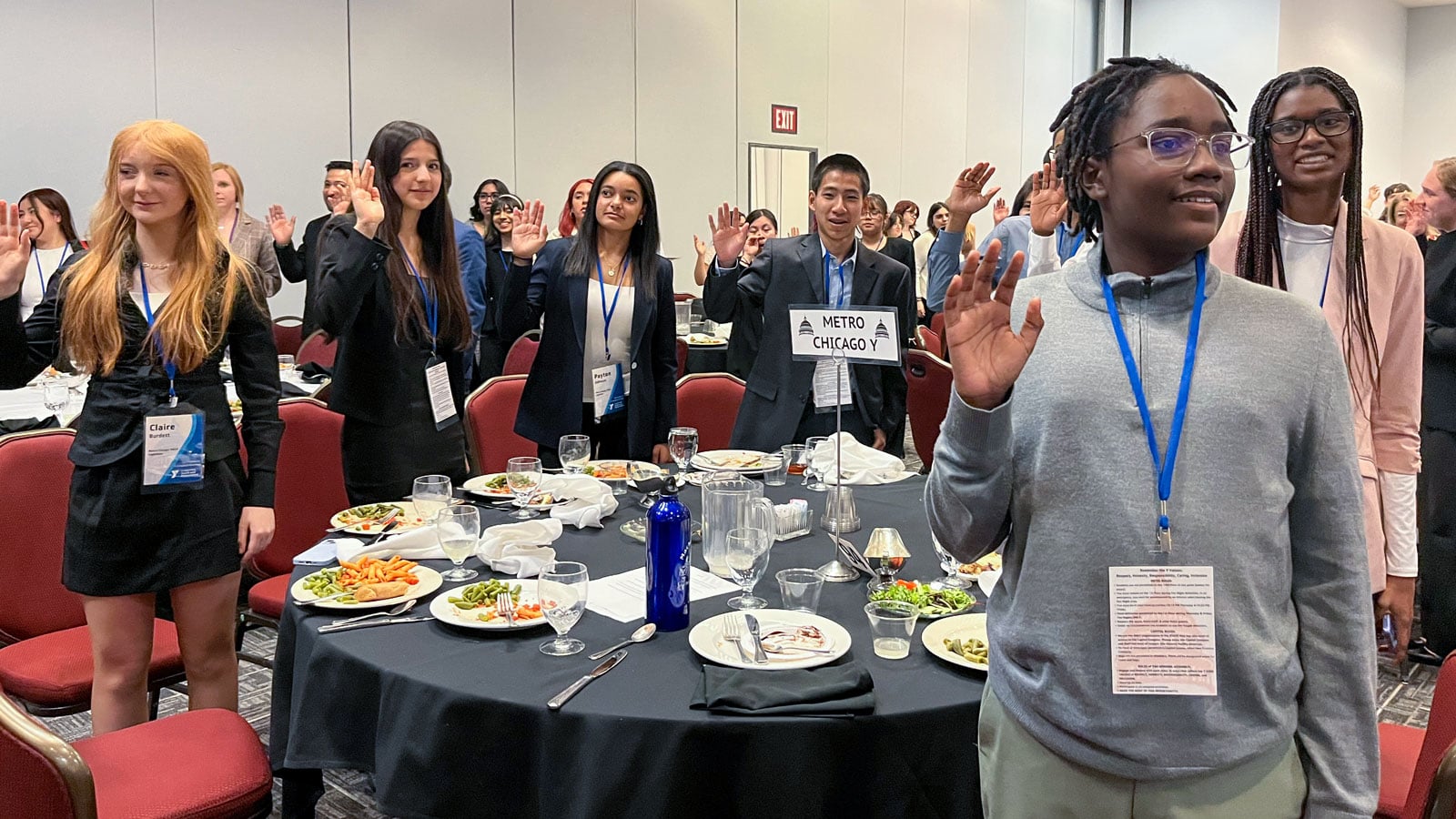
Youth delegation from YMCA of Metro Chicago s Youth & Government program taking a mock oath of office in Springfield, Ill. on March 20, 2025. Photo: Courtesy of Jill Edelblute
Serving as a legislator, Camarena works on writing and advocating on a proposed bill she will present at a culminating event in Springfield every March, alongside other students throughout the state.
One of the proposed bills Camarena previously worked on for the program aimed to require instruction about the contributions of Latin Americans in public elementary and high schools in Illinois. That idea may become a real law after state Rep. Eva-Dina Delgado (D-Chicago) filed the bill last month in the Illinois legislature. Camarena and fellow Youth & Government program participant Payton Johnson first brought the idea to Delgado last summer.
“We started discussing the disparities and the lack of education that we received regarding our own identities,” said Camarena, who is Mexican American. “[Filing the bill] felt like such an accomplishment for the Latino community as a whole because any small step towards making change is critical, especially for marginalized communities.”
During her time in the Youth & Government program, Camarena has also proposed a bill to address gerrymandering by requiring an independent commission in Illinois to draw districts. This year, Camarena is working on a voter registration bill that would ensure high school students receive materials so those eligible to vote can get registered.
Last year, Camarena had an opportunity to visit Washington, D.C., as part of YMCA’s Youth Advocate Program, where she joined other young people from across the country to advocate for YMCA’s legislative priorities to members of Congress.
Jill Edelblute, senior director of government relations for the YMCA of Metropolitan Chicago and head advisor of its Youth and Government program, said the initiative gives students the opportunity to talk and negotiate with people who have different backgrounds.
“It is an incredibly important thing in this day and age where things escalate online and in social media in a way that would never happen if you were talking to somebody in person and working to try and solve a problem together,” Edelblute said. “They’re not only learning the practical skills of the legislative process, but they’re also learning about other people, and behind other people with different experiences, that there are commonalities.”
Nine out of 10 young people care deeply for their communities, but many don’t know where to start or question if their efforts will make a difference, according to the recent study from the Institute for Citizens & Scholars measuring civic engagement among Gen Z youth.
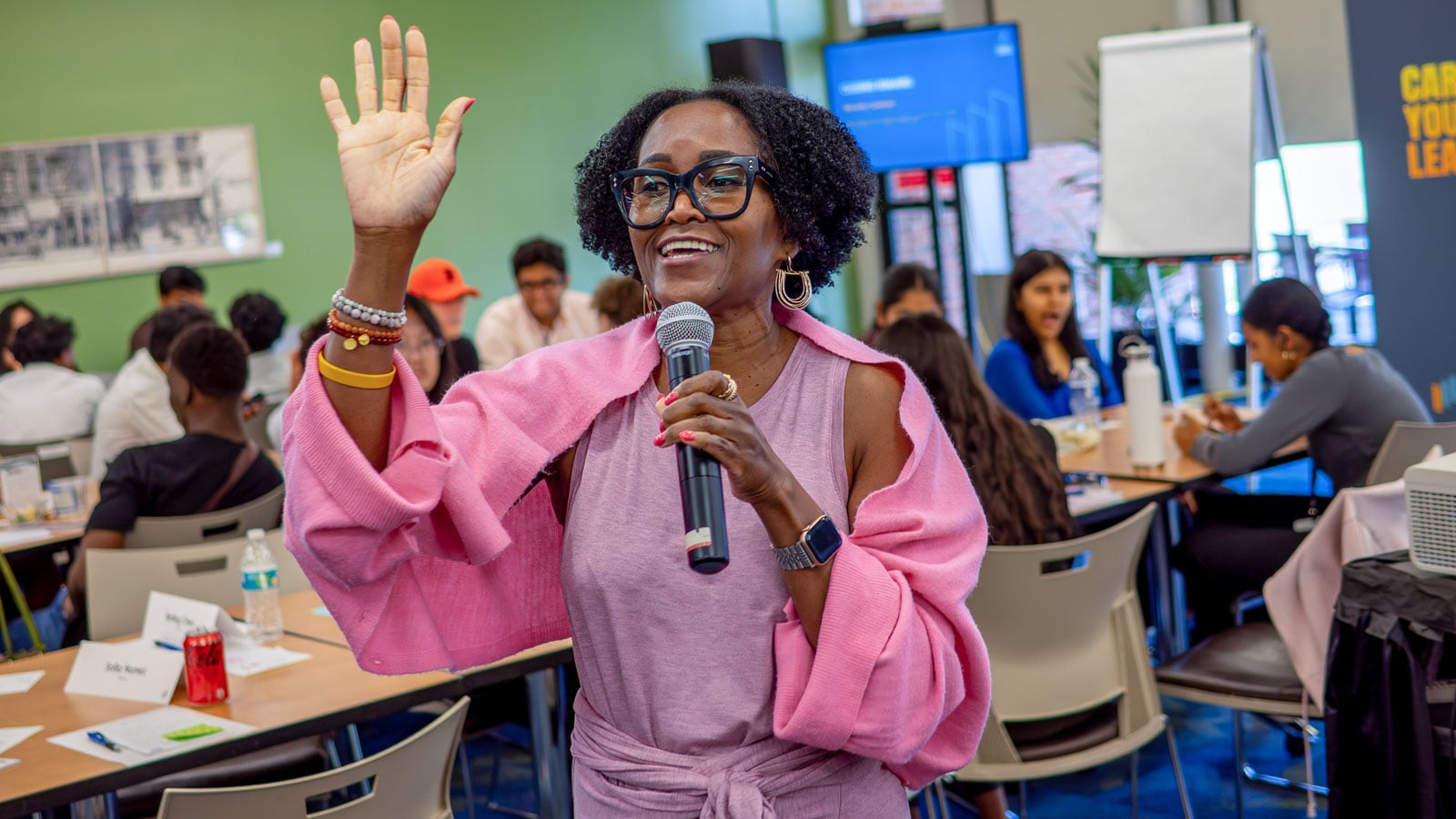
Audra Watson, chief of youth civic programs at the Institute for Citizens & Scholars, during a Carnegie Young Leaders event gathering held July 28-30, 2025. Photo: Courtesy of the Institute for Citizens & Scholars
Audra Watson, chief of youth civic programs at the Institute for Citizens & Scholars, said that while social media creates opportunities for young people to connect with others on issues they care about and learn more about what’s happening around them, they still prefer to participate in civic engagement in person.
“They actually prefer to have difficult conversations and engage with others in person, and part of the reason is because of the bad pieces of social media — things live on forever,” Watson said. “They're sometimes worried about saying the wrong thing, and so these are opportunities, when they are in person, to have conversations with one another.”
The Carnegie Young Leaders for Civic Preparedness is a nationwide program where young people work in teams to tackle an issue in their community. Four teams from Illinois, including in the Chicago area, are currently working on projects related to increasing civic engagement in their communities. One team in Iroquois County, for instance, is hosting a monthly dinner series to foster bipartisan dialogue about agriculture and Illinois food systems.
“When we think about civic engagement, I often say that voting is a low bar,” Watson said. “All voting is important, but to their day-to-day lives, what happens at the community level is going to be even more important for them. [Young people are] practicing these skills now.”
Camarena, who founded and serves as president of the Civic Leaders of America chapter at Lincoln Park High School, said that starting the chapter at her school helped her feel less isolated about current political issues after she discovered that her peers shared similar concerns over the state of the nation and its policies.
The student chapter holds informal debates, and has previously hosted food drives and discussed know your rights information.
“I think a lot of people, because of our current polarized environment, really lack a sense of community, hope regarding the future,” Camarena said. “It’s really hard seeing all these things that are happening that we feel like we can’t really make an impact.”
Hope is what it takes to get more young people involved, Camarena said.
Camarena learned it firsthand when, through her chapter, she organized a student walkout at her high school last year to protest what she described as unconstitutional federal policies coming from the Trump administration.
“Initially, I felt a sense of hopelessness because it was like, ‘I'm just a kid. I don't know if this is going to have an impact.’ But when we were doing the walkout, and I turned around and I see 300 people behind me, I remember I just see this one student, this freshman, chanting, ‘This is what democracy looks like.’ I think that moment really spoke to me,” Camarena said. “It doesn't matter if 10 people would have showed up or one person would have showed up, just having this one person, it can really create a strong sense of hope.”