A Grocery Store-Adjacent Sushi Bar Isn’t Where You’d Expect to Find Sought-After Fish, But 312 Fish Market Surprises in More Ways Than One
Lisa Shames
August 19, 2025
Get more recipes, food news, and stories at wttw.com/food or by signing up for our Deep Dish newsletter.
Have a food story or recommendation? Email us at [email protected].
Located next to an Asian supermarket on the second floor of an indoor mall in an undeveloped area across the river from Chinatown, 312 Fish Market announces itself with barely a whisper. Blink and you might miss the only clue you have arrived at this 5-year-old sushi bar: the small wooden sign hanging over the register reminiscent of the Chicago flag with “312” engraved under the four stars and “Fish Market” in tiny lettering on the bottom.
But 312 Fish Market’s under-the-radar status hasn’t stopped plenty of people from finding it, including acclaimed chefs like Thomas Keller (The French Laundry, Per Se) and Alinea’s Grant Achatz, the latter of whom recommended it to his former boss and mentor Keller.
On a recent Friday afternoon, the 35 or so people gathered around the restaurant’s seating area, mere inches from the market’s snack section, knew exactly where they were. The tightly packed crowd was there to watch the twice-a-month public tuna butchering that 312 Fish Market has been hosting for the last four years. An announcement the day before on the restaurant’s Instagram was the event’s only tip-off.
The day’s star attraction was laying on its side, stretched out atop two tables with a wood pallet underneath. The fish’s one visible eye was wide open and its mouth slightly agape, looking as surprised to be there as those who just happened to wander by on their way to one of 88 Marketplace’s other food court restaurants or the nearby restrooms.
Butchering a whole fish in front of a crowd is not a normal activity for a sushi restaurant – but 312 Fish Market has never played by the rules.
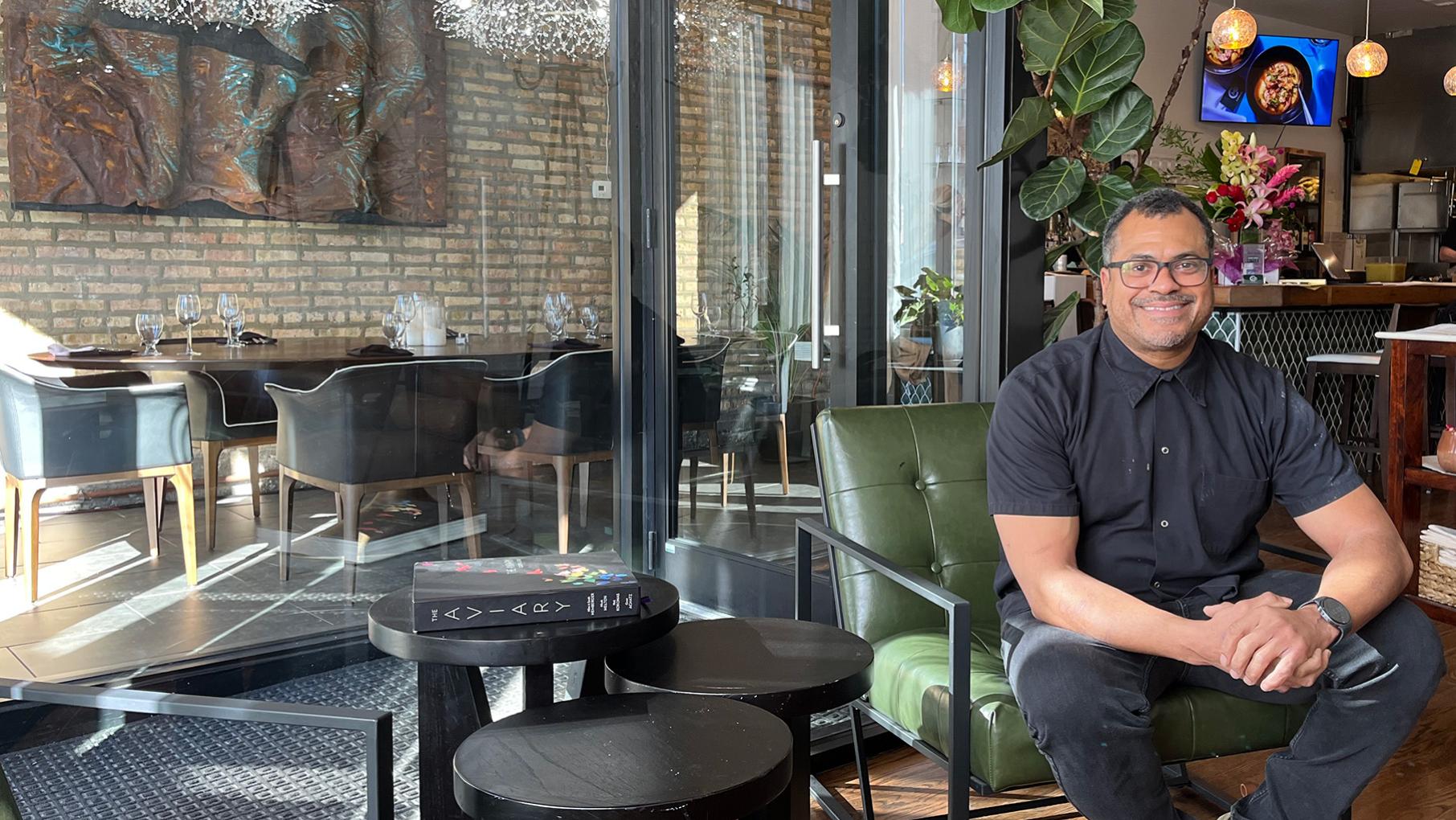
When restaurateur Jackson Chiu, previously of Wicker Park’s now closed Runa, and chef Joe Fung, formerly of Sushi-San, opened 312 Fish Market in 2020 during the pandemic, they knew it was risky. But since in-restaurant dining wasn’t allowed, it actually made a lot of sense.
“We decided that opening next to a market might be a little better because, with Covid being at its worst peak, that was the only place we could actually open it,” says Chiu. “We decided to take a chance.”
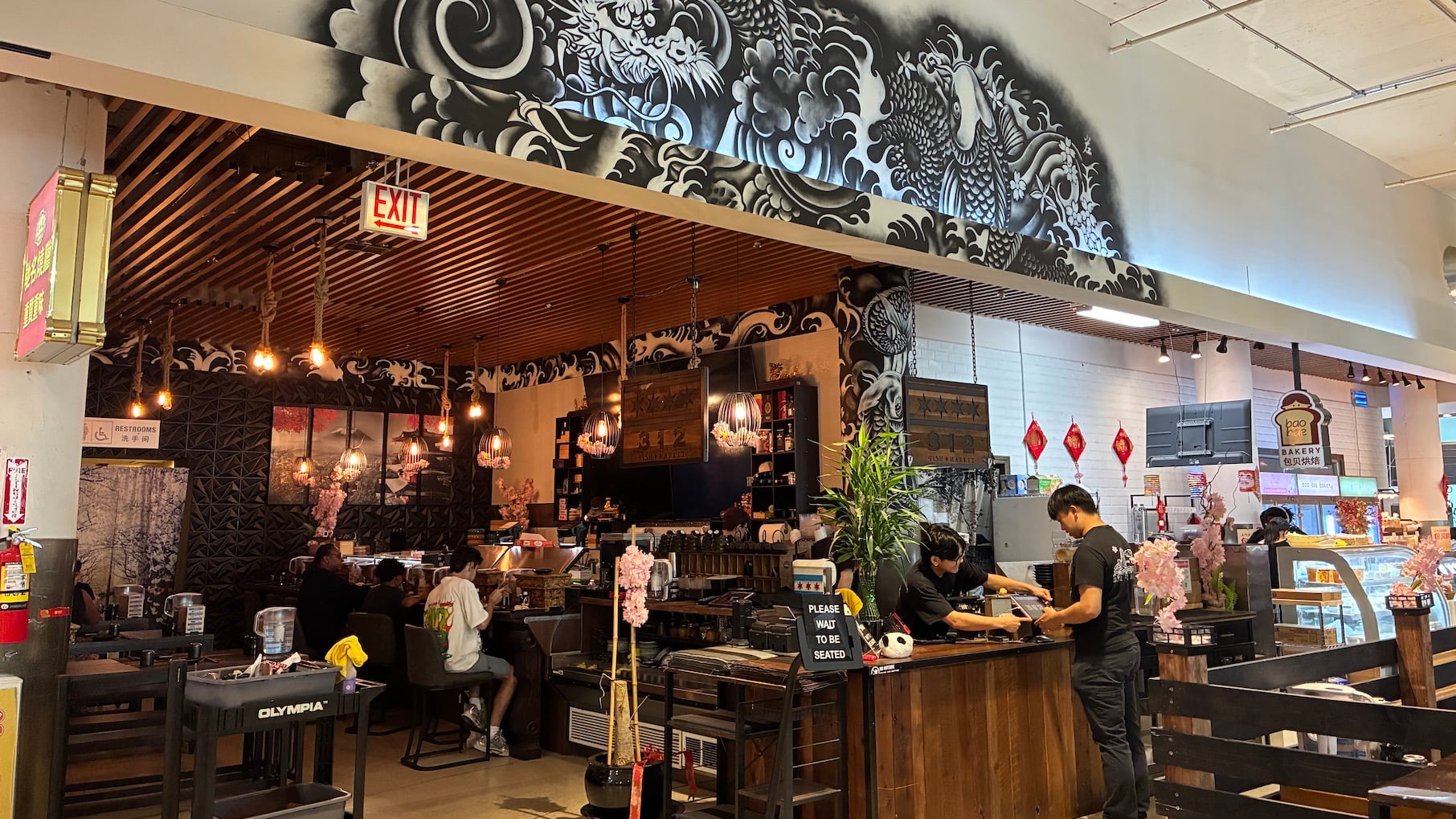
While other Chicago restaurants were scrambling to shift to take-out-only mode, that was 312’s starting point. The restaurant had eight seats, initially used only for pre-shift staff meals. 312 Fish Market now has around 50 seats, including at the sushi bar, a few tables next to it and additional tables out front in the open area next to the market. The restaurant’s vibe is laidback, with touches like earth-toned mismatched plates.
“It was kind of perfect because it let us slowly ease into dining in because, honestly, we weren't ready for it yet either,” says Chiu.
Being next to a market does come with advantages like access to fresh produce. 312 doesn’t get any seafood from the market, but relies on a small network of global purveyors. Additional storage is another plus, including the loading dock and its accompanying forklift, which allows for the whole, massive tuna to be brought in.
But there are the preconceived notions that come with being a sushi business adjacent to a supermarket. “The biggest misconception is people think that we're grocery store sushi,” says Chiu, adding that they don’t do anything that's prepackaged in advance – not even their legendary sushi trays. “Once you place the order, we'll make it on the spot for you.”
312’s success has allowed Fung and Chiu to start work on a second restaurant at 33rd and Halsted streets in Bridgeport, with a full kitchen and liquor license. (312’s limited space doesn’t allow for hot dishes, while its location in a market requires it to be BYO.) The Japanese diner and izakaya will offer breakfast as well as a prix fixe dinner. They are hoping to open by the middle of next year.
From the get-go, Chiu and Fung knew exactly what they wanted 312 Fish Market to offer. “We’re just serving fresh, high-quality fish, and we're not trying to cover up anything with sauces or toppings,” says Chiu. “We showcase what we serve.”
Which brings us back to that 581-pound elephant, er, tuna in the room.
Initially, 312 butchered small tunas at around 120 pounds. But as demand grew, so did the size of the fish. They get their tuna from Balfegó, a family-run business based in Spain’s L’Ametlla de Mar that is known for its commitment to sustainability and the quality of its bluefin tuna.
“We’re paying a lot more money for it, but at the end of the day, it tastes a lot better,” says Chiu.
Besides what they use themselves, 312 shares some of the tuna with its restaurant colleagues around Chicago.
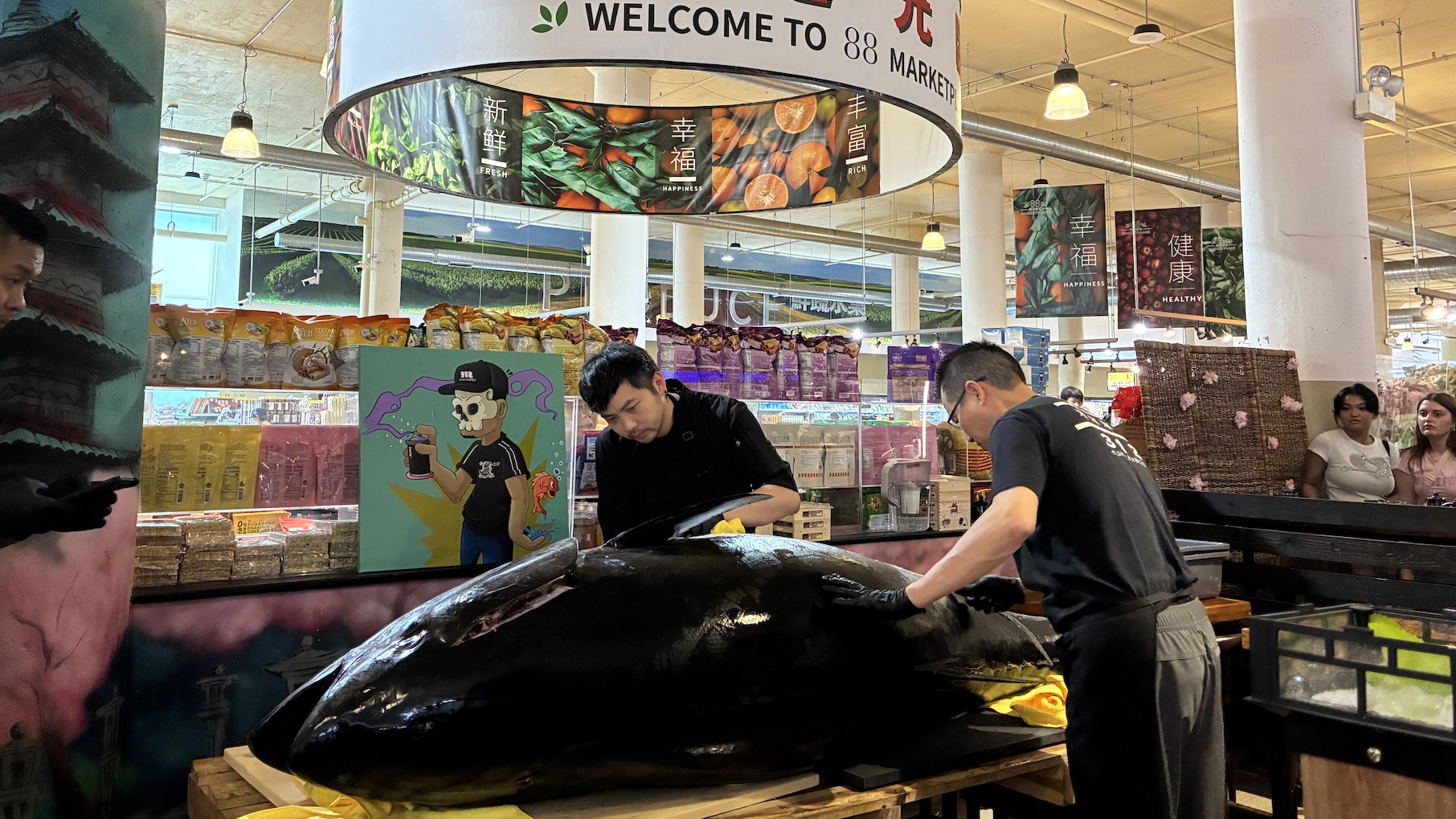
At 3 p.m., the butchering begins with the crowd already three deep. The plastic wrap around the 10-foot tuna is removed and Fung, along with sous chef Frank Wu, gets busy. Chiu documents the hard work on his phone, lending a hand when needed. Nearby, a tray holds knives of various sizes and shapes, plastic wrap, and towels, a set-up that looks like that of an operating room.
Fung and Wu first get to work on removing some of the skin. “The skin is basically like body armor for the fish and it’s very tough,” says Chiu.
“Nope, no way,” says one woman as she walks by, who obviously isn’t there to watch. (Note: Surprisingly, the butchering process isn’t gory, unless perhaps you’re the tuna.)
At 3:15 p.m. the first big chunk of ruby red tuna is separated and passed to one of the chefs to wrap. “I want that piece,” says a crowd member.
By now, a small group of people has also gathered on the other side of the plastic partition separating the market from 312’s dining area with cellphones in hand as they move snack items to get a better look.
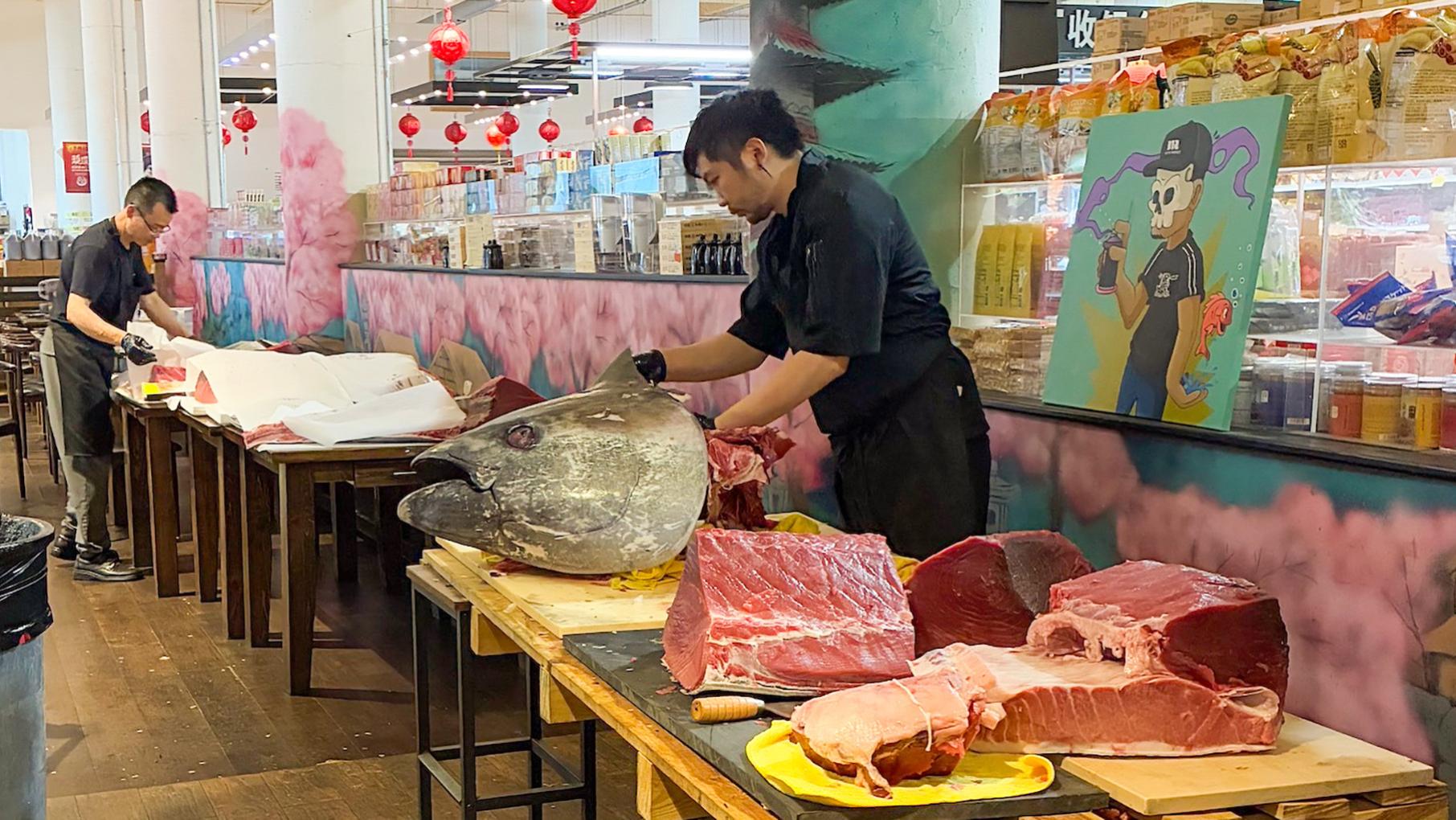
Minutes later, with a bit of tugging, another huge section is freed from the fish with wows from the crowd accompanying it. The process repeats over and over, with little to no talking between the chefs, who have done this 80 or so times over the years.
“I come here a lot,” says Peter Meade, who lives nearby, and had gotten a prime viewing spot. He’s only seen the tuna butchering from a distance during a market shopping trip. “Me and my girlfriend are big foodies, so it’s nice to see where the food we eat comes from. You never really understand how big a tuna is when you’re eating it.”
The removal of the tuna’s spine provides a unique perspective of the fish. A curved knife helps with the process, which requires four team members. “That looks like when Geppetto was inside the whale,” says a viewer, referencing Pinocchio.
Chiu holds up two fingers to a staff member, who brings him two spoons. Chiu proceeds to carefully scrape the tuna bits around the spine into a bowl. “We want to give people a better appreciation for the fish and not waste any of it,” he says.
By 3:45 p.m. hardly any of the tuna is left except for the head, which Fung continues to trim with a small knife. The end of the butchering is acknowledged with a round of applause, followed by the handing out of handrolls filled with the fresh tuna to the audience.
“That was dope, man,” says one of the viewers. I couldn’t agree more.