Most people would agree that Chicago is a town that loves its politics, for better or worse.
But if that love is so strong it’s got you thinking about running for elected office, you’d do well to think long and hard before jumping into the challenging and sometimes-cutthroat process of getting your name on the ballot.
While legal experts say the process has evolved in favor of greater ballot access, there are still plenty of hurdles hopeful candidates must jump over — and plenty of areas where reformers hope to see change.
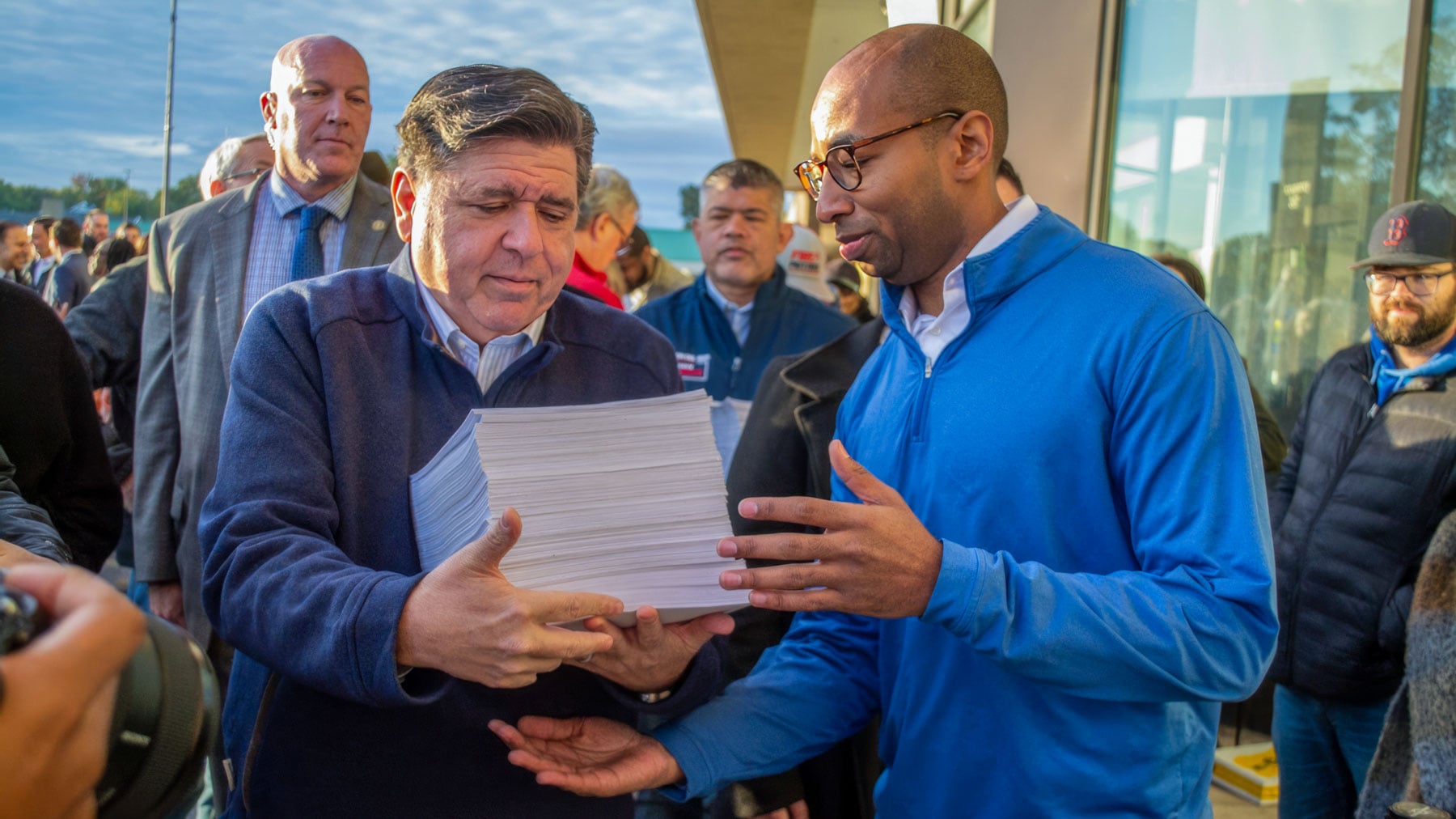
On paper, the mechanics of getting on the ballot in Chicago aren’t so different from elsewhere in Illinois. After filing the raft of necessary paperwork, it’s time to pass petitions. Anyone who’s come in or out of a grocery store, ‘L’ station or other high-traffic area in the runup to election season is all too familiar with those eager-eyed folks clutching their clipboards and asking you to help so-and-so get on the ballot.
At first glance, it’s a sign of the democratic process at work.
But how many signatures do they need to nab? That’s where it gets interesting.
In the 2023 election, aldermanic candidates needed 473. Candidates for a seat on a police district council needed between 193 and 758 signatures. Mayoral hopefuls needed a whopping 12,500 valid signatures.
By contrast, major party candidates for governor of Illinois only need 5,000 valid signatures. That disparity can in part be chalked up to the fact that Chicago’s elections are nonpartisan — gubernatorial candidates running as independents or as representatives of a new political party need 25,000 valid signatures.
Barriers to Entry
Many political watchers consider the high threshold for candidates to qualify for Chicago’s elections part of the legacy of the Democratic machine crafted by former Mayor Richard J. Daley and perfected by his son, former Mayor Richard M. Daley.
“It leaves the average person out of the mix,” said Elmhurst University political science professor Constance Mixon. “That’s not good for democracy.”
With plenty of attention on efforts to ensure that voters can cast their ballots freely and fairly, Mixon said the need to protect and expand the rights of potential candidates to get on those ballots is often overlooked.
“Democracy requires a healthy field of candidates,” Mixon said.
If candidates want to play on that field, the rule of thumb is to gather at least three times the minimum number of signatures so they don’t get ejected. And there are all kinds of ways those names can get disqualified.
Those who sign candidates’ petitions must be registered voters, and in the case of city and police district council races and school board races, must live in the right ward or district. Voters also can’t sign petitions for more than one candidate in any given race.
The number of signatures each candidate has to collect to qualify to run for elected office is set by the General Assembly.
Once all those signatures are collected and filed, the process of verifying them is costly and time-consuming for election officials, who face tight deadlines to finalize the list of candidates who have qualified for the ballot.
Election officials are on their own in navigating how best to validate petition signatures, since state law offers no guidance.
During the 2023 municipal elections, the Chicago Board of Election Commissioners spent approximately $258,000 on handwriting experts, court reporters and hearing officers charged with figuring out whether challenged candidates had collected enough signatures to qualify to run for mayor or City Council, said Max Bever, the board’s spokesperson. The board’s 2023 budget was $56.6 million, records show.
By comparison, the tab for those expenses for the March 2026 primary election — even with few local offices on the ballot — was nearly $139,000, plus the cost of employee salaries, Bever said. The board’s 2026 budget is $27 million, records show.
State officials spent more than $164,000 on overtime for employees and to hire hearing officers for the 2026 primaries, Illinois State Board of Elections spokesperson Matt Dietrich said.
The Chicago Board of Election Commissioners is the only election authority in Illinois “to use certified handwriting experts to add another layer of accuracy to this process,” Bever said.
Employees charged with verifying signatures attend a 90-minute training session about how to make sure signatures match, Bever said.
It’s not just getting valid signatures — it’s also making sure they’re delivered to Chicago’s board of elections according to a detailed set of specifications. That’s one reason why, although it’s not a requirement, many candidates hire election lawyers to walk them through the process.
“There are a lot of landmines that are out there,” said attorney Ed Mullen. “Not numbering your petitions, putting them in a folder and not binding them, not signing your statement of candidacy or not notarizing your statement of candidacy, filing your statement of economic interest in the wrong office — there’s just a lot of simple things that people do every cycle that get them kicked off the ballot.”
Think of those rules as an incumbent-protection package, finely honed over the course of decades to make winning reelection as easy as possible, said attorney Michael Dorf, who has represented former Mayor Lori Lightfoot and a host of other prominent elected officials.
“The election code was written by incumbents to keep incumbents in office,” Dorf said. “Illinois makes it, I think, particularly difficult for people who are not supported by an organization to just go ahead and run for office.”
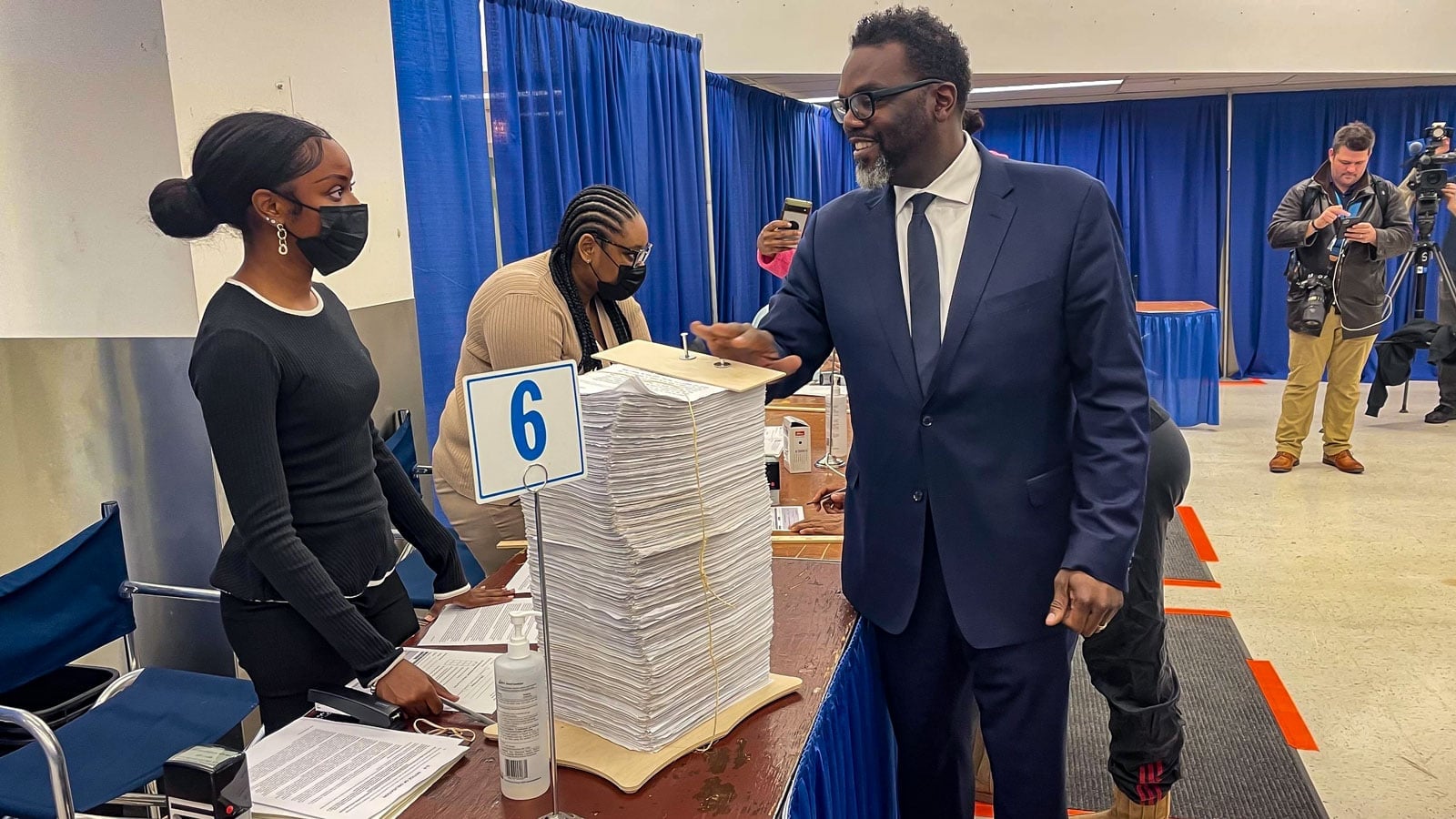
Brandon Johnson files petitions with nearly 42,000 signatures to become an official candidate for mayor of Chicago on Nov. 21, 2022. Heather Cherone / WTTW News
The Ballot Challenge Battle
Perhaps the best-known part of Chicago’s election process to news junkies is the ballot challenge process, where candidates must defend themselves against charges like failing to gather enough signatures or not having lived in their ward long enough.
Each case gets a hearing officer who oversees what longtime election attorney and hearing officer Joseph A. Morris calls a “mini lawsuit,” allowing each party to present evidence and argue for or against including a candidate’s name on the ballot.
The hearing officer then makes a recommendation to the election board, which can either accept or reject the officer’s findings. Parties can appeal the board’s decision in the Circuit Court of Cook County, then the Illinois Appellate Court, then all the way up to the Illinois Supreme Court.
“A lot of time and expense is devoted to the receiving of nominating papers and then giving fair hearings to everybody involved when there’s a challenge,” Morris said. “It’s a cost to democracy that is probably a very good investment in my opinion.”
Judges typically give candidates struggling to get on the ballot the benefit of the doubt, since the law is designed to favor robust elections, Dorf said.
While the law might favor having people on the ballot, people invested in getting a political foe kicked off are often far less decorous, Mullen and Dorf said.
“It’s not a function of the law, but more a function of the culture, that there are a lot more objections during the aldermanic races,” Mullen said. “They are a lot more personal and intense.”
Alisa Kaplan, executive director of Reform for Illinois, a group that tracks campaign contributions and lobbies for increased transparency in government, said it makes sense to force candidates to demonstrate their seriousness by overcoming some kind of hurdle.
But those requirements should be just the “bare minimum” to ensure that ballots are not overly crowded, Kaplan said, arguing that the current requirements serve only to bolster the ambitions of those who have the support of the Cook County Democratic Party or are wealthy enough to finance their campaigns directly.
“All these requirements do is drain the resources of good candidates,” Kaplan said. “It favors the wealthy and the well-connected in a system where they already have so many advantages.”
The system can also be transformed into a weapon by candidates with ample resources to prevent voters from getting to decide between candidates, Kaplan said.
An effort in 2022 to replace the pen-and-paper petitions with digital signatures captured by computer tablets or phones stalled.
Kaplan said that proposal should be revived, since it would prevent candidates from having to collect triple the number of signatures to ensure they have enough to qualify for the ballot.
“Surely we can find a better way,” Kaplan said.
But many observers say a better way doesn’t appear to be in the offing any time soon.
“One of the anecdotes that election lawyers have is, when somebody is first running for office, they say everybody should be allowed on the ballot, we should have total democracy, everybody should have a fair chance,” Dorf said. “Once they get elected, their viewpoint of the world changes drastically.”