After 34 Years, a Hopleaf Bartender Retires in a Changed World of Beer
Daniel Hautzinger
November 17, 2026
Get more recipes, food news, and stories by signing up for our Deep Dish newsletter.
The bartender known as Mighty Slim was in the basement of the legendary Delirium Café in Brussels when he heard another American “pontificating” about American beers and trying to recall the name of the brewmaster at Chicago’s Goose Island Brewery. Slim chimed in to answer: Greg Hall.
“And he looked and he said, ‘Holy cow, you’re the bartender from the Hopleaf!’” Slim recalls. “And my wife turned to me and said, ‘Jeez, we can’t go anywhere.’”
That a bartender would be recognized an ocean away from their workplace is an indication of both Slim’s presence and the stature of Hopleaf, a bar and restaurant in Chicago’s Andersonville neighborhood known for its extensive Belgian beer list, mussels, and fries served thin, salty, and piled in a paper cone. Thirty-four years ago, when Slim first started working at Hopleaf a year or so after it opened, no one in the beer mecca of Belgium would be talking about a beer bar or a brewery in Chicago. The craft beer revolution in America had barely begun.
Today, Hopleaf draws people from around the world for its rare beers and lived-in atmosphere, Goose Island is a global brand owned by Anheuser-Busch InBev, and Slim just retired after three and a half decades serving beers, stories, and conversation on Clark Street. The world of American beer has changed – and Slim has been there to witness it from one of the bars that helped change it.
A Hopleaf History
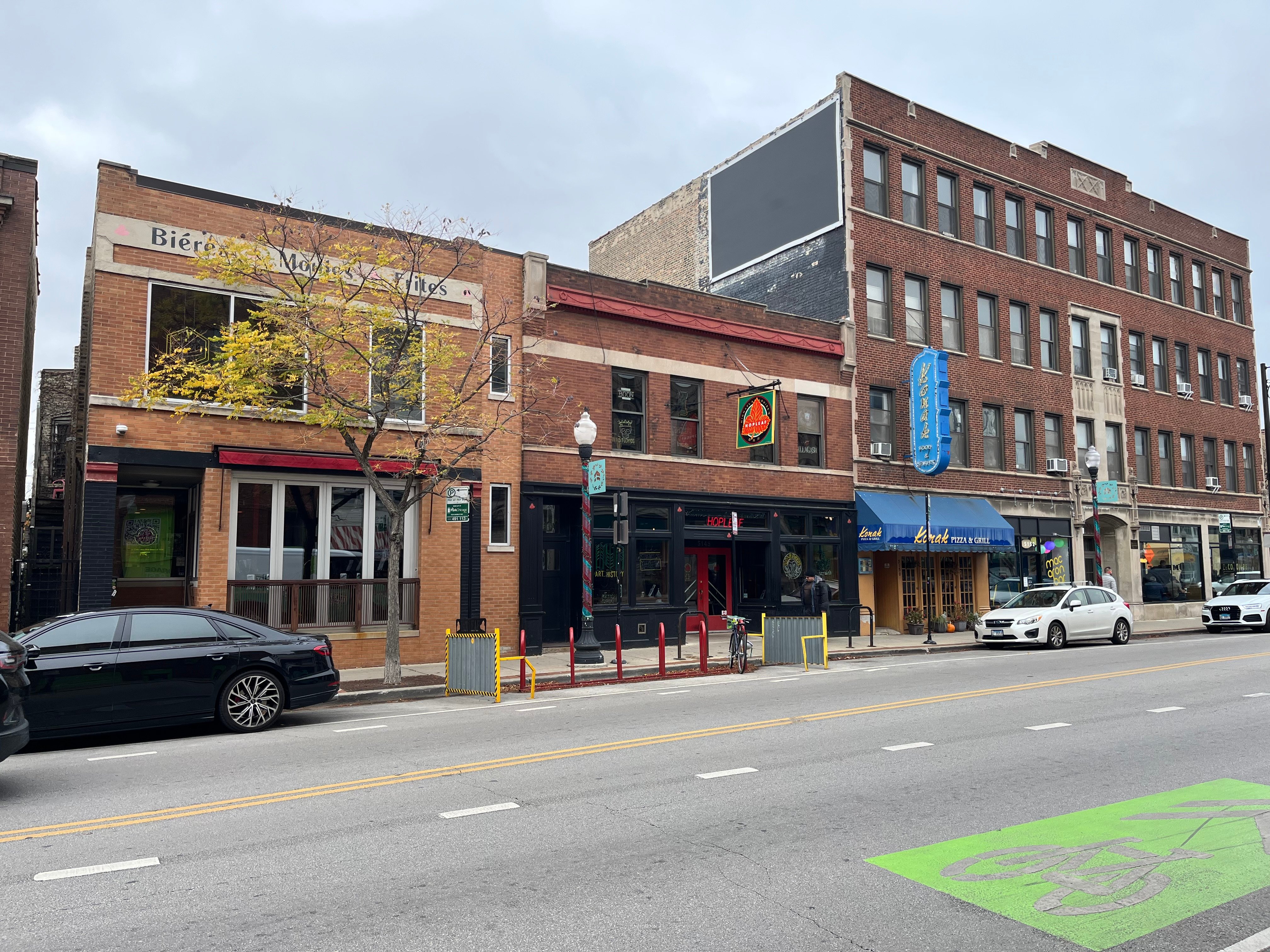
When Michael Roper opened Hopleaf in 1992, Andersonville was still an out-of-the-way neighborhood with some lingering Swedish influence. The bar that would become Hopleaf didn’t have windows, opened at 7:00 am, played pornography on the TV, and made most of its money from poker machines. Roper added windows, got rid of the TV and the poker machines, and brought in some Belgian beers and early American craft brewers like Bell’s.
“That was when craft beer was just starting,” says Slim, who prefers not to share his real name or the origin of his nickname. “Back then, Leinenkugel was a craft beer, because they weren’t bought out yet.”
He came to Hopleaf from MaxTavern, a respected bar at Racine Avenue and George Street that also carried some more “eclectic, eccentric” beers. (“I’ve never worked at a place that sold Miller, Budweiser, Old Style,” he says.) When MaxTavern shut down suddenly, Roper hired several of its bartenders, who also brought along some of its clientele.
The Lincoln Park and Lakeview area was becoming more expensive, “so people were either moving up to Rogers Park or they were moving down to Wicker Park,” Slim says. He went north, eventually buying a house near his new workplace in Andersonville, “30 years ago, when you could afford a house in this neighborhood.”
Roper also eventually bought Hopleaf’s building from his Swedish immigrant landlord, who lived upstairs, allowing him to add a tiny kitchen to the bar, and later expanded into the building next door when that went up for sale. There are currently 62 taps and over a hundred beers available at Hopleaf, down from a pre-pandemic peak of around 350 offerings.
But when Slim started there in 1993, “I think we had eight taps and 35 beers,” he says – and that was exceptional. Most bars offered just one or a few mass-produced commercial beers. Hopleaf began to gain a reputation as a place where beer lovers could find ales imported from Belgium alongside American craft beers, including ones from Chicago’s nascent scene.
“There was a time when we would have a sour beer on tap and somebody would order it, and they’d taste it and be like, ‘Ugh, there’s something wrong with this beer!’” Slim recalls. At this point, we’ve gone through a full cycle of American craft beer: underground indies became giants, breweries popped up in every old industrial space, specialized breweries started to open, the industry over-extended, and now things are contracting.
In Slim’s understandably biased estimation, Hopleaf has not only been a boon to Chicago’s beer culture but also to Andersonville itself. “It’s always been a nice, quaint neighborhood, but 30 years ago it wasn’t the nicest neighborhood, like it is today,” he says. “And I think the Hopleaf as an anchor on one end of the strip has had a lot to do with it.”
He sees himself as not just an ambassador for Hopleaf and beer, getting customers to try new brews and introducing them to new styles, but also for the neighborhood at large. “If [customers] come in and they’re looking to do something, I can tell you where to go.”
Despite all that change, the original room of Hopleaf hasn’t changed much, according to Slim, other than signage from breweries around the world, the removal of a jukebox, and some updated furniture. Employees have come and gone, but Slim has been another fixture as solid as the heavy bar.
Tending to the Customers
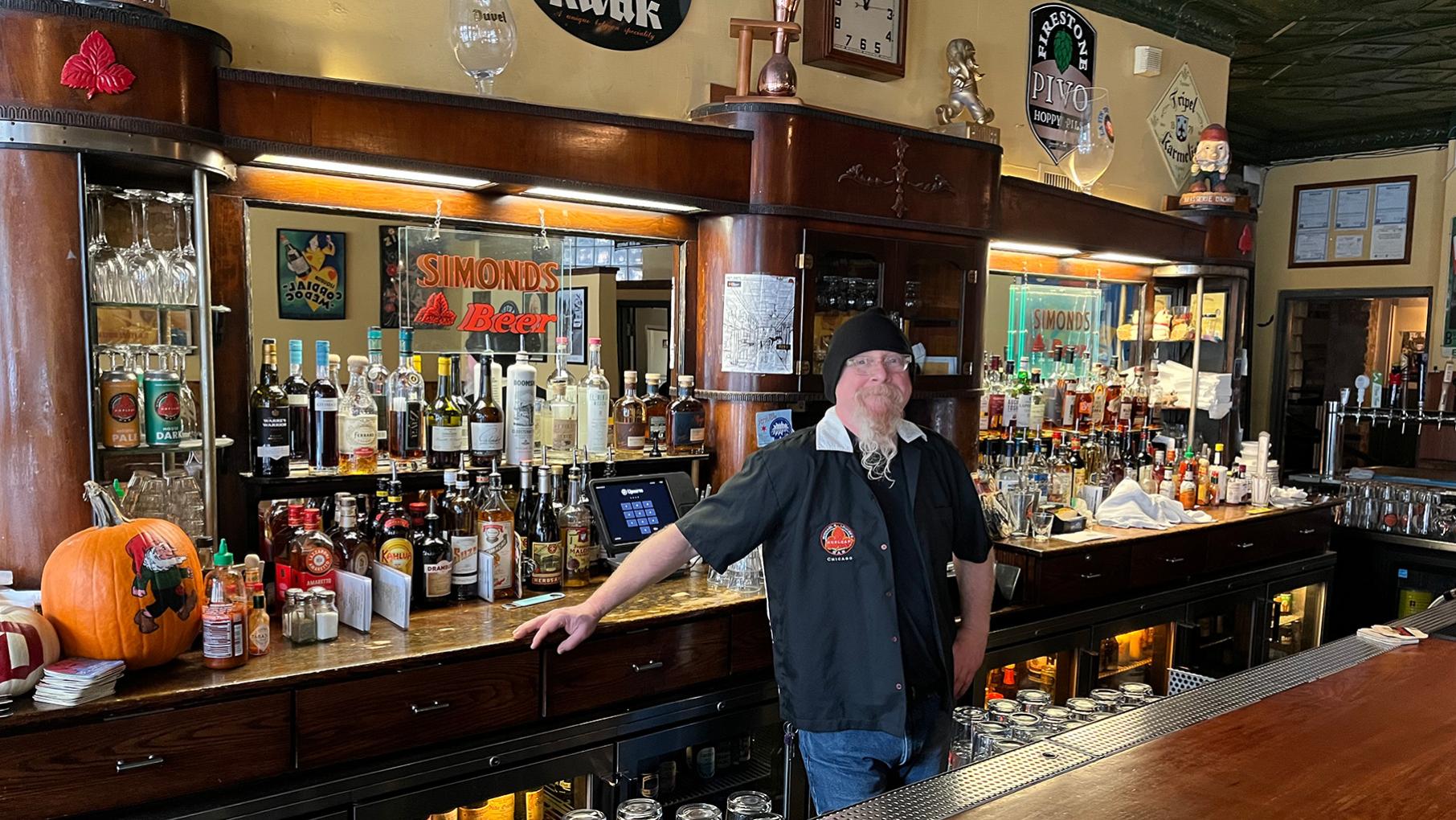
Slim has a cheery, round face accented by a white-blond mustache and long, curling tendrils of beard. He’s sweeter and milder than you might expect from a lifetime bartender who looks a bit like a biker. But, as he has learned over his decades in hospitality, looks can be deceptive.
“When you start a conversation, you never know who you’re gonna meet,” he says. Hopleaf draws everyone from kids who have been in Chicago for less than a month and legally drinking for less than a year to old timers who have been enjoying beer here for three times as long as those kids have been alive. “Some of my favorite customers are people that I kind of looked at sideways like, ‘Is this gonna be trouble?’” Slim says. “No, they’re just people that want to drink.”
He knows that people come to a bar to have a drink both because they’ve had a good day and because they’ve had a bad day. He tries to give rude customers better service “just to make them feel a little better;” it’s not about him.
“It’s called bartending. You’re tending to the customers, [is] the way I’ve always looked at it,” he says.
He meets all sorts of people. There was the woman who recognized the antique bar Roper put in when he opened the Hopleaf as the exact one in which her parents kept Crayolas for her to color with while they ran their tavern, which was demolished. A Canadian curling team comes in every year when here for an event in the suburbs. (Slim keeps a note on his phone of repeat customers’ descriptions so he can give them the thrill of greeting them by name.) A neighbor from Turkey walked over with his cane every day for years to smoke one cigarette and have a beer; after he turned 95, his drinks were on the house for the final four years of his life.
That, of course, was back when you could smoke inside bars – another thing that has changed. When Slim would get home at 4:00 am in those days, his wife always made him shower to get rid of the ashtray smell before going to bed. You might expect working at a bar for 34 years to be detrimental to your health, but it has arguably been the opposite for Slim. For a long time, Roper offered any employee $500 if they stopped smoking for a year; Slim took him up on it, bought an elliptical, and hasn’t gone back since.
The late hours are behind him too. He finished out his tenure at Hopleaf working the day shift. Knowing what closing the bar is like, he tries to help out his younger colleagues by coming in early every day. “I know all the nooks and crannies that didn’t get cleaned,” he says. If he does the work, it gives them a chance to go to bed a bit earlier. “I know what needs to be cleaned, what needs to be stocked. I’m the support staff for the night shift now.”
“There’s never been a more fastidious bartender,” Roper says of Slim. “He can’t stand an untidy bar. And you should see his garage at home.”
The admiration is mutual. “I’ve known some jerks that own bars, God bless ‘em,” Slim says; Roper isn’t one of them. “When you find a place that you like working at, for somebody that you like to work for, it’s not so much a job anymore, it’s a passion. That’s what you should be doing. That’s kind of how I felt about the Hopleaf.”
Roper began stepping back from running Hopleaf when he turned 70 two years ago, but he’s still plenty involved and there frequently; no one would say he’s retired. But he doesn’t want to make the mistake of his dad, who retired at 86 and regretted it. He has fielded inquiries from some restaurant groups about buying the bar, but he doesn’t want Hopleaf franchised across the country. He’s still considering a succession plan.
“I could be the curmudgeon that comes in and sits at the end of the bar and complains about everything that used to be better,” he says.
And now he could be joined by his longest-serving bartender, sitting on the other side of the bar he tended for 34 years, reminiscing about all the people who have come in over the years, in a curmudgeonly way or not – and sharing a beer with them.