


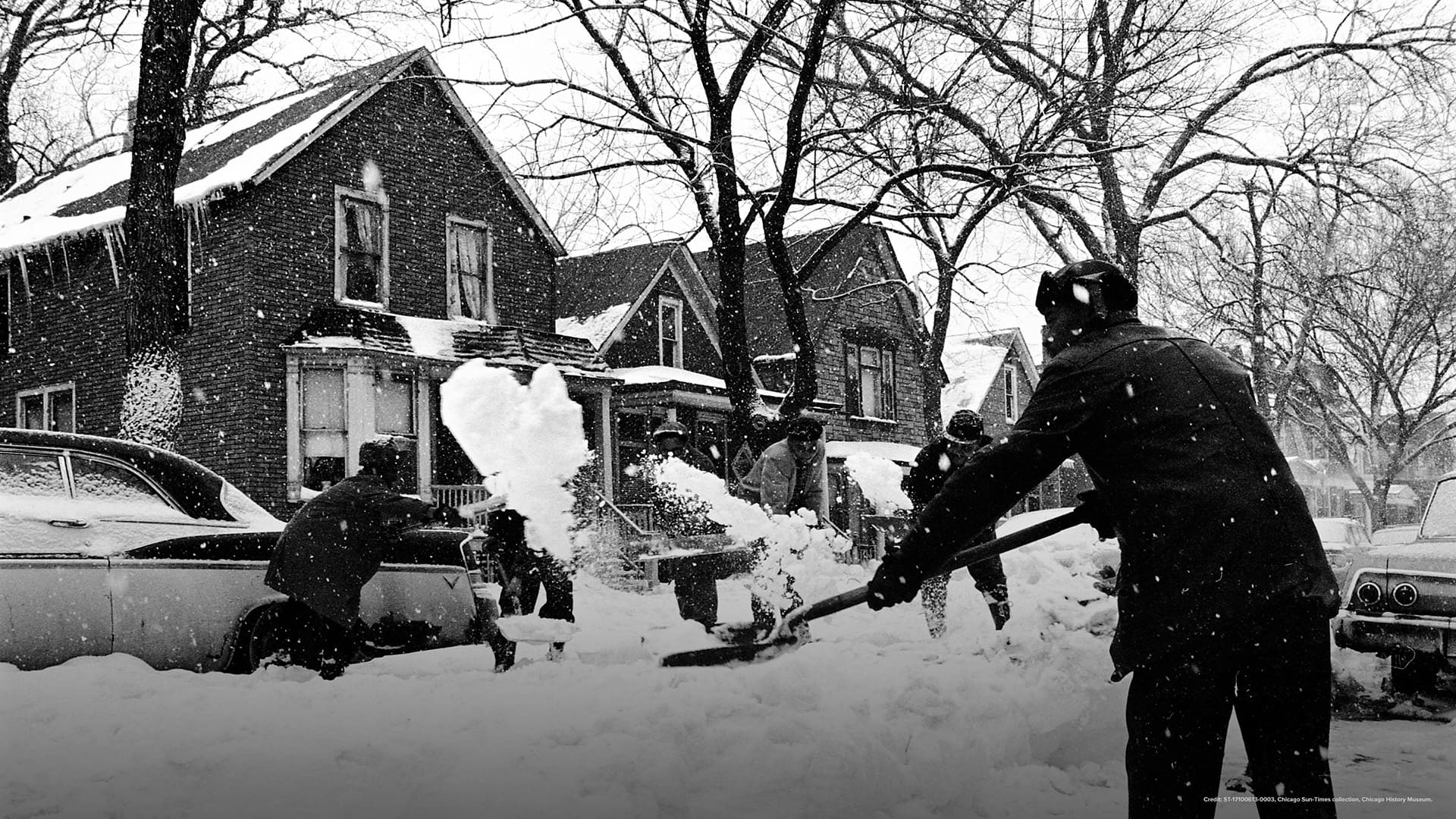




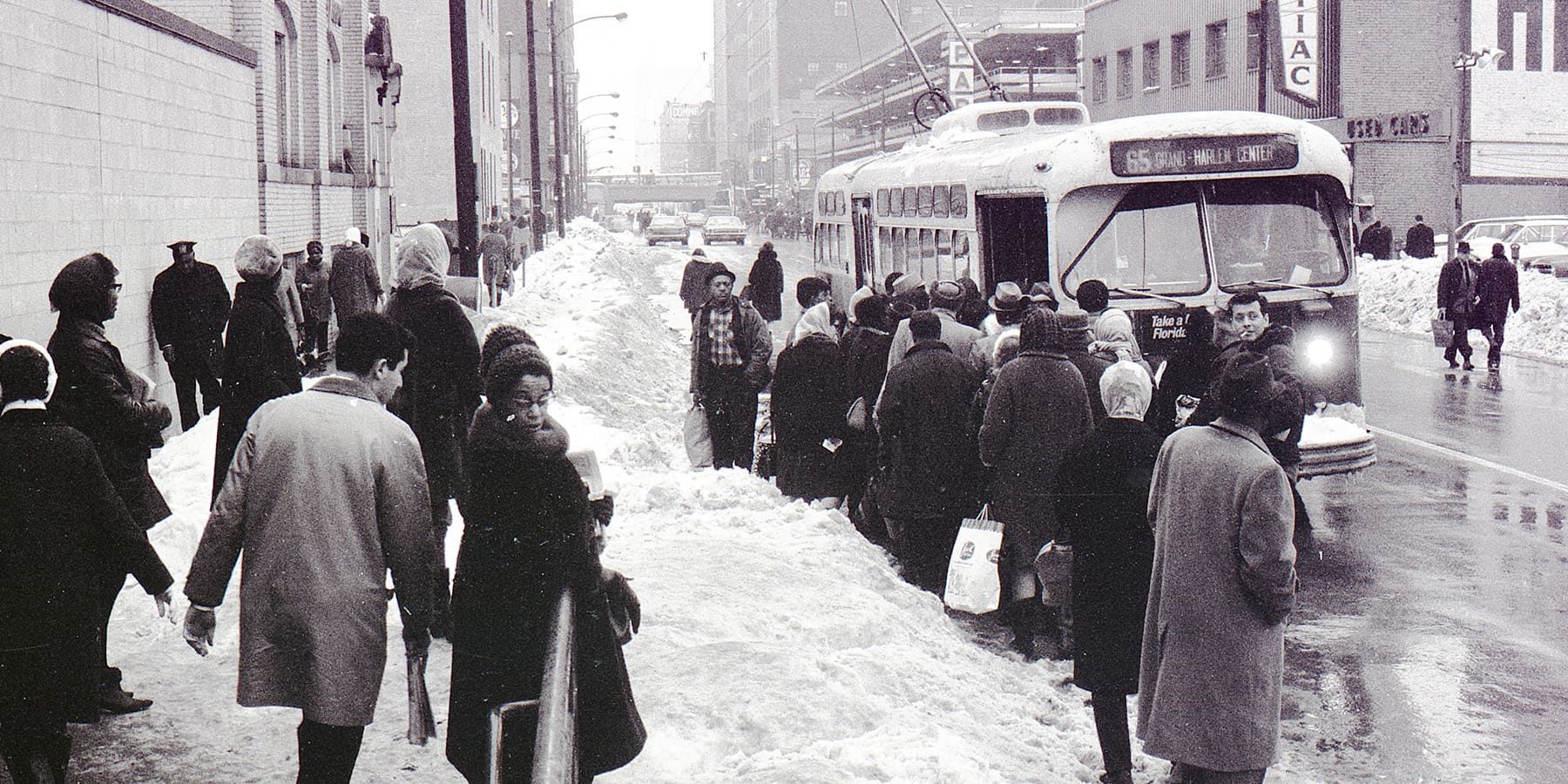
Chicagoans are a tough crowd when it comes to enduring the city’s famously challenging winters. Puffy parkas down past our knees, heavy boots crunching on icy sidewalks, scarves pulled taut around our faces to ward off the blustery wind tunnel created by our magnificent skyscrapers – we can handle the snow. But every now and then, a snowstorm can bring even this hardy town to a standstill. Chicago’s biggest blizzards have tested the limits of the city’s infrastructure and demonstrated the resilience of its people. The legendary snowstorms below, listed by the amount of snowfall, aren’t just weather events, they’re part of Chicago’s collective memory.
January 26-27, 1967
Total Snowfall: 23 inches
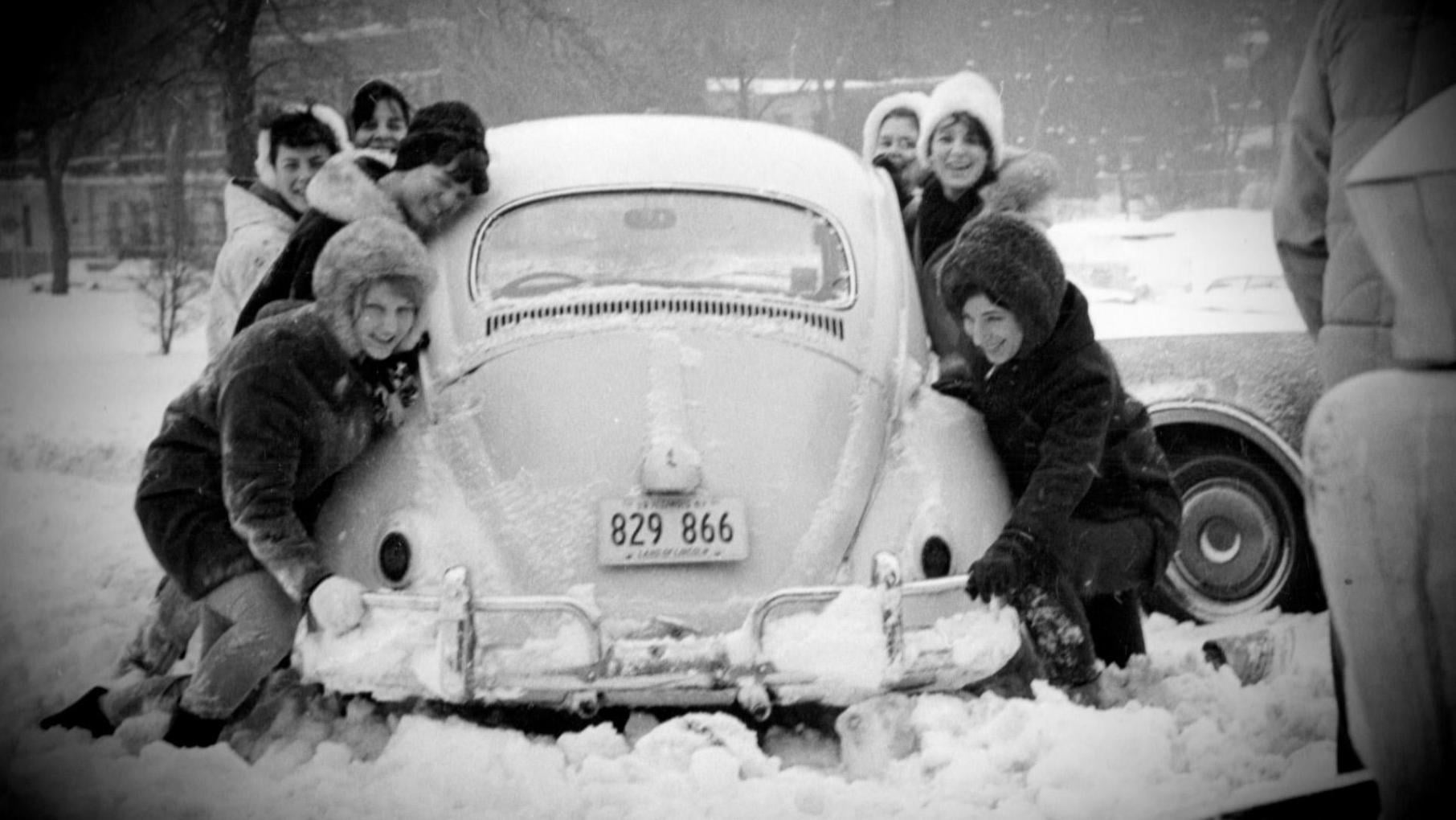
A couple of days before Chicago’s largest recorded snowfall, Chicagoans were enjoying unseasonably warm weather. On January 24, 1967, temperatures reached 65 degrees, according to Jim Allsopp with the National Weather Service (NWS). Snow was in the forecast, but in the absence of computer models and satellite imagery at the time, no one predicted the battering that was to come.
“The blizzard of 1967 is the most important blizzard in Chicago’s history. It is the blizzard to end all blizzards,” journalist Linze Rice told Chicago Stories.
In the early morning of January 26, the snow began to fall. It was business as usual for most of the city as people went to work and school. But the snow fell rapidly at a rate of 2 inches per hour, and by noon, 8 inches had already accumulated. The city experienced whiteout conditions with recorded wind speeds reaching 53 miles per hour at Midway Airport.
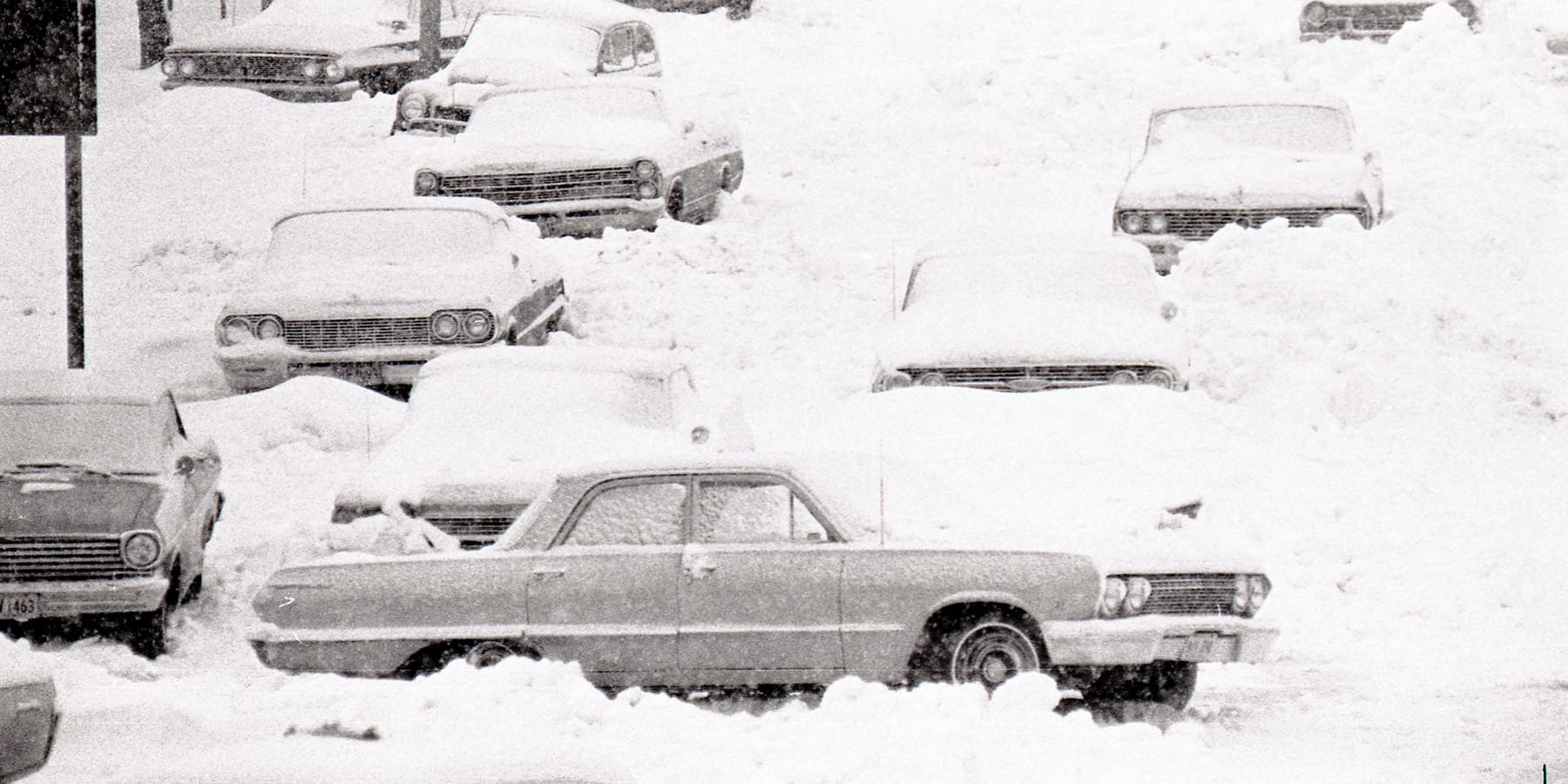
The city was blindsided. O’Hare Airport was closed for the first time in its history. Midway Airport also closed. People who commuted to work that morning found themselves in long lines for trains and buses. Others were stuck at work and opted to sleep in their offices. By the next morning, a staggering 23 inches of snow had fallen on Chicago. Some 20,000 cars and 800 CTA buses were stranded on city roads, though other estimates suggest up to 50,000 cars had been stranded.
“Some of the photos that we have show people walking through the city streets and trying to find their cars,” Chicago Tribune reporter Marianne Mather told Chicago Stories. “People are brushing off the snow and peering in to the car windows if they can find a car.”
According to Allsopp, pregnant women in labor were taken to the hospital by “sled, bulldozer, and snowplow,” and “at least a dozen babies were born at home.” Alec Jeong’s mother, Anna, was pregnant with Alec at the time of the blizzard. Anna was stranded in a car overnight with her husband, sister, and toddler. Their car had run out of gas and walking wasn’t an option, so they took the ‘L’ in an attempt to make it home to Rogers Park. But Alec had different plans.
“I kind of knocked on my mom’s womb and said, ‘I think I’d like to come out now!’” Jeong told Chicago Stories. “My mom’s water breaks…and they start putting newspaper all on the floor.” Alec’s mom, understandably, didn’t particularly want to give birth on the CTA. The train, too, was uncooperative, as it got stuck at Howard Street station for two hours. But Anna made it off the train in time to give birth at an Evanston hospital. “Luckily, I was not born on newspaper.”
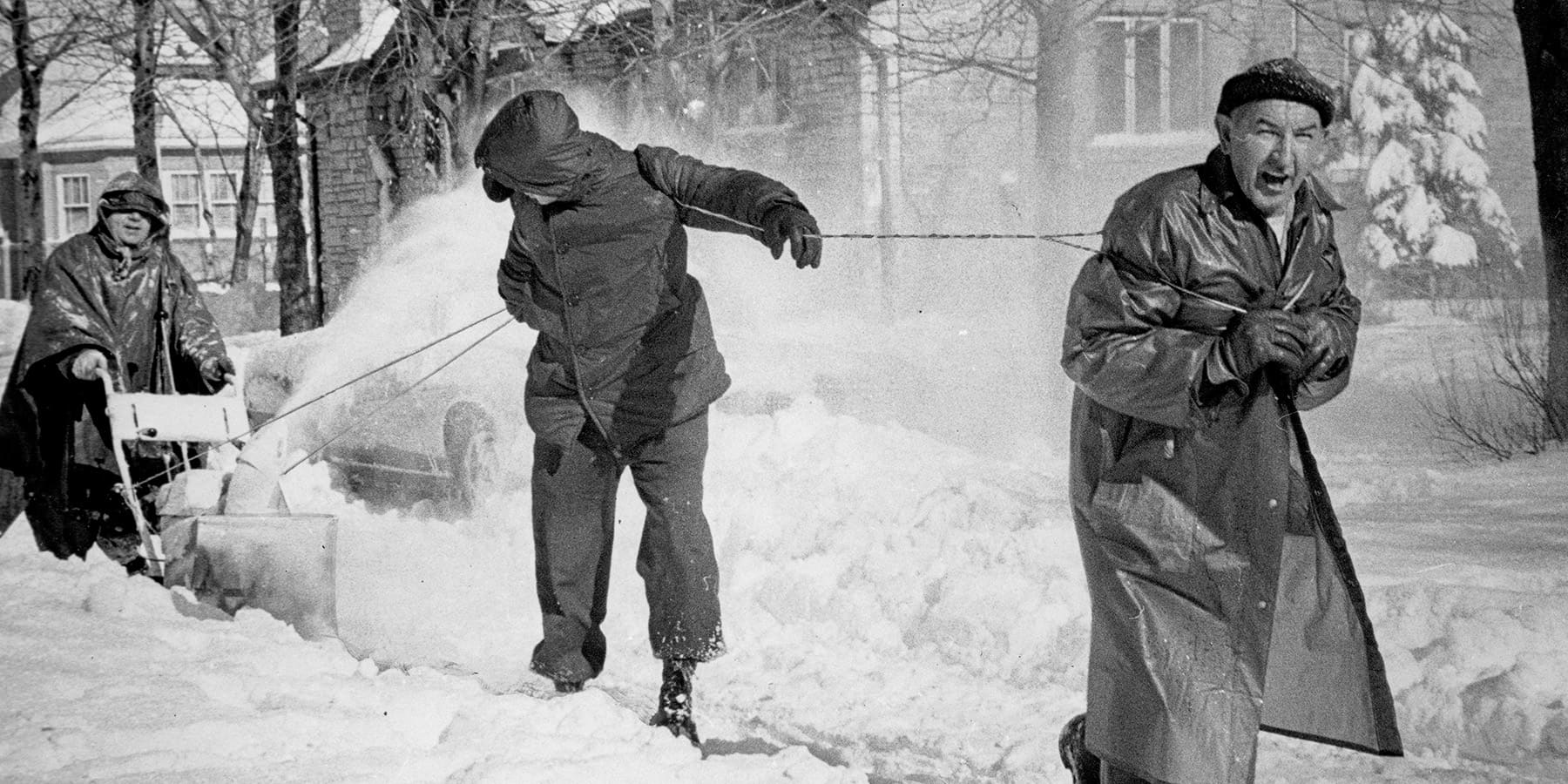
It took quite a bit of machinery and manpower to dig the city out of the snow – some 500 pieces of snow removal equipment and extra help from surrounding states. Some 60 deaths were attributed to the blizzard of 1967. And the city’s economy lost an estimated $150 million.
“They figure in today’s dollars, there was $1.4 billion in losses because of the disruption in transportation and commerce, which was the greatest since the Chicago Fire back in 1871,” meteorologist Tom Skilling told Chicago Stories. “There had been nothing even comparable to it.”
January 1-3, 1999
Total Snowfall: 21.6 inches
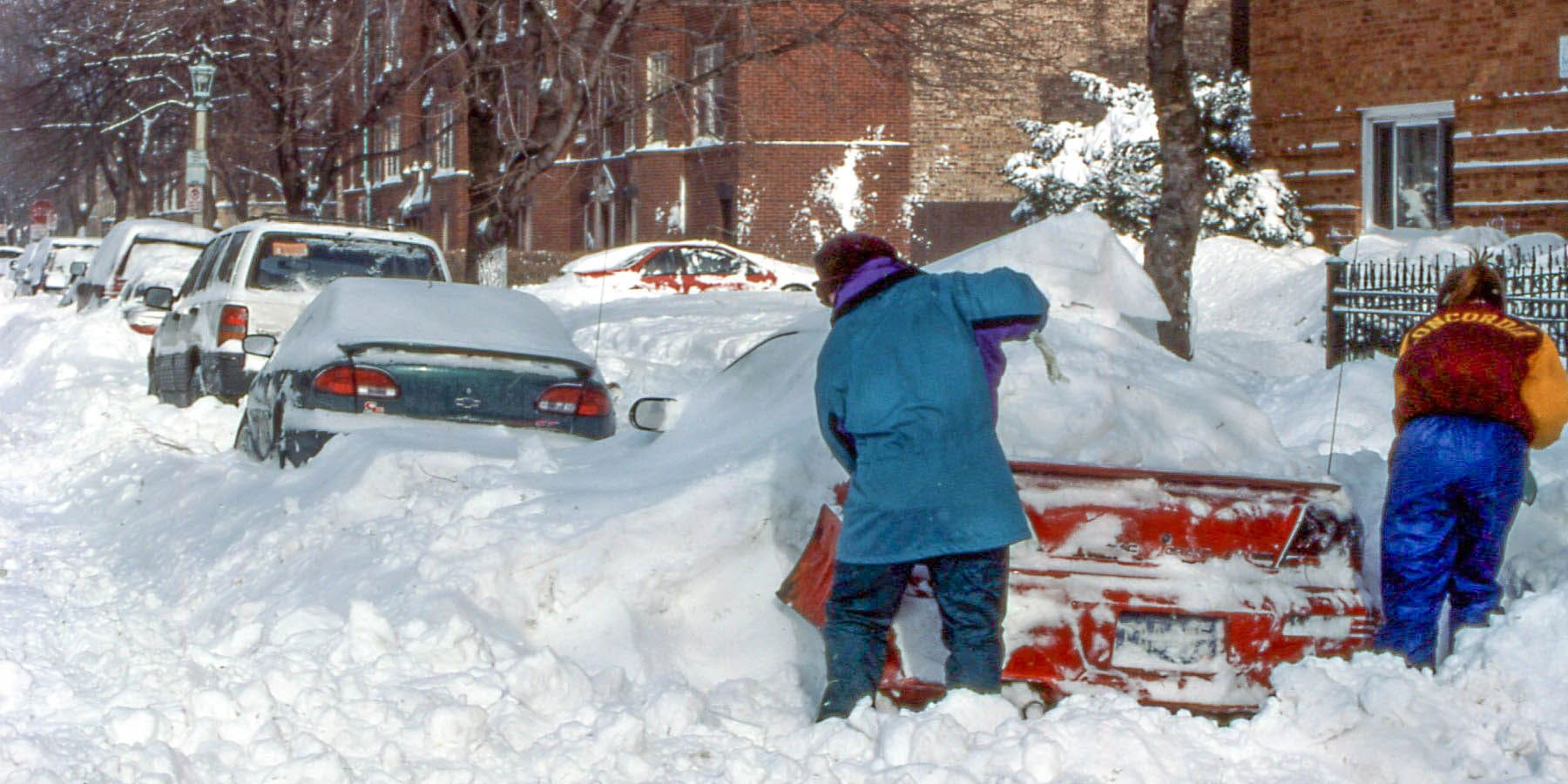
On New Year’s Day in 1999, as Chicagoans were planning their return to work and school, a storm system brought moisture up from Texas and the Gulf of Mexico and began to pummel much of the Midwest. Most of the snow fell on January 2, dropping some 17 inches in a matter of hours, according to the January 3 front page of the Chicago Tribune. Mayor Richard M. Daley deployed the city’s 700 pieces of heavy snow removal equipment and 1,400 workers. Most flights were cancelled out of O’Hare and Midway, and Lake Shore Drive was closed as 60-mile-per-hour winds battered the lakefront.
As with the storm of 1967, unseasonably warm weather prior to the blizzard threw Chicagoans off kilter. “The storm arrived only weeks after unusually warm temperatures, reaching 60 degrees in recent days, had begun to lull folks into a belief that winter might actually be taking the year off,” reported the Tribune. Chicagoans may not have been mentally prepared. But unlike the 1967 blizzard, improved weather modeling helped meteorologists predict the coming onslaught this time.
“I think the fact the community was ready for [the storm], and accurate forecasting was one of the big reasons,” Skilling said. “Secondly, we’ve got a heck of a group of people removing snow and treating our streets in this city. They did a heck of a job.”
January 31-February 2, 2011
Total Snowfall: 21.2 inches
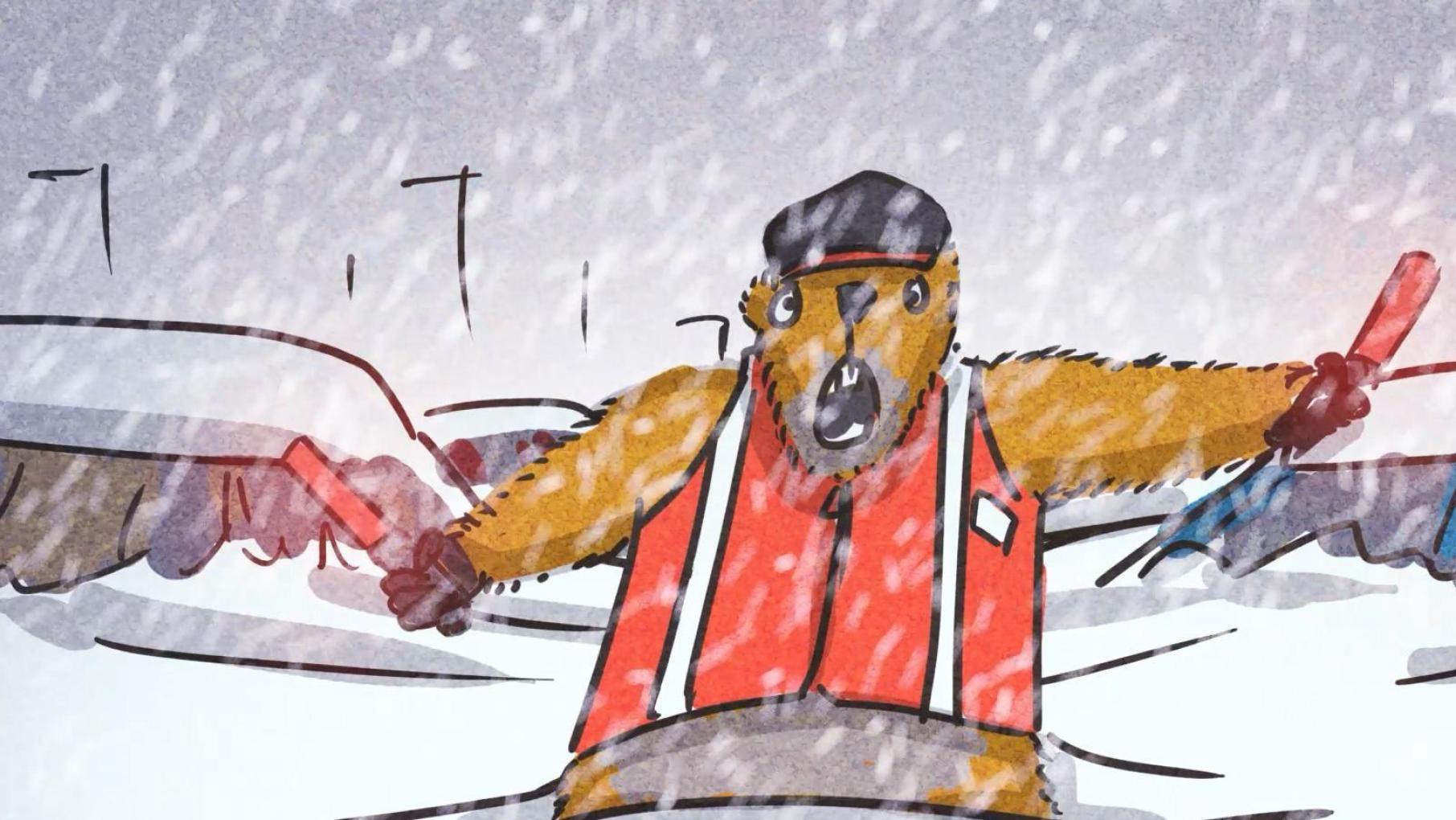
Snowmageddon! Also known as the Groundhog Day blizzard of 2011, this twice-nicknamed snowstorm ranks third (so far) in Chicago’s largest snowstorms. The storm system dropped snow over the course of three days, with winds reaching 70 miles per hour along the lakefront. Flights were canceled at O’Hare and Midway, schools and universities shut down, and tens of thousands of Illinoisans lost power.
“I went out with a camera, I walked around, and it really felt like you were in a snow globe – but when they’re shaking the snow globe,” Rice said. “It was really violent. It was extremely windy.”
The most enduring image of this snowstorm is of hundreds of vehicles stranded on Lake Shore Drive. Whiteout conditions rapidly overwhelmed afternoon commuters on February 1 as people tried to make it home before the worst of the storm hit. But multiple accidents jammed the roads and brought traffic to a standstill. According to one New York Times story, passengers aboard a CTA bus bonded over crossword puzzles and shared snacks. The city moved to close Lake Shore Drive, but it was too late. The snow quickly piled up in drifts against vehicles, leaving people stranded. After several hours, some people attempted to leave their cars on foot, but not everyone was successful, as emergency responders told people to turn back and wait in their vehicles for shelter. Some Chicagoans were stuck for 12 hours before being rescued the next morning, and it took the city all day to clear the abandoned vehicles on Lake Shore Drive and elsewhere in the city.
January 12-14, 1979
Total Snowfall: 20.3 inches
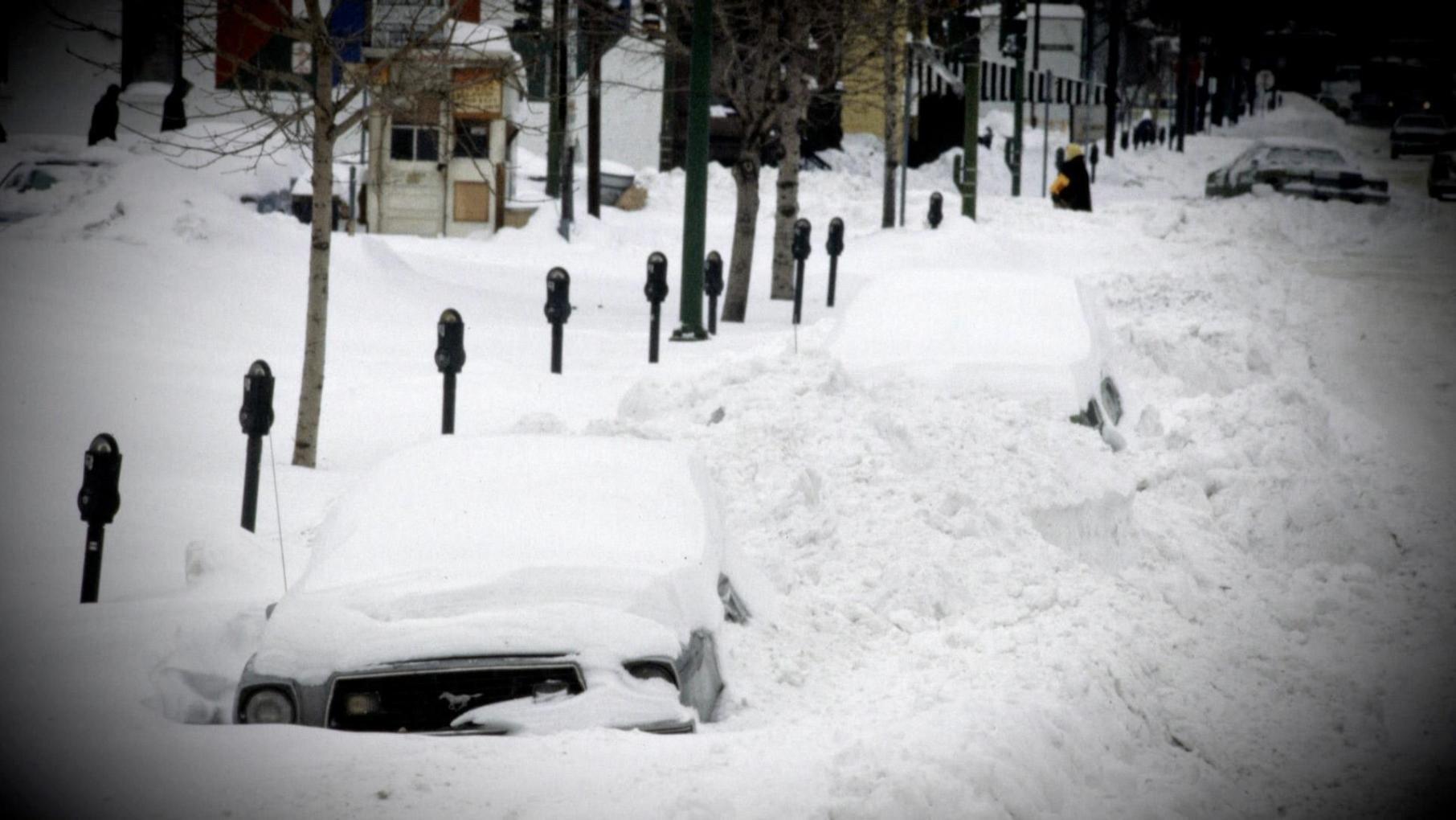
Perhaps no weather event had bigger political consequences in Chicago than the blizzard of 1979. By mid-January, the city had already endured a tough winter with lots of snow and frigid temperatures that prevented the snow from melting.
“We, by that time, had 39 inches of snow for the season. That’s more snow than we typically get in a whole winter,” Skilling said. “It’s only January, and here comes this next storm.”
Forecasters initially predicted just a few inches, but when the snow began falling on the evening of Friday, January 12, it did not stop for 38 hours, piling 20.3 inches upon Chicago. Below-zero temperatures paired with 40-mile-per-hour winds created a bone-rattling windchill. Flights in and out of Chicago were cancelled, and public transportation struggled to overcome the sheer volume of snow. The Department of Streets and Sanitation deployed its snowplows around the clock, even adding plows to garbage trucks to expand its fleet. But the streets were difficult to navigate, and the situation was not helped by the vehicles people were forced to abandon on the roads.
“Particularly the side streets were not being plowed. This is the city of Chicago, and it takes a lot to stop this city. But that blizzard stopped it,” journalist Steve Garnett told Chicago Stories.
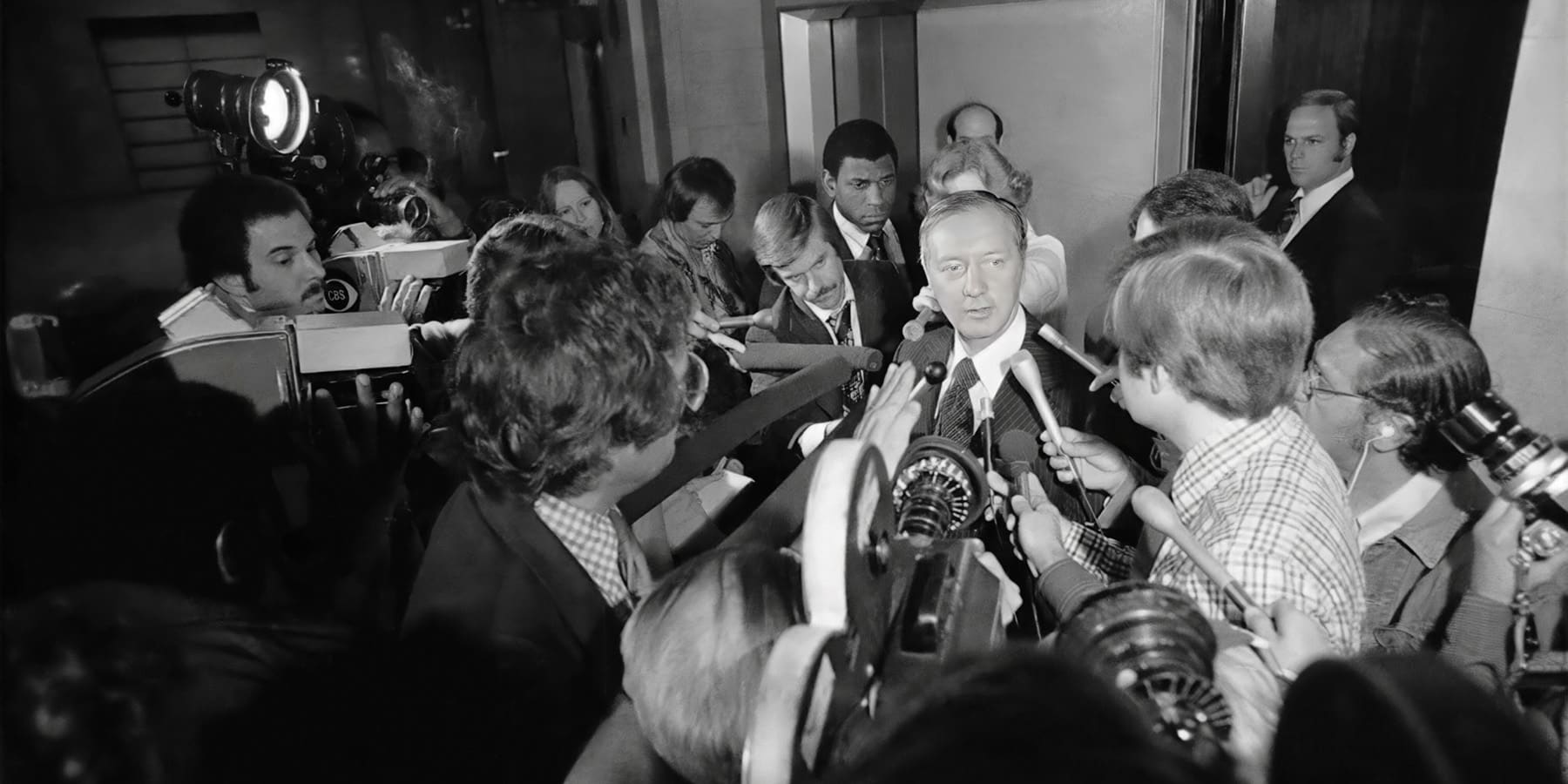
That became a big problem for Mayor Michael Bilandic, who was approaching the Democratic primary for his re-election. Bilandic’s administration (which followed that of the powerful Richard J. Daley) struggled to wade through the cascading issues the snowstorm created. Schools remained closed for a week, and trash wasn’t collected for 10 days. Bilandic asked people to remove their cars from side streets so plows could tend to them, telling people to park in plowed school parking lots – or face a ticket. But many of those parking lots were still buried in snow, too, and a lot of Chicagoans got ticketed anyway. To make transportation matters worse, in order to speed up some of the delays, CTA trains began to skip the least populated stops along the ‘L’, most of which were in Black neighborhoods.
“I do remember being bypassed,” Garnett said. “The excuse was we’re trying to make the trains [run] a little bit more express to get people to their destinations faster. The attitude in the African-American communities was, ‘Yeah. Faster without us.’”
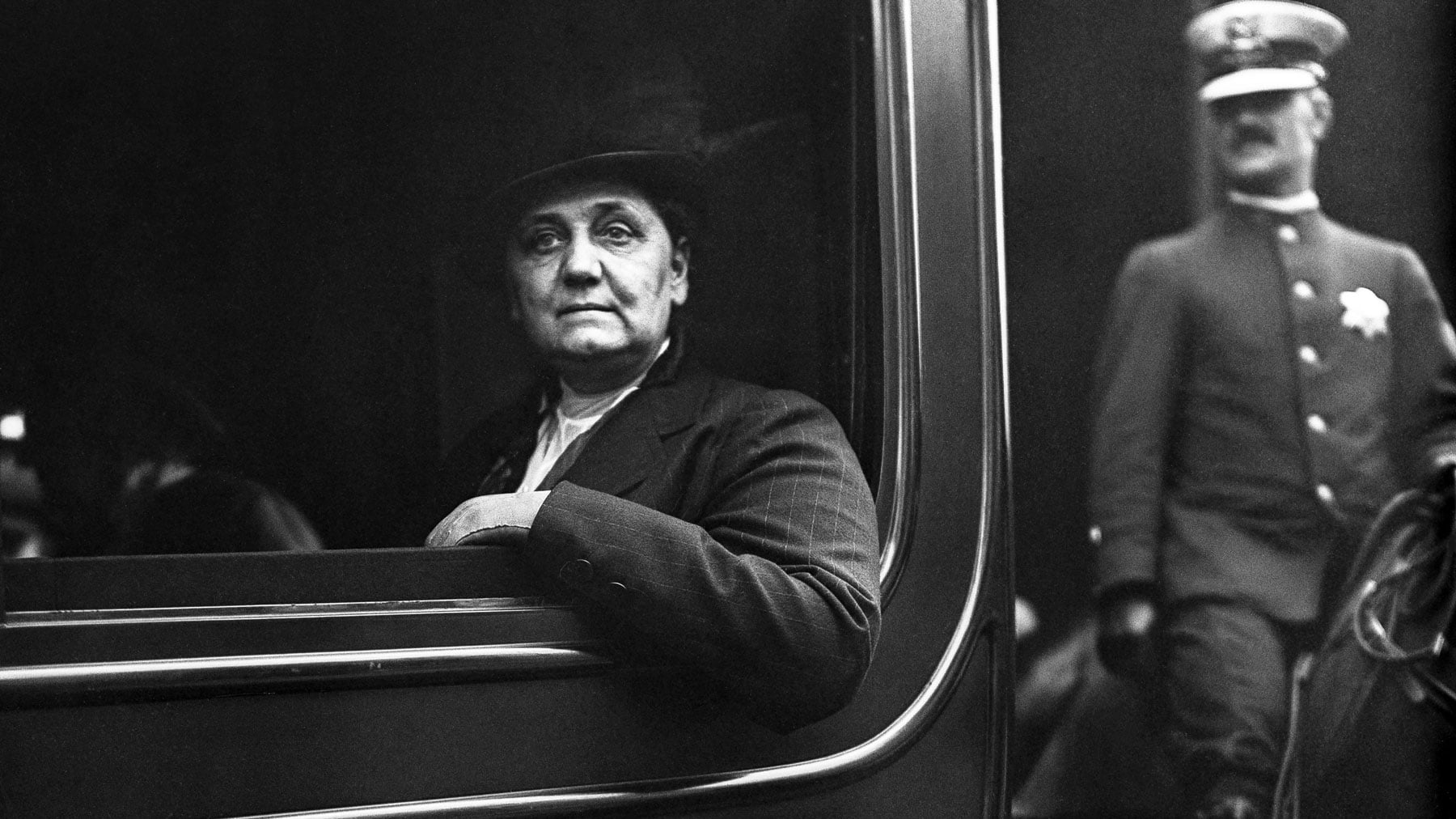
Jane Byrne seized the opportunity to capitalize on Bilandic’s growing political fiasco. Byrne was challenging Bilandic in the Democratic primary (back when Chicago had partisan mayoral elections), a couple years after he had fired her as the city’s Commissioner of Consumer Sales. Byrne’s campaign portrayed Bilandic’s administration as incompetent and disorganized, and on February 27, voters chose Byrne as the Democratic candidate for mayor. She went on to become the next mayor of Chicago and the first female mayor of a major American city.
January 31-February 2, 2015
Total Snowfall: 19.3 inches
Exactly four years to the day after the memorable 2011 blizzard came Chicago’s fifth-largest snowstorm. It was the weekend of Super Bowl XLIX, and while Tom Brady was securing yet another championship for the Patriots (likely to the dismay of jealous Bears fans everywhere), some 19.3 inches of snow were falling on Chicagoland.
Most of the snow fell on Sunday, with wind speeds reaching nearly 40 miles per hour. The city dealt with the almost-routine disruptions brought on by snowstorms: school was called off for hundreds of thousands of students in the Chicago area, and flights were cancelled out of O’Hare and Midway airports. But because the snow fell on a weekend, it wasn’t as hard on the city.
“Not many people are driving to work because it’s a Saturday and Sunday, in that case,” meteorologist Alicia Roman told Chicago Stories. “I’m sure Monday morning was going to be affected, but by that time, they had their plan in place to get people through the morning commute. The timing is everything.”
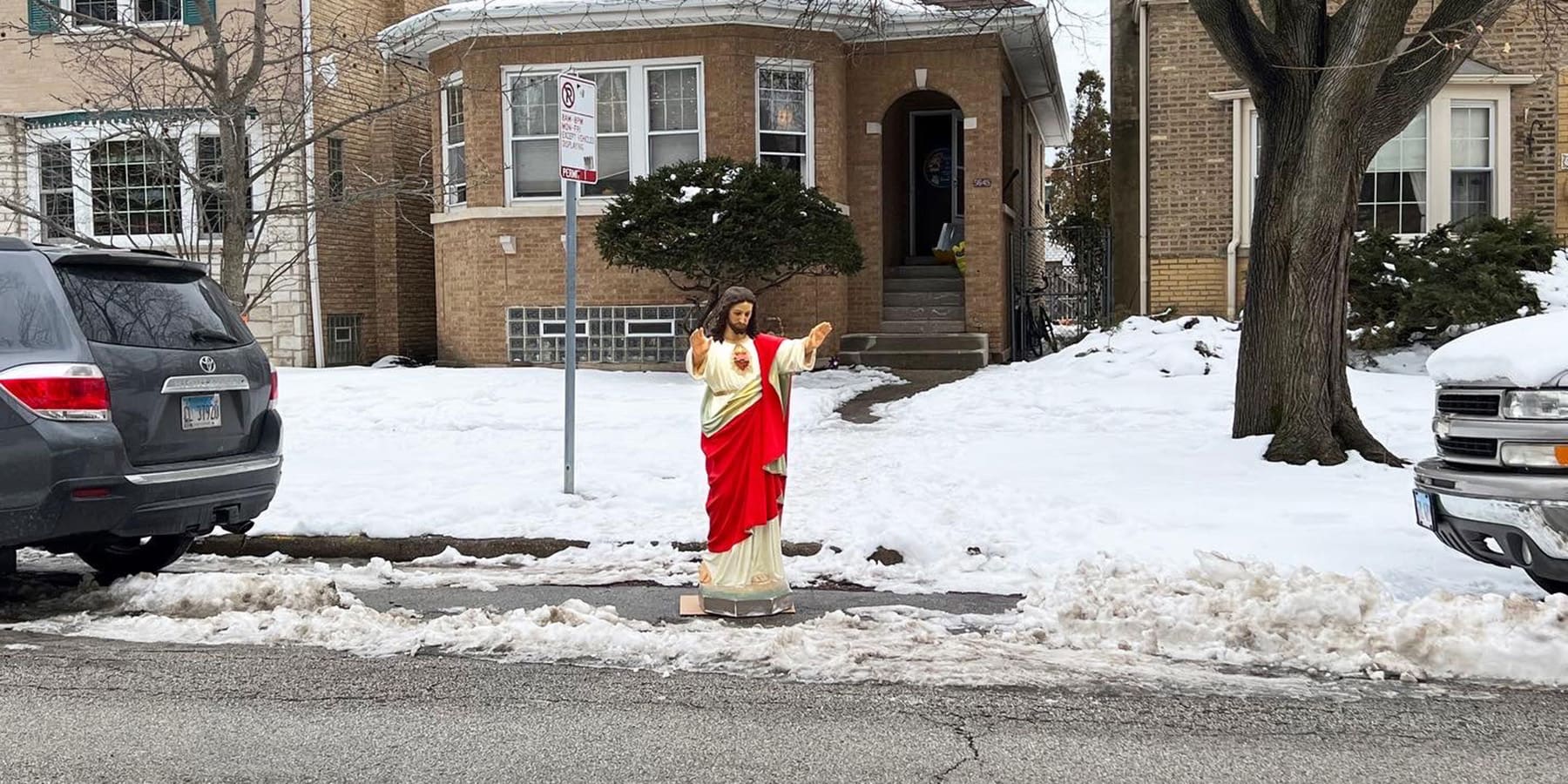
Still, digging out of a snowstorm can cause headaches, especially for Chicagoans with cars.
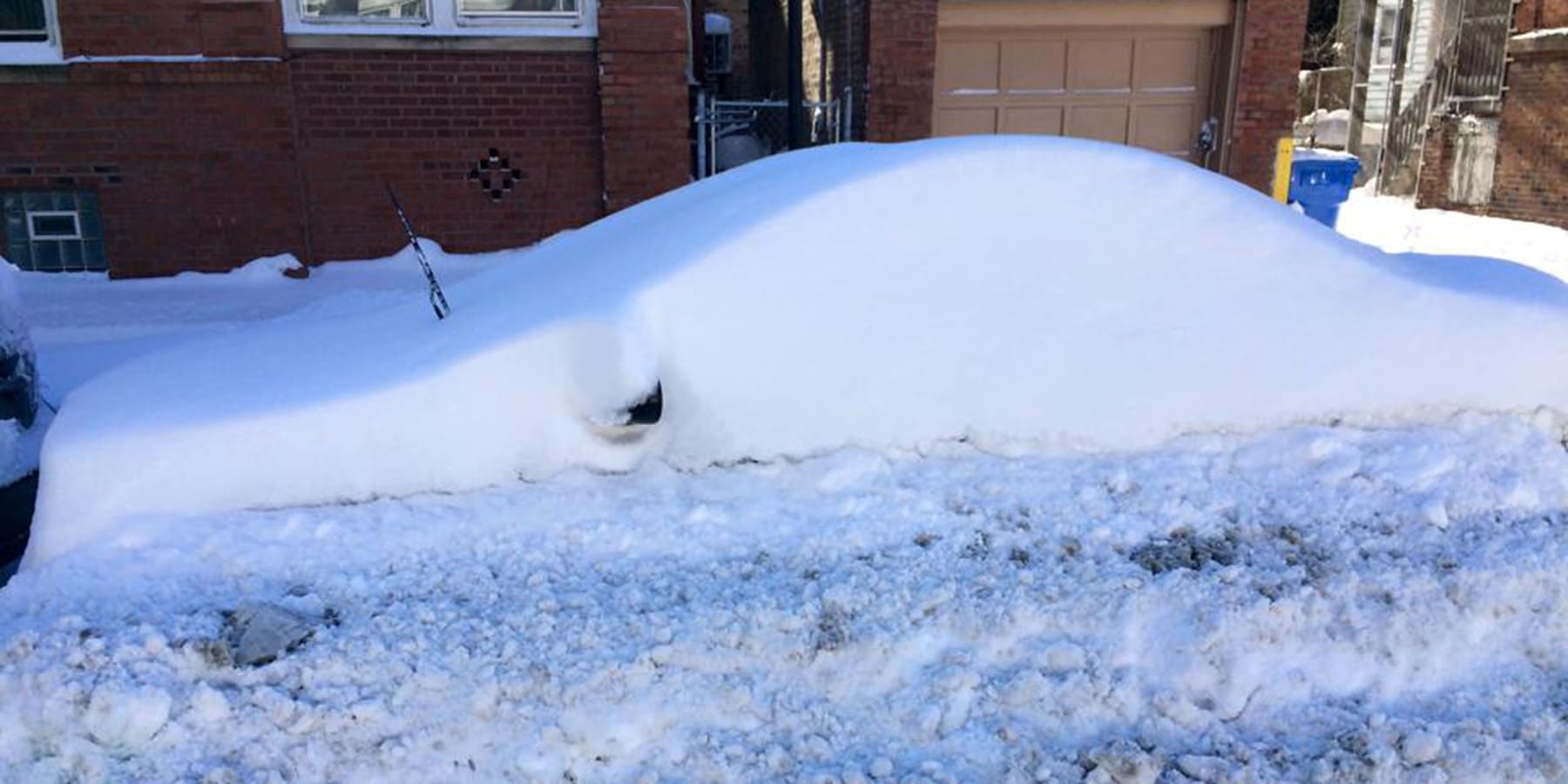
“I’ll never forget going out after the snow had stopped. A couple of plows had pushed all the snow onto the cars that were on the street, and my husband and I were looking for our car, not being able to find it, thinking, did it get towed?” Rice said. “Lo and behold, no – it was completely buried under snow. It was probably under about 10 feet of snow.”
Other Honorable Mentions
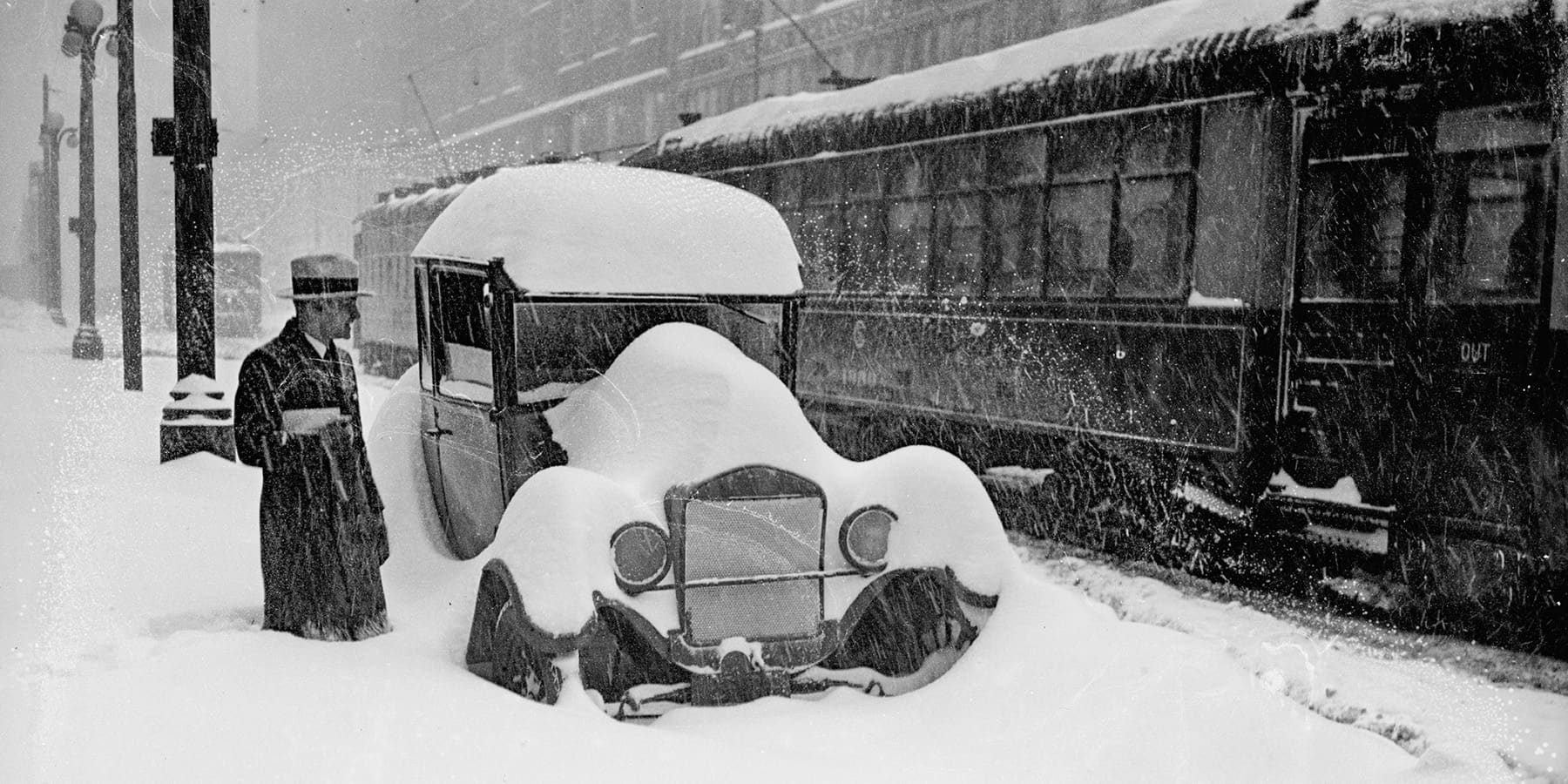
The U.S. Weather Bureau (now the National Weather Service) began keeping consistent records of snowfall starting in 1884. So we don’t know, for example, what kind of snow early settlers such as Jean Baptiste Pointe DuSable encountered. The remaining snowstorms that round out the top ten biggest snowstorms in Chicago all occurred prior to 1940. In 1930, 1931, 1939, 1918, and 1929, Chicago saw record snowfalls ranging from 14.8 to 19.2 inches.
Related