















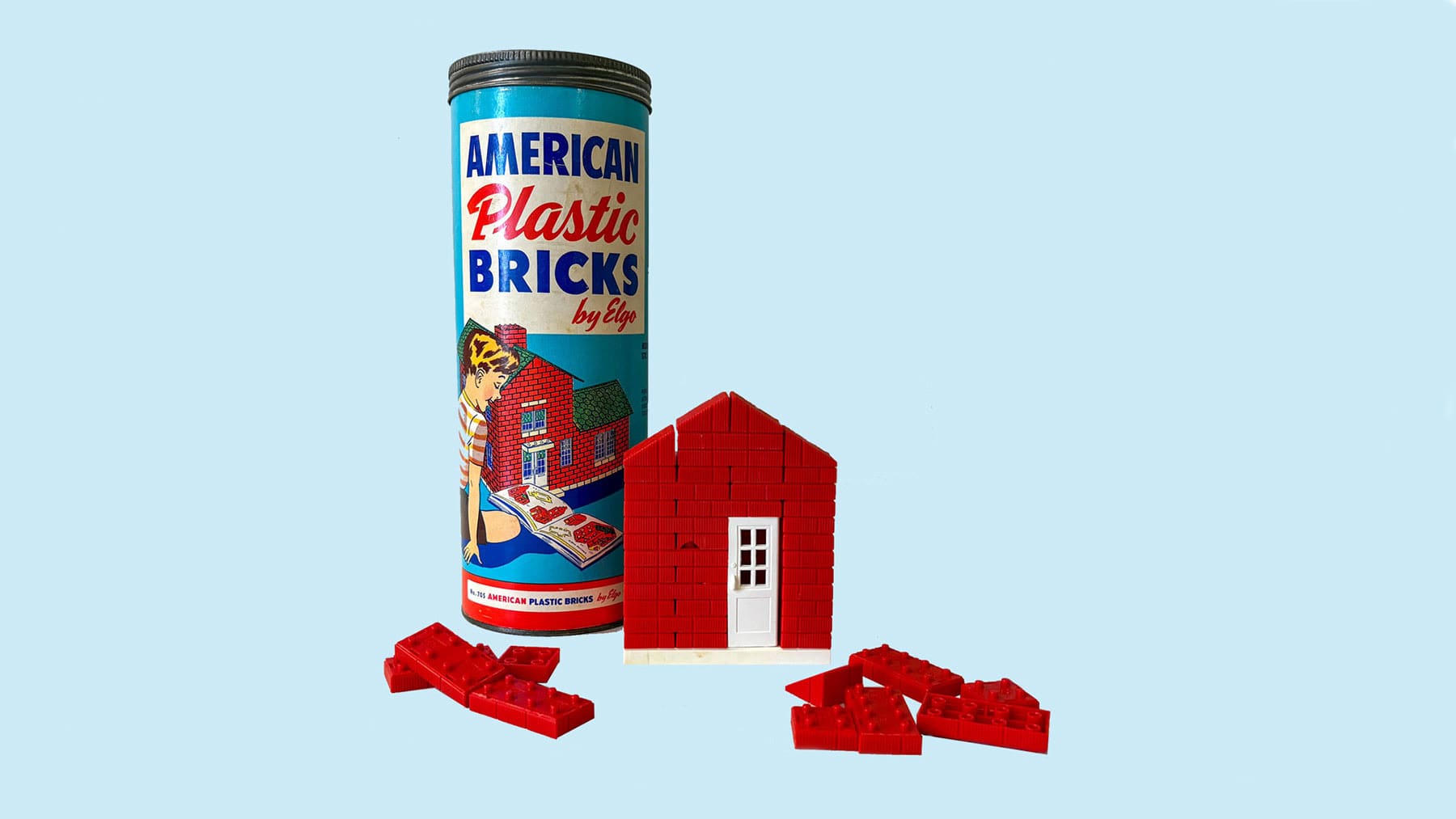
You know them, you love them, and you hate to step on them. Introduced by a Danish company in 1949, LEGO bricks have become one of the world’s most recognizable toys. But before LEGOs, a company called Elgo created a simple set of red and white plastic bricks in Chicago.
Most people would understandably assume that Elgo was some kind of unimaginative rip-off of the LEGO brand. In reality, Elgo’s origins are decades earlier. Back in Michigan in 1917, two brothers-in-law, Harold Elliott and Samuel Goss, Jr., combined parts of their first names and created a toy company, Halsam Products Company. They later moved their factory to 4114 North Ravenswood Avenue, near Dovetail Brewing today. They produced mostly wooden toys, such as letter blocks, checkers, and domino sets. They later created a plastics division called Elgo – this time combining the letters of their last names.
According to the Made in Chicago Museum, “in what has to rank as one of the more bizarre semi-coincidences in the history of registered trademarks, Elgo Plastics, Inc. was actually established as a division of Chicago’s Halsam Products Company in 1941.” Two years prior, Halsam applied for a patent for its "toy building bricks," which was granted in 1941. That’s eight years before LEGO began producing its bricks.
American Plastic Bricks by Elgo, as they were officially known, were similar to LEGOs in that they were a set of plastic bricks with which kids could build houses, buildings, and other structures. But they varied in the details. While LEGOs came in multiple colors, American Plastic Bricks were mostly red with some white pieces. The Elgo sets also came with a cardboard roof and plastic pieces for doors and windows. Their bricks, while stackable, were thinner and did not lock into place like LEGOs. One 1961 ad in the Chicago Tribune offered a 290-piece set of American Plastic Bricks that featured a garage door and “doors and windows that open” for $4.98.
So, were LEGO bricks inspired by Elgo? Nope! LEGO, like Elgo, is a combination of words – “leg godt,” which is Danish for “play well.” Per LEGO's own history, its bricks were inspired by a company named Kiddicraft’s “Self-Locking Building Bricks,” invented by an English toymaker named Hilary Fisher Page, who filed his patent in 1939.
In 1962, Halsam was acquired by Playskool, which was later acquired by Milton Bradley and then Hasbro. In the end, there is no connection between Elgo and LEGO, just one of the more peculiar coincidences in toy history unfolding an ocean apart.
Related